Community Corner
Financial Planning Strategies for Year-End
As the holiday season approaches, we discuss important retirement planning and charitable gifting items to consider before December 31st.

This is a paid post contributed by a Patch Community Partner. The views expressed in this post are the author's own, and the information presented has not been verified by Patch.
Accretive On: Year-End Planning
2020 has certainly been a year that most of us will never forget. Most importantly, we hope that you and your loved ones have stayed healthy. As the countdown to 2021 begins, we are faced with at least one more newsworthy event next month, a presidential election. While it’s our job as advisors to be agnostic about the outcome, we need to be pragmatic about how either outcome could impact our financial planning recommendations. With that, our year-end checklist is a bit different this year, as the various election results could bring yet another round of changes to tax law.
Find out what's happening in Long Valleyfor free with the latest updates from Patch.
As we write this, there is no formal tax plan from the Biden campaign, although there have been some proposed changes introduced. Before jumping into what those are, and the year-end planning strategies to consider, it is important to note that not only is the outcome of the election an unknown, but so is the actual policy to be enacted for 2021.
Retirement Plan and IRA Contributions
Find out what's happening in Long Valleyfor free with the latest updates from Patch.
If you are enrolled in your employer’s retirement plan, such as a 401(k) or 403(b), then you have most likely been contributing via payroll deduction throughout the year. The maximum deferral amount is $19,500 for 2020 (and $25,000 for those over 50), so now is a good time to revisit what you have contributed year-to-date and make sure you are on track for your yearly savings target.
Biden Tax Proposal
One of the more notable differences in tax policy from the Biden campaign would be the elimination of the tax deduction for retirement plan contributions. The proposal states that instead of a deduction, retirement savers would receive a credit equal to a specified percentage of the amount contributed to the pre-tax plan. (Estimated to be a 26% credit)
Portfolio Rebalancing
While it is never an easy time to invest, 2020 has been especially difficult. In March, equity markets in the US experienced their first bear market since 2011 (defined by a 20% decline from recent market highs), followed by a fast recovery that began on March 23rd. Beyond the overall market volatility, we have seen a large deviation between various asset class returns. You can see by the graphic below, that US technology stocks (Nasdaq) have outperformed US Small Cap stocks (Russell 2000) by more than 37% and Non-US stocks(MSCI ACWI ex-USA) by nearly 38% year-to-date.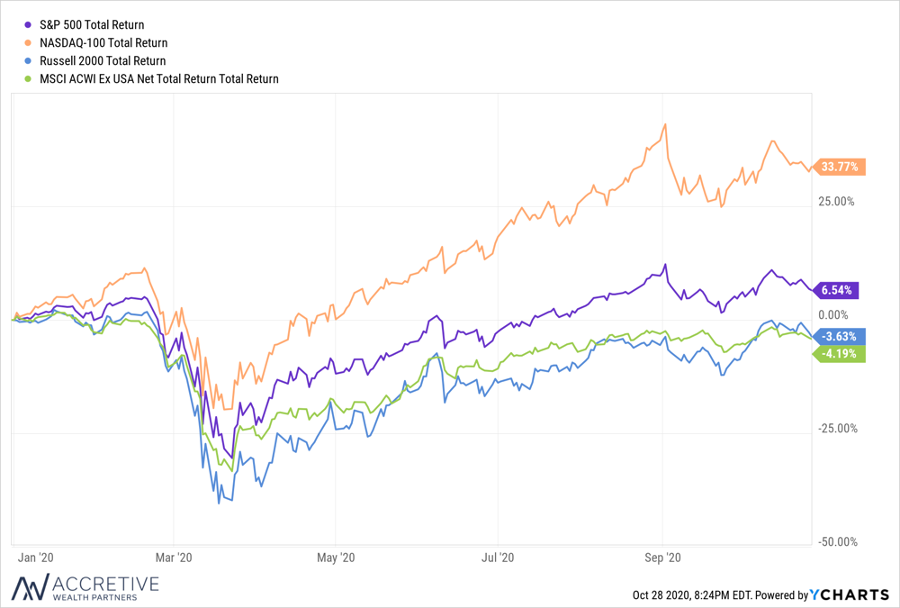
Given the substantial difference in outcomes, now might be a good time to revisit your overall allocation to ensure that it properly reflects your risk tolerance and investment objectives.
Biden Tax Proposal
If you are a high-income earner, then rebalancing in 2020 rather than 2021 may save you tax dollars if Biden is elected. $400,000 of Adjusted Gross Income (AGI) is reportedly the proposed threshold for earners that may see higher taxes under the new administration.
Gifting
Year-end tends to be the most active time of the year for giving, and we expect this year to be no different. The CARES Act had two notable inclusions around charitable giving for 2020. The first, is a new $300 deduction for taxpayers who do not itemize their deductions. (Previously, only those who itemize their deductions could deduct charitable contributions) The second, is an increase in charitable contributions, up to 100% of AGI, previously capped at 60%.
Biden Tax Proposal
High-income earners who itemize their deductions may see a new cap, which is currently proposed to be at 28%. Therefore, any taxpayers that are in the 32%, 35%, 37%, or the newly proposed 39.6% bracket, could see a substantial increase in their effective tax rate. As a result, you may want to consider lumping multiple years’ worth of charitable contributions into 2020.
Time to Plan
In conclusion, it is important to start planning what actions will be most appropriate for your individual situation, even with the outcome of November 3rd still being uncertain. Be ready to implement your year-end strategy as things unfold once the holiday season begins, and don’t be afraid to contact your trusted financial, tax, and legal advisors if necessary.
Stephen Esposito, CFP® is a Managing Partner at Accretive Wealth Partners, LLC
Email the author: steve@accretivewealthpartners.com
Disclosures: The information contained above is for illustrative purposes only.
The views expressed in this commentary are subject to change based on market and other conditions. These documents may contain certain statements that may be deemed forward‐looking statements. Please note that any such statements are not guarantees of any future performance and actual results or developments may differ materially from those projected. Any projections, market outlooks, or estimates are based upon certain assumptions and should not be construed as indicative of actual events that will occur.
Accretive Wealth Partners, LLC (“Accretive Wealth”) is a registered investment advisor. Advisory services are only offered to clients or prospective clients where Accretive Wealth and its representatives are properly licensed or exempt from licensure.
Visit www.accretivewealthpartners.com for important disclosures.
This is a paid post contributed by a Patch Community Partner, a local sponsor. To learn more, click here.