Community Corner
Russ's Ravings: All I Want For Christmas Is Brain Surgery
After months of testing the decision has been made to remove the tumor from my head. And it can't happen fast enough.


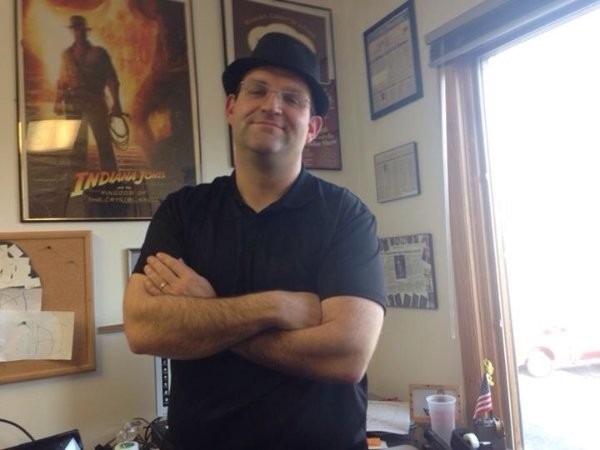
Editor's note: The following is Patch Field Editor Russ Crespolini's, hopefully, weekly column. It is reflective of his opinion alone.
You ever walk through the city with a container of your own chilled urine? If you haven't, you haven't lived. But come to think of it, the punchline might be that more people are carting around containers of urine in the city than one might suspect.
But I am already digressing.
Find out what's happening in Long Valleyfor free with the latest updates from Patch.
The truth of the matter is this is one of the many indignities one suffers when they have certain medical diagnoses. As some of you know who read this column I have been dealing with a brain tumor diagnosis for a few months. Here below is a nifty list of other stories in the "Tumor Tales" series that deal with my attempt to process what I am experiencing. I discuss my diagnosis, my fears of telling my daughter, the testing process, the isolations and depression associated with it and more. Check it out for yourself:
- Russ's Ravings: The Doctor Called To Tell Me I Have A Tumor
- Russ's Ravings: Your Life Flashes Before Your Eyes
- Russ's Ravings: A Tale Of (At Least) Two Tumors
- Russ's Ravings: The Horrors Of Waiting Mitigated By Laughter
- Russ's Ravings: 'One Slip, And You're Toast'
- Russ's Ravings: I'm not Okay. And That's Okay
All caught up? Good. Let us proceed.
Find out what's happening in Long Valleyfor free with the latest updates from Patch.
So as you may remember, in the 'One Slip, And You're Toast' column I talked about a disastrous experience I had with a doctor for a second opinion. I was told the next step for me was an inferior petrosal sinus sampling (IPSS). The IPSS is an invasive procedure in which adrenocorticotropic hormone (ACTH) levels are sampled from the veins that drain from the pituitary gland. This is done through what is apparently a really painful catheterization process. So, good times. They send the probes up into the brain through the groin to grab the samples.
This second endocrinologist who reviewed my results described the IPSS test to me and followed it up by telling me that the test is dangerous because one slip and I am toast.
As in dead.
He said it with no malice, he was just trying to make a point of the seriousness of what I was facing.
A True Network That Helped
One of my earlier columns, a couple in fact, had been picked up by the an organization called the Pituitary Network Association. The PNA is an international non-profit organization for patients with pituitary tumors and disorders, their families, loved ones, and the physicians and health care providers who treat them.
PNA was founded in 1992 by a group of acromegalic patients in order to communicate and share their experiences and concerns. PNA has rapidly grown to become the world's largest and fastest growing patient advocacy organization devoted to the treatment and cure of pituitary disorders. This was a nice discovery because my thoughts were being shared with other people who were going through something similar. It also showed me the power of this Patch network. But I also discovered that their network included experts.
I reached out to them and immediately got a response back that walked me through why I needed to find a specialist in this area and then gave me the name of one at Sloan Kettering in New York. The next morning, my doctor messaged me to tell me she found a specialist that can help me with this test and what comes after.
It was the same name.
So now I knew where I was headed next. Sure, one slip and I might be toast. But I needed to trust that these specialists won't slip.
Enter Sloan Kettering
So now we are back to me in New York City carting around a container of my own urine, collected over the past 24 hours, and kept in my refrigerator. It is as revolting and challenging as it sounds.
I was instructed to bring this sample (so they can check out my cortisol levels to see if I was "secreting" that day) to the second floor of "main" in Sloan Kettering where I would be meeting an interventional radiologist. Specifically:
Amy Robin Deipolyi, MD, PhD
Interventional Radiologist
She is as impressive as she sounds. If not more so.
I want to be clear that I was not going to a Sloan Kettering center here in New Jersey or one of the many different locations they have scattered around the area. I was going to the numero uno, big shot main facility.
I also want to point out, I was absolutely terrified.
A colleague of mine here at Patch reached out to me before I went in, when I first started writing about this journey and he was kind and generous enough to share his experience with me about his time at Sloan or MSK as the cool kids say.
Some of what he focused on was to not get overwhelmed by the place when I arrived. And boy was he right. This place was absolutely massive in every way. Level after level greeted me when I arrived at the fully-staffed valet parking lot at 6 a.m. The place could have been cold and impersonal just due to the volume of people they deal with on a regular basis.
But it wasn't.
Each and every person I came in contact with was kind, compassionate and supportive. From the security guards in the hallways to the staff checking you in to the doctors and nurses. As someone who has had surgeries and been to other facilities throughout my life, this has not been the norm.
I can't tell you how many disinterested people spoke to me over the years when I was at my most vulnerable physically. I was another task to get off their desk for their shift and nothing more. I was sure that would be the case for a facility this size. I could not have been more wrong.
Even as I was being wheeled into the procedure room every person we crossed paths with in the hallway offered me words of encouragement and kindness. Everyone in the procedure room took the time to speak to me and introduce themselves.
Which is nice being on a first name basis with people about to send probes into your groin.
And it struck me, the enormity of this place isn't about the physical size of it at all. It is about the people who come there, much more ill than myself, who are greeted with something that is hard to come by in situations like these: hope. The enormity of this place is about that hope that it generates.
Sure, there are anecdotes about how in 2019 we really should be past those open-backed gowns that have you mooning everyone you come in contact with (fun fact, the pocket in front will not hold your cell phone. Your phone will actually just fall through the hole, bounce off your knee and skitter across the room into the hall).
But those silly little observations easily move to the background when you consider the amount of good being done in that building every single day.
My procedure, since I am writing this two days later, was a success. I was released Friday and spent most of Saturday resting and I am feeling pretty normal. Dr. Deipolyi called me with the results (I sort of want to friend her on Facebook but like, I also think that might be weird) and the results do show that the little hitchhiker in my brain is what is causing my problems.
And that means it needs to come out.
So that means brain surgery.
And I have to say, I am oddly at peace with that. Because then we will know for sure whether or not this is cancer (you can't biopsy a tumor like this because of its location). And we will be able to remove the cause of my symptoms.
And the reason I am at peace with it is because I now know where I am going to get this done. And I know the people inside that building are going to use their incredible set of skills to make sure I get better. Just like they do every single day for so many others.
Am I still afraid? Of course I am. I am not an idiot. I have to have freaking brain surgery. But I am also filled with hope because people like Dr. Deipolyi are going to be there waiting for me.
And you can't ask for more than that.
Russ Crespolini is a Field Editor for Patch Media, adjunct professor and college newspaper advisor. His columns have won awards from the National Newspaper Association and the New Jersey Press Association.
He writes them in hopes of connecting with readers and engaging with them. And because it is cheaper than therapy. He can be reached at russ.crespolini@patch.com
Get more local news delivered straight to your inbox. Sign up for free Patch newsletters and alerts.