

Doris (Van Duyne) Heddy makes apple cider the way the Van Duynes of Montville have been making apple cider for generations. Located on Pine Brook Road, the Van Duyne Cider Mill recently opened for its 114th season of providing fresh pressed cider to its customers.
"I love it. I really do," said Heddy,75. "It's been my life."
"She's got deep roots here," said Heddy's husband, Brian Cooke, who has been with her for 20 years helping to make cider. "When the Van Duyne's came here, there were only 15 states."
Find out what's happening in Montvillefor free with the latest updates from Patch.
Doris Heddy and her first husband took over the cider mill from her father, Harvey Van Duyne, in 1975. The Van Duyne Cider Mill is believed to be the oldest continuously operating cider mill in the United States that is still owned by the original family that established it.
"There's probably not one older," said Harold Rapp, president of the Society for the Preservation of Old Mills (SPOOM). According to the group's website, SPOOM is an international, non-profit, organization that studies, catalogues and documents old mills throughout the USA, Canada, Europe and Australia.
Find out what's happening in Montvillefor free with the latest updates from Patch.
Rapp cites the seasonal nature of a cider mill as one reason that the mills have faded away over time.
"Unlike a grist mill, where they grind all year long, a cider mill is not a year-round activity," he said.
Despite Montville's gradual, but steady shift from agrarian community to modern New Jersey town, the Van Duyne Cider Mill continues to press cider the way it did in the 1890s. However, the apples are no longer grown in the area.
"Years ago people brought apples from their orchards here for us to press," Heddy said. "There was a processing fee of 15 or 20 cents for three gallons of cider. But, of course, that's all changed now. There's no orchard here, and now we buy apples in Warwick, N.Y."
According to Kathy Fisher, president of the Montville Historic Society, Abraham Van Duyne purchased 160 acres of land in 1795 on what is now Pine Brook Road. By 1810 the family's orchard was producing fruit and a mill was built to process the family's annual crop of apples.
"In 1938, the Van Duyne's began to buy apples, as it was less expensive than raising their own crop," Fisher said.
Sometime between 1894 and 1898, it is unclear exactly when, as sources list three different years, John Wilson Van Duyne built the current cider mill. It is a three-story clapboard barn, built from trees grown on the property, which were milled in the family's saw mill. Both the saw mill and the barn are still standing. The barn continues to house the Boomer and Boschert cider press, which was ordered by Van Duyne in 1894, and is still in use today.
Boomer and Boschert, a company based in Syracuse, N.Y., were manufacturers of a variety of presses. According to an article in the Sept. 12, 1910 edition of Syracuse's The Post Standard newspaper, by the early 1900's, Boomer and Boschert presses were in use in every industrial country in the world.
In 1966, Sales Manager, Ronald R. Smith, of The Dunning & Boschert Press Co., Inc., sent a letter to Heddy's father.
"We are…proud that our equipment is still operating after 70 years of service," Smith wrote 44 years ago this month.
The press has changed very little since it was built in 1894. At some point, it was converted from steam power to electric power.
In the '70s, when Doris Heddy and her first husband took over the mill, they added stainless steel and refrigeration to the original cider mill's process. The upgrades came from equipment that the O'Dowd Dairy in Pine Brook had outgrown.
"In the old days there was no refrigeration," Heddy said. "Of course, some people liked that. They would set the jug to the side, let the cider 'work' a few days, and when the cork blew out you knew you had something really special."
Today, Heddy and Cooke work hard to insure that the cider doesn't ferment or turn hard.
"This thing didn't come with an instruction manual," Cooke said about the cider mill and press. "When I got here twenty years ago, Doris told me a little about how things are done, but I've learned a lot from trial and error.
"For instance, you can't rush it. If I press the apples too fast, more of the solids leak into the cider. It's those solids that speed up the fermentation process. So I press it slow, let it sit for a while, and filter it several times, to get a deep rich cider that is as clear as it can be without it being light juice."
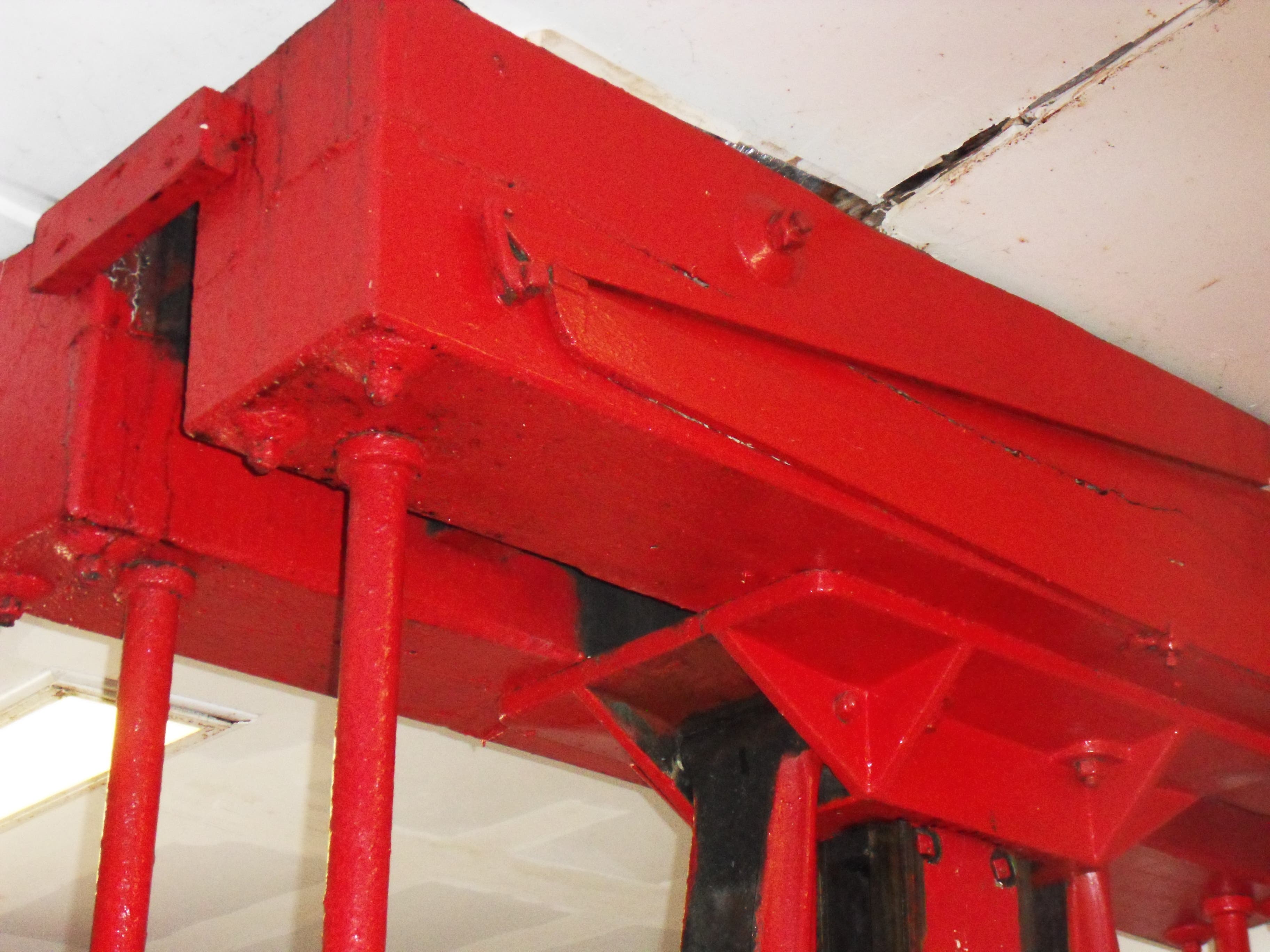
The process begins upstairs in the barn where the apples are washed and shredded. Layers of shredded apples are placed in frames lined with porous cloth. The filled cloths are stacked rack upon rack and pressed. The press, known as a screw press, pushes down on the racks, squeezing the juice through the cloth. Thick beams anchor the press to the ceiling.
As the press pushes down on the racks of apples, the pressure increases. When it reaches maximum pressure, the beams begin to bend and creak.
During the process, the juice runs into a large rectangular stainless basin under the press, and is filtered several times as it flows through a pipe that leads to a stainless holding tank in a refrigerated room next to the cider counter. When people order cider, Doris Heddy dispenses it from a tap into plastic gallon or half gallon jugs.
"We press every two to three days," Heddy said. "There's about three gallons of cider to every bushel of apples. In the height of the season, we sell about 150 gallons per week. I have the best customers in the world. Some of them say they have had Van Duyne Cider on their table for 60 years."
Only about 14 acres of the original Van Duyne tract of 160 remain, and those are segmented into three separate parcels. Despite its historic nature, and roots in an agricultural tradition, the cider mill property, roughly 1.75 acres, is not farm assessed.
An adjoining 10-acre tract, where Abraham Van Duyne was buried in 1808, is used to raise livestock, like goats, which Heddy and Cooke rent out to petting zoos. Adjacent to that is their home, built on just over an acre that Heddy's father deeded to her when she got married. It's where she and her first husband raised their four children.
Cooke agrees that the customers are the best in the world, noting that when the press is in need of repair he cannot simply run out for spare parts. Often it is the customers who offer knowledge, resources, and labor to keep things running smoothly. Some customers also provide services such as advertising, which helps the mill to continue to operate year after year.
He enjoys the cider mill, possessing both an admiration and an apprehension of it.
"It's old," he said. "I don't want to change things or mess with things. Still, it was built before safety standards, when it was common for farmers to be injured by machines. When I got here 20 years ago, I took one look at the gears and said, 'I'm gonna do something about that.' But, you know, it's been twenty years, and I don't want to mess with it."
Cooke also enjoys working on the adjacent farmland, but, to make ends meet, he works full time as a welder nine months out of the year. Cooke is concerned about the future. Both he and Heddy acknowledge that the cider mill is a costly labor of love, which is becoming more difficult to manage as taxes go up and they get older.
In recent years Heddy has talked about selling the mill.
"It's very hard to think of getting rid of it, the cider mill," she said. "Very, very hard."
So, for the time being, Heddy and Cooke continue to press cider for their customers.
"It's a lot of work," she said. "It's gotta be in your blood, being on a farm. It's hard work. You have to love it."
The Van Duyne Cider Mill is open daily from 10 a.m. to 6 p.m., seven days a week from October through mid-December. It is located at 160 Pine Brook Road in Montville.