Community Corner
Local History Mystery: Where's the Art?
Freethinker, "suffragist," agnostic and artist Emily Palmer Cape's art is missing.
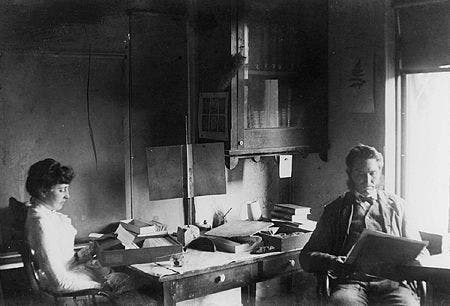


It’s surprising when a local history story arrives by way of New Hampshire, but Emily Palmer Cape was an extraordinary woman. When Patch published a story about local artists of the late 19th century, chef Paul Green, who lives and cooks in New Hampshire, took notice. An amateur art collector, he owns a painting by Emily Palmer Cape, one of the artists mentioned in the story. He shared his information and piqued this writer’s curiosity.
Emily Palmer Cape has a story worth telling, and a good bit of it is set in our area. Born in 1865 in Manhattan, in a time when many wealthy New Yorkers had a “country” home in the Oranges, Cape was the first “New York co-ed,” the very first female student at Columbia College. Recalling her university experience for a 1916 article in the New York Times, Cape remembered studying alone for the entrance examinations. “It was in New Jersey,” she said, “and the real hard work was carried on very often by a lamp on the porch or a light by the bedside, where the pages of ancient history or German or French would be read and memorized.”
When she entered college in the fall of 1883, it was with the written permission and encouragement of Columbia University’s President Frederick Augustus Porter Barnard. However, Cape remembered that “a few of the Faculty seriously objected.” A compromise was reached: Cape could take the examinations with men, but would not be allowed to attend lectures. There were flaws in this plan. Cape recalled a particular logic exam. “In going up for my examination, which was held with the boys,” she said, “I found that the questions were based entirely on the notes which had been given at the lectures from which I had been debarred.” She wrote all she knew on the topic, the economist and logician Willian Stanley Jevons, and “was marked almost 100 percent.” Cape completed her studies in 1887 and saw the founding of Barnard College soon afterwards.
Find out what's happening in South Orangefor free with the latest updates from Patch.
Cape was an artist, as well, and attended the National Academy of Design. Marriage to Henry Cape in 1890 and the birth of two children didn’t appear to slow her down. The New York Times Social Notes continued to record her participation in Sorosis, a women’s discussion group, where she presented papers on the nature of art. She was also a member of the American Sociological Society and the Rationalist and Positivist Societies of London. In 1891, she edited the work of Lester Frank Ward, who believed that the female gender preceded males on earth, and that women were superior to men, especially in prehistoric times.
The Cape family’s travels were recorded occasionally in The New York Times Social Notes. Still, Emily Palmer Cape was not your average socialite; she was an agnostic, a freethinker, and a self-described “suffragist.” She also seems to have stayed in our area, as The New York Times described “an exhibition of local talent” held at Edward Peckham’s studio on Cleveland Street in Orange in which Cape participated. Phone books and directories of that era list families named Cape who lived in the Oranges; I suspect that the Capes had a “country” home in our community.
Find out what's happening in South Orangefor free with the latest updates from Patch.
In 1917, the newly-formed Society of Independent Artists held an exhibition in Manhattan. Emily Palmer Cape displayed paintings, along with fellow members Man Ray, Joseph Stella and Marcel Duchamp. In 1918, her son, Lieutenant Henry Cape, Jr., a fighter pilot, married Miss Helen Sayles, a student at the Masters School in Dobbs Ferry, N.Y. (She probably knew the Kip daughters, who studied there at the same time.)
In 1926, at age 60, Cape undertook a round-the-world journey on the S. S. Belgenland. The trip lasted about six months, and the journals Cape kept are held at the University of Michigan Clements Library. In Thailand, she described the "crowds of humanity much nude & many handsome bronze bodies!" She was apparently indefatigable and enthusiastic: "Cairo! It's fascinating!" she wrote.
Cape died in Florida in 1953, when she was 88 years old. Born at the end of the Civil War, Cape saw dramatic changes in this country, particularly in the value of education for women. Emily Palmer Cape lived a high-profile life and clearly rubbed shoulders with some interesting thinkers and remarkable artists. She left behind written work and a lifetime of newspaper clippings. The mystery that reader Paul Green ponders is this: Where’s the art? He picked up a painting by chance at a sale, but hasn’t found another—or even a picture of another— anywhere. Nor has he found photos of Cape, apart from the image on the right.
Local history often means mining local resources, people’s memories, in particular. In this case, reader memories of Cape and her art teacher Edward Peckham would be most welcome. And it might be worth a peek in the attic; if you find a oil painting signed E. P. Cape, take a photo, send it in, and give it another look. It may give a look at a remarkable life.