Neighbor News
Today from Bedtime Math: Color Explosion
Has your choice of crayon color waxed or waned over the years? Find out in this fun challenge from Bedtime Math!

First, we wanted to tell you about Bedtime Math’s fun new colorful website - check it out! Now you can find all our math problems, parent posts, and info about our Crazy 8s after-school math club much more easily, with wacky art from our book illustrator Jim Paillot pointing the way.
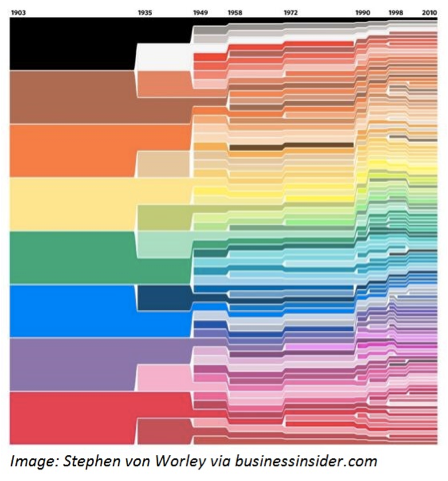
And speaking of color, we’re loving this map of Crayola crayon colors, showing how Crayola has added more and more shades over the years. Back when the company started in 1903 as Binney & Smith, there were just 8 crayon shades: red, orange, yellow, green, blue, purple, brown and black. By 1935 there were 16 colors, including useful shades like pink, navy blue, and white. What’s cool is the chart creator, Stephen von Worley, chose years that had an exact multiple of the original colors, so the stripes line up nicely - for instance, by 1949 there were 48 colors, exactly 6 times as many as the start. 2010 shows zillions of teeny stripes, about 15 per section, giving us 120 colors. It’s also fun to see how grey and plain red have been squished to the side, as the families of purples and greens have exploded. No question that we can draw much more exciting pictures today!
Now here’s today’s math~
Find out what's happening in Summitfor free with the latest updates from Patch.
Wee ones: The “primary colors,” from which all other colors are mixed, are red, yellow and blue. How many colors is that?
Little kids: If you mix any 2 primary colors in equal amounts, you get a secondary color. Since there are 3 primary colors, how many pairs can you mix from them? Bonus: If you line up your 6 total colors in a circle from red around to red again, and mix a new color in between each pair that touch, how may colors do you have now?
Find out what's happening in Summitfor free with the latest updates from Patch.
Big kids: By 1972 there were 9 times as many shades as the 8 Crayola started with. How many were there that year? Bonus: If the vat of wax for red-orange uses twice as much red wax as yellow, and it uses 36 cups in total, how many cups of each color are in there?
Answers:
Wee ones: 3 colors.
Little kids: 3 new colors: green, orange and purple. Bonus: 12 colors, since the 6 colors create 6 spaces between them to fill (one space after each).
Big kids: 72 colors. Bonus: 24 parts red and 12 parts yellow. There are 2 parts red and 1 part yellow, making red 2 parts out of 3.