Politics & Government
Residents Present 'Balloon Test' To Challenge Cell Tower
Despite lots of high-tech talk, residents challenge T-Mobile plan by flying a balloon.
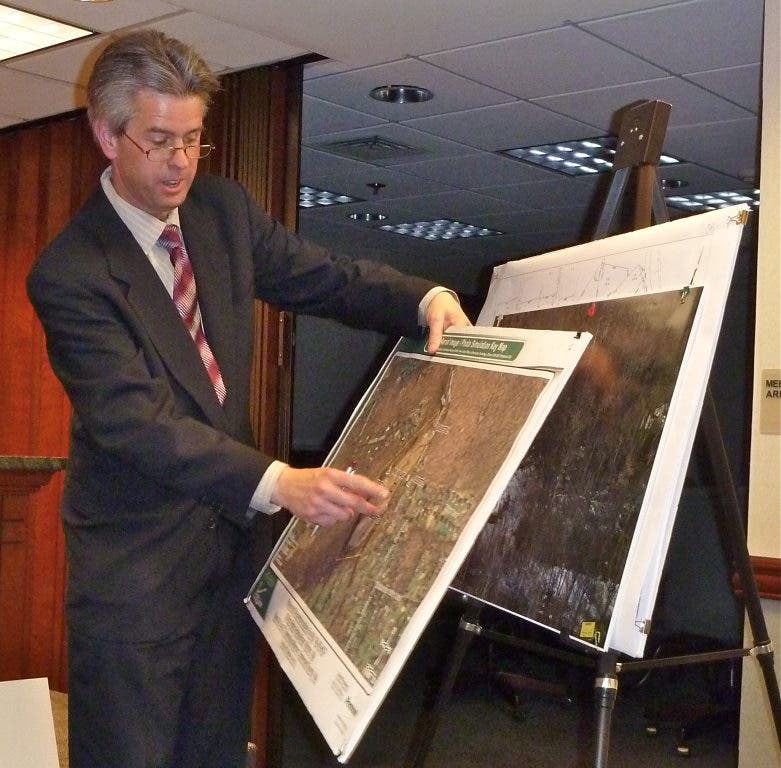

Residents opposed to the construction of a proposed focused their fight on the disruption of tax-funded open space land and neighborhood aesthetics at the Board of Adjustment meeting on Monday night.
Planner for the cell tower applicants, Ronald Reinertson, in what is likely his final testimony, withstood a barrage of emotionally-charged questions from the public, some of which anticipated responses inconsistent with appreciation of community values.
“I have a view from my home that overlooks the quarry,” said Ronald Pimpao, who lives at 15 Dock Watch Hollow Road. His property line is approximately 165 feet from the proposed tower. “Would you find the view appealing or not appealing?”
Find out what's happening in Warrenfor free with the latest updates from Patch.
“Based on the park photos taken across from (your home), I don’t think (the tower) would have a substantial (visual) impact,” Reinertson said. “I would not have a problem.”
The residents burst out laughing.
Find out what's happening in Warrenfor free with the latest updates from Patch.
“I would have more of a problem walking into someone's house and not having cell service,” Reinertson added.
More laughter.
Earlier in the evening, Reinertson and the attorney representing the cell providers, Greg Meese, indicated that radio frequency engineer Ronald Pierson would visit the site to determine its suitability for a new technology developed by Alcatel Lucent known as “light radio,” which shrinks a cell tower’s functionality into the size of a three-inch square cube. The unit can be mounted on poles, sides of buildings or anywhere else there is power and a broadband connection
While opponents of the tower would welcome the technology’s deployment in place of an ominous tower, Alcatel Lucent spokesperson Denise Paniyk-Dale said on Monday that “light radio remains a technology, not a product,” and that it would not likely be available until 2013 at the earliest.
While visual impact is one major concern for residents opposed to the tower, the other is clearly their belief the land was not originally intended for more than public park development when purchased.
The county purchased the 23 acres of land in 1971 with open space tax funds. As recent as two years ago, the county publicly said it planned to turn the space into a park.
A reminder of that intent was provided by Jeffery Foose, who presented a newspaper article from October 2008 in which Somerset County Freeholder Peter Palmer told Warren Township Committee Member Mal Plager of the former quarry site: “these 23 acres will be maintained for passive recreation.”
To further his case against the construction of the tower based on aesthetics, Foose also submitted the 2008 Open Space Report, which recorded the 23-acre parcel’s “unique environmental and physical characteristics.”
To demonstrate why the county’s assessment should be upheld, Foose led a team of 10 citizens on a recent experiment to float a balloon at 160 feet to illustrate the height and location of the proposed cell tower. He then took photos to indicate the striking visual impact and how close the tower will be to area homes.
“Rather than spend money on legal fees, we spent some money on a balloon, and did the test ourselves,” Foose said.
Although Planning Board President Foster Cooper did allow Foose to admit a photograph of the balloon with a clear view of Pimpao’s home, Meese and Cooper agreed that more verification of the coordinates of the balloon and the photograph must be provided at the next meeting in April.
Reinertson, however, rejected Foose’s photograph as inconclusive.
“I’m not buying exactly where this photo is at,” Reinertson said.
“I’m not buying your photo either,” Foose retorted. “But based on my photograph, do you still feel that the site is suitable for a cell phone tower?”
“Yes,” Reinertson said.
Resident Michael Mullhaney who lives on Dock Watch Hollow, continued to challenge Reinertson.
“(Based on Foose’s photographs), How can you say that the tower would not be in the line of sight?” Mullhaney asked.
“I take pictures from the right of way,” Reinertson said.
“And from the base of trees it seems,” Mullhaney sniped. “Do you think that he would be taking pictures that are not beneficial to his employer?”
Beneficial is a word that both sides were hung up on. The cell tower, which falls under a “d” variance, has to meet what is known as the “SICA test.”
The SICA test states that in order to be granted a “d” variance, the provider must demonstrate that the proposed application meets both the positive and negative criteria in accordance with New Jersey’s Municipal Land Use Law. In short, the applicant must demonstrate that negative criteria for inherently beneficial use is significantly less than inherently beneficial use.
“The statutory criteria included wording that said ‘inherently beneficial’,” said 38-year resident Sally Davidson to Reinertson. “How is the tower beneficial?”
Reinertson reminded Davidson that the law stated that the application would not go through if there were a substantial detriment to the public good and he did not believe that is the case.
More testimony on the issue to the Zoning board’s next meeting in April.