Schools
Why Does a Parking Lot Insist on Being a Pond Again?
When "The 100-Year Flood" happens twice in the same decade, we have to stop calling it that. And start pumping.

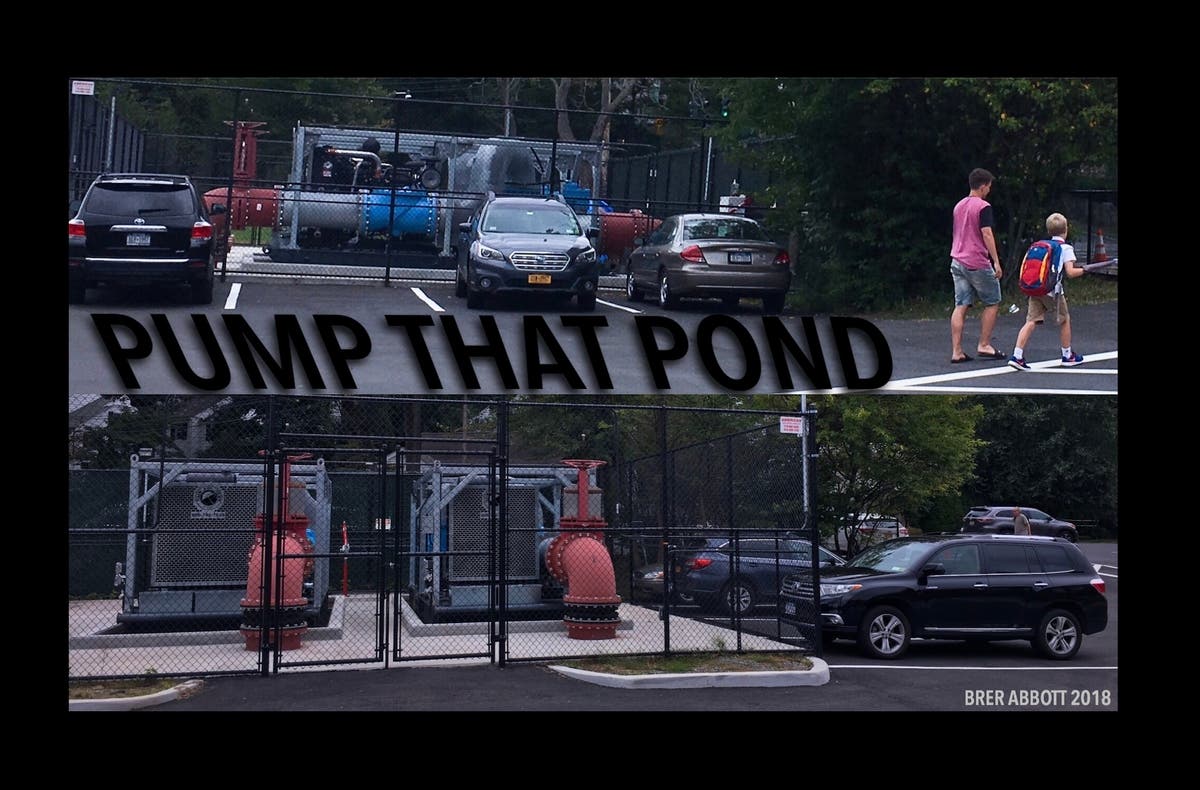
BRONXVILLE, NY — It is "Main Street" if ever there was a quintessential American Main Street. So why do we call it Pondfield Road? "There was a pond over by the School," according to old-timey Villagers like myself. "In ought-7 and again in '11." By which we mean 2007 and 2011.
Semantics. You call it flooding. I say it's a pond, just doing its pond thing. Can we all agree on "parking lot"?
We don't have the option. The decision was made for us long before we were born or settled here. The precise story of how the pond of Pondfield became a parking lot is for another day (but coming soon to Patch).
Find out what's happening in Bronxville-Eastchesterfor free with the latest updates from Patch.
Suffice to say it was a long-ago decision — this pond-to-parking lot conversion — and it pointed Bronxville Village in one direction and one direction only, apparently:
"We just call them 'The Pumps,'" says Dan Carlin, Bronxville School's Assistant Superintendent of Business, with a refreshing refusal to aggrandize a solution that thrills no one.
Find out what's happening in Bronxville-Eastchesterfor free with the latest updates from Patch.
"In today's world we wouldn't fill in the pond, necessarily, for the sake of a parking lot," says Mike Lee, the School's Director of Facilities.
I spoke at length with Dan and Mike about The Pumps on a recent quiet Friday afternoon at the School. It hadn't been so quiet the rainy week prior, when Mr Lee had to manually activate Pump 1.
"A thirty-dollar part [failed and] delayed the designed workings of a $10 million system," Mr Carlin complained.
It was exactly the sort of dumb little problem you'd expect on any given SpaceX or Ariane launch. A battery in a sensor winked out. Pump 1 didn't know that its well was filling with water. (Now is the time you'd best stop reading this and check the battery on your home's own sump pump.)
Mr Lee was unfazed. "I was here, working late. It wasn't a problem." The Pumps send messages to Mike's phone. And if Mike is not nearby, others on staff know what to do, 24/7. The Village's Department of Public Works will also eventually train their people to perform a manual override, according to Dan, but at the moment DPW-VOB doesn't have a boss.
The Pumps are massive. Bus-length, almost. Easily as wide. Maybe not quite so high. But highly visible, within their fenced area opposite the Bronxville Elementary School playground. The sort of thing you'd expect to see in a shipyard.
The manufacturer is Rain for Rent, which they do not do. Nor are they renting us The Pumps. We own them. "They're good for twenty years, we're told," says Mr Carlin.
Right now, there are two. An additional three will be installed in late November.
"We're arguing over price," Dan told us, with a distinct note of unconcern. One gets the sense, talking to him and observing Dan at Board of Ed meetings, that Mr Carlin is accustomed to getting his way on price.
Still, he's up against a true behemoth. Bakersfield, CA-based Rain for Rent mottoes itself "Liquid Ingenuity®," but that's too modest.
This is what happens when you parking-lot a pond. A few generations later, your heirs are negotiating with industry-straddling monster corporations. Rain for Rent will sell you, in fact, the elaborate mechanical and infrastructural solutions that follow naturally from burying — or attempting to — Nature. Do these come with any guarantees? Mr Carlin is totally candid:
"No," he says. "That thirty inches of rain in the Carolinas" — we were speaking in the horror-aftermath of Hurricane Florence — "I don't know if we could pump that out in time, even with all five [pumps] running."
That's the disaster scenario. Bronxville Village is spending $7.5 million federal tax dollars — FEMA is paying for 75% of The Pumps — and has raised $1.8 million locally (split $900,ooo each between School and Village) to keep us comfortably fixed at pre-disaster. We don't want the School to flood again. Again.
"There was five feet of standing water in the School in 2007 and in 2011," Mr Carlin reminds us. The 2011 flood was less severe-seeming only because we were better prepared for it. The first floor of the School was stripped, after 2007, "seven feet down and seven up, of all organic materials" — here defined by Dan as anything not tile and masonry. All wood, sheetrock, carpeting, and the like are long gone.
FEMA's National Flood Insurance Program also picked up the tab for moving the School's boiler from the basement to a dedicated structure on Meadow Avenue.
"We're basing our needs on our actual history," says Mike Lee. And who would want two or three more pumps along Midland Avenue, anyway, in addition to the five that will be there come Christmas? How many Rain for Rent pumps is still not enough?
The good news is that The Pumps — all two of them, at present — can handle a downpour. Confident of its sensor's battery, Pump 1 switched itself on at 1:48pm on Sept 18. So did Pump 2. What is one good measure of the success of The Pumps?
"We didn't have to interrupt classes and send teachers out to move their cars," said Mr Carlin.
Our series about flood mitigation in Bronxville Village continues. Next: How they work, The Pumps. CORRECTION: (This is why tape recorders are good for everyone.) My written notes confused information about the increased volume of the Bronx River with that of the groundwater, and who was speaking — it was Mr Lee, not Mr Carlin. Thusly corrected 24 Sept 18, deleting from the above: "In the space of ninety minutes, according to Mr Carlin, our normal 26 cubic square feet of underground water had surged to 660 cubic square feet — but you would never have known it, up here at parking-lot level."