Health & Fitness
Modernity Projects and an Instrumental Showcase
Ingenuity, ambiguity and uncertainty best characterize the modern era, and Ross School juniors keep them in mind when embarking on the Modernity Project.


History Lesson: Students Complete Modernity Projects
Ingenuity, ambiguity and uncertainty best characterize the modern era, and juniors keep them in mind when embarking on the Modernity Project. An opportunity for students to choose a medium to express themselves, the Modernity Project also asks them to explain why their projects embody the modern mentality. It offers a unique lens through which to view history.
“It was a really great opportunity for students to educate one another,” said cultural history teacher Carrie Clark, who taught the modernity unit with help from Jen Cross, Chair of Visual Arts. “The projects were fantastic,” said science teacher Hugh McGuinness who assisted a few students.
Find out what's happening in East Hamptonfor free with the latest updates from Patch.
Everyone came together on Feb. 17 to celebrate the completion of the unit with a postmodern party, or salon. This year’s projects ranged from a study of one profound military invention to a mix of jazz performances. Louis Caiola and Jon Lesser built a model tank for their project. “The construction of the Renault FT 17 tank reflects multiple aspects of the modern era,” said Louis. “It was a revolutionary design for a vehicle…it was one of the first military designs to be mass produced and sold across the globe.”
Kate Nelson focused her project on the advent of typewriters. “I really liked that the Modernity Project was a synthesis of the whole unit we were studying and that we could take all of that information and apply it to what we’re interested in,” she said. “I’ve been collecting typewriters since before the unit.”
Find out what's happening in East Hamptonfor free with the latest updates from Patch.
Other projects included Nantaporn Yuennan’s masks; Ben Stein’s radio; Clark Hamilton’s light bulb; Gabrielle Ment’s trapeze act; JoJo Coehlo’s study of Jack the Ripper; Gavin Nelson’s maps of New York City and Paris; and independent musical performances by Annie Strada, Miles Kozatch, Kate Fitzsimons and Sofia Kriger. In addition, many international students looked at modernization in their own countries, for example, Chloe Wan and Phil Liu’s photographic portrayal of modernity’s impact on Shanghai women; William Wang’s animation about China; or Amina AlTajir’s map of a city in Bahrain in the style of Haussman’s redesign of Paris in the 19th century.
The modernity unit also included Cubist portraits. Displayed on a wall outside the Café, the portraits were done in the eleventh grade Integrated Arts class, where students studied Modern Art within an historical context. They began by looking at Cezanne and his influence on the development of Cubism and made master copies of Cezanne’s self portraits to observe how he fractured form and used a geometric structure to render his subjects.
Cezanne also began to incorporate multiple perspectives in his images. In the process of making their works, students made portraits of classmates, emulating his style. They then put tracing paper over their initial drawings and further abstracted their images using the style of Picasso and Juan Gris. In their final portraits, they added color and collage elements.
: Instrumental Showcase
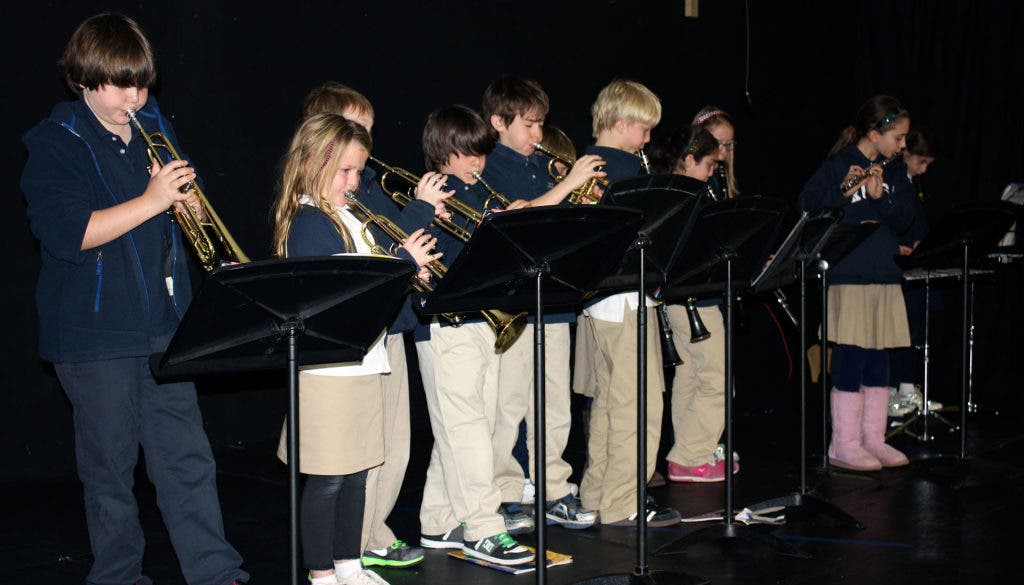
Parents, faculty and students were given a special treat just before the Mid-Winter Break. The third and fourth grade instrumentalists presented a Midwinter Instrumental Showcase to their parents and second grade peers on February 15 in the Multi-Purpose Room. The showcase featured several short pieces by the Lower School Orchestra, Band and Recorder Ensemble, who were led by music teachers Maureen Isbister, Diana Brown and Margaret Bodkin.
— Carey London