Community Corner
Why Our City Needs a Public Bank
Joshua Clennon Calls on Albany to Pass the New York Public Banking Act (S1762A/A5782)

This is a paid post contributed by a Patch Community Partner. The views expressed in this post are the author's own, and the information presented has not been verified by Patch.
By: Joshua Clennon, Jorge Cabanillas, Meera Chakravarthy, Juliana Leite Neri, Drake Reed
Find out what's happening in Harlemfor free with the latest updates from Patch.
Capital plays a vital role in how our cities are built, the way our businesses are run, the jobs we take, and even the types of educational opportunities we receive. In Harlem, capital provides the people of our great neighborhood the opportunity to achieve better outcomes in their interests, goals, and microeconomics. However, for generations, the City of New York has exploited and extracted wealth from communities of color by funneling public dollars to Wall Street Banks that profit from the gentrification and displacement of communities of color. We witness the tax dollars of Harlem residents fund massive luxury developments (e.g. Hudson Yards) while public housing in our neighborhood deteriorates. It's time we take charge, reinvest in our communities, and ensure public funds are actually utilized for the benefit of the public. It's time we start a public bank to steer public dollars into communities who need it most. Communities of color and low-income communities deserve real opportunities and financial independence.
Racial identity and financial inequality have been intertwined concepts throughout our country's history. We see this manifest in terms of who has access to property ownership, who gets approved for bank loans, and who has access to educational grants and opportunities. In Chalres I Harris's famous article “Whiteness as Property,” he analyzes how the concept of color is embedded in power constructs of property.
Find out what's happening in Harlemfor free with the latest updates from Patch.
The concept of property and race originated in the transatlanic slave trade with the exchange of black and brown people as commodities in slave captialism. During those times, black and brown people could not take part in the exchange of commodities, rather they were the commodities creating financial inequality.
Whiteness and capital share a common premise, also known as "a conceptual nucleus.” This premise is the right to exclude. Even as America overturned Jim Crow legislation, whiteness and exclusionary practices to access capital have been significant obstacles for systemic change. These practices continue to protect institutional power and keep it in the hands of few, not the many.
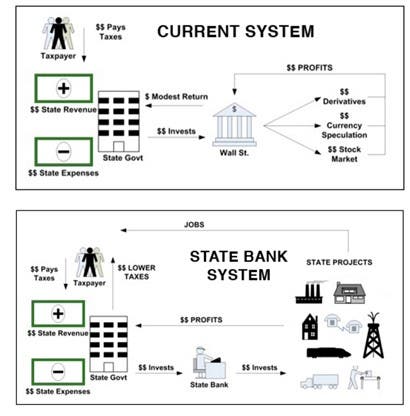
One way exclusionary practices to capital is conceptualized is through our banking systems. Our policies have pushed the "top 5 banks" to control most of our taxpayers deposits. Big banks stopped betting on main street and local economies because they are not as lucrative of investments. We can no longer rely solely on community banks to support our local structures because the top five banks control too much of the market share. As a result, tax revenue generated from neighborhoods, like Harlem, are invested in the top tier banks, and end up financing the development of luxury housing or big box retail that exacerbates gentrification and displacement in black and brown communities.
We must acknowledge this and fight for a change.
The concept of a public bank is that public dollars should work for the public good, not private gain. A public bank would hold all the state's deposits, which is mainly taxpayer revenue. But rather than investing the funds in markets where there is most monetary gain, they will create affordable credit that is loaned out in partnership with the state's local banks. Equitable investments are made in projects that will help increase jobs, support low income housing/public infrastructure, foster community wealth building, and strengthen small businesses in the community. [1]
The state bank holds the state government accountable by ensuring every taxpayer dollar is directly invested back into our communities.
Public Banking has been successful for 65 years in North Dakota. When North Dakota collects taxes, the state does not place the funds into private commercial banks, rather the funds are placed in the Bank of North Dakota which reinvests in the local economy, leading to long term growth and sustainability for the state. During the 2008 financial crisis, North Dakota was the only state in the country that ran a large budget surplus and had the lowest unemployment and foreclosure rates in the country because of the public banking infrastructure.
The Bank of North Dakota supports the local banks which created one of the strongest credit markets in the country. We should implement the successful public banking model in New York.
In New York City, as vast amounts of wealth continue to be reaped off the Real Estate market, a majority of people of color still experience rent burden, overcrowding, displacement, and exploitation. The wealth disparity is also demonstrated spatially, as our frontline workers who help maintain the city everyday, are often pushed to the outskirts and sometimes even out of the city. As a result, those with closer proximity to the city's wealth, such as high tech workers and creators, arrange their lives closer to their jobs. The generalized spatial arrangement is due to the city’s overreliance on ever increasing real estate values. We can see this happening as rent prices are constantly rising in Harlem making affordable housing more difficult to access.
How would public banking and its relation to space look like in New York City? How could it help shift our spatial and community development? One way a public bank could feasibly integrate with spatial development in our communities, is it can help create investment in new sectors that diversify our economy and take some decision making power from the dominating real estate sector. A public bank can also help spur jobs through public infrastructure projects that move us towards becoming a greener city and a more democratically run city through the development and support of housing and worker cooperatives. This has the power of altering the New York City landscape into one that is more accountable to the people than to private profit.
Democratizing the use of capital and credit through public banking can be extremely powerful in how we develop our communities and strengthen access. While there are limitations to a public bank as this will only operate at a municipal level, it can give us an opening to scaling up to the federal level- where we may be able to administer efforts such as redistribution of the percentage of the nation’s GDP (which we all contribute to through consumption or selling) to meet basic necessities like single payer healthcare, free college, a guaranteed wage, and much more.
It's time we begin to reclaim the power of our people in this city and in our neighborhood of Harlem. It is time we start igniting change in our local businesses. We need to support our barbers, our bodega owners, and our healthcare workers. We know we can support all of them by providing equitable access to capital.
If you believe in the power of redistributing wealth and reinvesting in our local communities, let's join together and democratize wealth by advocating for a public bank for New York City.
[1] Armstrong, Marc; Munger, Sam, "Public Banking in America Legislative Guide", Spring 2011 Issue, Public Banking Institute and Center for State Innovation, 2011.
This post is an advertorial piece contributed by a Patch Community Partner, a local brand partner. To learn more, click here.