Community Corner
Black History in Levittown
Paul Manton touches on the creation of Levittown and the 18th century in his latest post.

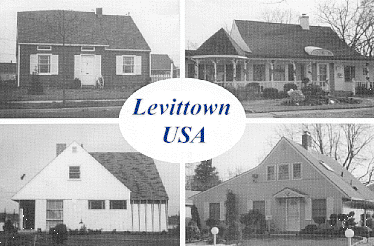
Levittown, I fancy, is to the whole "white flight" myth what Roswell, New Mexico is to UFO buffs; urban legends both coincidentally entering the popular culture in 1947.
It's true that Levitt & Sons contained a "caucasians only" clause in their original contracts until the U.S. Supreme Court's 1949 Shelly vs. Kramer decision ruled such restrictions unconstitutional. Conveniently omitted from subsequent accounts by many journalists and civil rights activists, for political reasons too complex to examine here, is that between 1934 and 1949, all real estate developers accepting assistance from the Federal Housing Authority were obligated to conform to FHA guidelines, which included racially restrictive covenants. Levitt & Sons was no exception. It wasn't a case of Levitt "trying to keep the blacks out of Levittown" as somebody who didn't know about the FHA policy once told me, but the case rules crafted by a federal agency, ironically, under Franklin Roosevelt's administration.
Find out what's happening in Levittownfor free with the latest updates from Patch.
Levittown has always had a less racially diverse population than many surrounding communities by virtue of the fact that more than 95 percent of its homes were built in the same styles, in the same sized plots, and within a five year period by the same developer. Houses fit into a much narrower price range than say, Hicksville or Wantagh. The person from a socioeconomic demographic unable to afford one house in Levittown - and historically that's been racial minorities - is unlikely to be able to afford any of the other houses. Our racial composition is a function of economic forces and residential developmental patterns, not racial restrictions from the 1940s or lingering racial discrimination. But why confuse the critics with the facts when they are determined to depict William Levitt as a racist?
Interestingly enough, our area does have a history of persons of African ancestry. A 1775 estimate of Queens County (which included present-day Nassau) counted 2,183 slaves, mostly owned by Quakers, who were the principal settlers in our area. The institution dates back to at least 1683 and we know that in 1732, Benjamin Seaman, son of Capt. John Seaman (whose Jerusalem Purchase started English settlement of the future Levittown) left several slaves in his will. Too, there were some 319 slaves in the Town of Hempstead in 1722.
Find out what's happening in Levittownfor free with the latest updates from Patch.
At the end of the 18th Century, there arose out of Jericho a spiritual awakening led by the Quaker preacher, Ellias Hicks. Hicks became nationally recognized in the 1810s and 1820s. His proposition was simple: the sons and daughters of Adam are all made in God's image and inherently free. Thus, to enslave any is an intrinsic evil that can't be reconciled with Christ's message. He and his followers, the "Hicksite" branch of Quakerism, were mirroring the rise of abolitionism across the sea led by Anglican clergyman, the parliamentarian William Wilberforce, and the pottery-manufacturer Josiah Wedgewood (Charles Darwin's maternal grandfather).
By 1800, slave owners in Jericho and the Jerusalem/Island Trees region (as the Levittown and Wantagh area was then called) were freeing their slaves and establishing institutions to assist them. Thomas Jackson, for example, a Quaker who lived in present day Wantagh, deeded land in 1835 for the creation of a Negro school. He also deeded the African Methodist Episcopal Zion Church sixteen years later. Both were located near Oakfield and Beltagh Avenue.
To the north, Valentine Hicks - the man who extended the LIRR across the Hempstead Plains to what's now Hicksville in 1837 - followed his kinsman's lead. His home, now the Main Maid Inn, became a stop on the Underground Railroad for slaves escaping from the South. In 1827, under pressure from the Hicksites and the growing abolitionist movement, New York State outlawed slavery.
The sons and daughters of freed slaves did not remain in our area for long, though. The growing industrialization of the twin cities on the Hudson, New York and Brooklyn created job opportunities notwithstanding racial prejudices. Our area became overwhelmingly white again with, during the 1920s and 1930s, black seasonal migrant workers from the Deep South arriving to tend the potato fields upon which Levitt homes now stand.
Want to learn more about the history of Levittown and the surrounding communities? Visit levittownhistoricalsociety.org.