Health & Fitness
Brooklyn, 1968: The Dream Before Levittown
A look at the history of Levittown from a local historian.

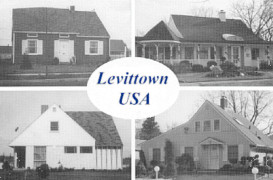
Back in the summer of 1968, about a fortnight before my family moved to Levittown, the ladies of Sixth Street in Brooklyn's Park Slope section congregated on the stoop across the street from the Methodist Hospital and spoke of moving to the suburbs: the American Dream, the lure of Levittown.
Most people in the old neighborhood had someone belong to them already living in Levittown and, in our case, it was my uncle Bill and aunt Jackie who bought their Levitt & Sons Cape Cod in 1953. Moreover, the Methodist Hospital, its Victorian Gothic building replaced in 1958 with a more modern structure and doctor's residence called the Wesley House, had plans in the offing to buy-out all the
brownstones on Sixth Street between Seventh and Eighth avenues.
The plan never came into fruition but it was a sufficient nudge for some of the families already eyeing Cape Cods and Ranches with backyards.
In many ways, the ladies congregating on the stoop were typical of the time and place. All had husbands off at work whilst they kept house, raised Baby Boom kids in crowded apartments, did the marketing, and assembled - weather permitting - in the late afternoon on the brownstone steps. None had college degrees, most had high school diplomas, a few even had jobs as cashiers and bank clerks.
They were quintessentially working class people from a time when that meant a church or school was the center of community life; television was only just beginning to replace books, radio, and newspapers as the principal source of information about the world; and a blue collar worker with an eighth grade education - invariably a veteran of World War Two or Korea - could support a wife and a few children with a 9-5 job; a university diploma was virtually a winning lottery ticket and the GI Bill tilted the odds in one's favor.
The ladies of Sixth Street, as they dreamt of what Alice Kramden in one Honeymooners episode called "a fancy house in Levittown", also smoked cigarettes. It seemed like everybody smoked cigarettes back then. It'd be the reason, a generation later, so many senior citizens with lung cancer would occupy hospital beds earnestly proclaiming ignorance over the health effects of smoke inhalation as though nearly 400,000 cigarettes consumed at a rate of two packs per day over forty years could have no discernible impact. (That'd be 1.52 years of smoking assuming a cigarette takes two minutes to smoke).
Now 1968 was a year of riots and assassinations and protest marches and the war in Vietnam. There's an odd romance about it with ageing Baby Boomers who seem to have forgotten just how close America came to civil war. And within ten years urban life would be seen as something permeated with violence, fear, apathy, disorder, and social decay; the late Victorian era social reforms that corrected many of the socioeconomic dislocations wrought by industrialization an gave the gaslight and steam-driven cities a certain charm, melted away.
Overnight close-knit neighborhoods in which families babysat for one another and attended one another's weddings and funerals became plagued by crime, garbage strikes, drugs, police corruption, and assaults on traditional norms and values.
The name "Kitty Genovese" became the catchphrase for what society was experiencing. The American Dream was coming to revolve less and less around stable families, friendly neighbors, and good schools and more and more around consumer goods and pop culture entertainment. The "sexual revolution" was dawning and its high priests - advocates like Alfred Kinsey - would leave this life decades later survived by family members, colleagues, and AIDS, herpies, unwanted pregnancies, NAMBLA, and cable pornography.
Today nobody in their right mind would send a seven year-old, in the heart of an American metropolitan area, around the corner to purchase a carton of cigarettes - or anything else. Too, by the 1970's, that convenience store would be demolished along with the adjoining delicatessen, laundry, and FTD florist shop and remain a weed-choked empty lot surrounded by a chain-link fence.
The Sixth Street ladies spoke of the American Dream and places like Levittown. It never occurred to them that this was precisely what they, albeit briefly, already enjoyed.
Want to learn more about the history of Levittown and the surrounding communities? Visit www.levittownhistoricalsociety.org