Health & Fitness
Levittown: The Most Spectacular Impossibility
A look at the history of Levittown from a local historian.

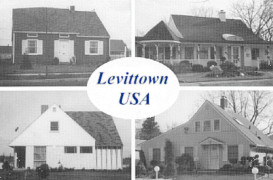
Newton and Leibniz co-invented calculus in the late 17th Century in order to comprehend quantities and variables that occur in highly changeable rates or in a manner whereupon irregularities negate more conventional measuring techniques. Levittown's early history was, in many respects, a phenomenon that required its own calculus.
On August 15, 1949, for example, at their Village Bathhouse Club office in Manhasset, Levitt & Sons held one of their camp-out-overnight mass housing contract signings in which 1,100 houses were estimated sold in one five-hour period. That's a rate of one house sold every three-and-a-half minutes - approximately, too, the time it took for the home-buying veteran, Levitt assistant, contract closer, and stenographer to close the deal.
The houses in question were 1949 Ranch houses with eight hundred square feet which made them 6% larger than the six thousand Cape Cods the company had already built since May 8, 1947. Several factors inspired Levitt & Sons to begin manufacturing Ranch houses for sale rather than continuing with Cape Cods for rent even after Congress passed the Rental and Housing Act but the first was the success of the Levitt mass-production technique itself. The original rate of production in the spring of 1947 of eighteen houses per day had, by July of the following year, reached thirty per day.
Applying these methods to the Ranch design worked well. Of the 17,447 mass-produced houses made by Levitt & Sons, 11,447 were Ranches - that's 65.6% of the entire development which, in kind, eventually ballooned into a project 88.54% larger than originally anticipated in the opening days of 1947.
The engineering genius of the Levitts notwithstanding, the calculus of Levittown is best appreciated when seen in the context of the confluence of the greatest housing shortage in American history and an extraordinary expansion of its consumer base. The Great Depression reduced the home-building industry to a ghost of its former self. Indeed, by 1935, home construction had plummeted by as much as 95% and the situation was merely exacerbated after Pearl Harbor when construction materials were needed for the war effort. This coincided with an upsurge in the U.S. population. It was estimated by the Federal Housing Authority that at least six million new homes would have to be constructed to meet the demand.
Levitt & Sons was probably in a better position to capitalize on this demand than any of the other builders who survived the realty famine of the Great Depression and the War years. Political prowess and a strong sense of the ebb-and-flow of the market in the pre-Crash period of the Roaring Twenties allowed them to develop an upper-middle class clientele base less vulnerable to the locust years that followed.
Consequently, by 1934, when the Roosevelt administration created the FHA in a largely unsuccessful endeavor to jump-start home building, Levitt & Sons was one of the few successful construction firms in the country. Between the Crash and Pearl Harbor, they company erected 350 homes in Rockville Centre, 200 in Manhasset, 150 in Great Neck, and 100 in Westchester. All of this foreshadowed the world-wide fame they would achieve in the Island Trees/Jerusalem area after the War when the April 1949 issue of Architectural Forum described our community as "the latest and most spectacular impossibility".
Want to learn more about the history of Levittown and the surrounding communities? Visit www.levittownhistoricalsociety.org