Health & Fitness
Levittown: The True Icon of Freedom
Looking for an icon of freedom? Look no further than your front door.

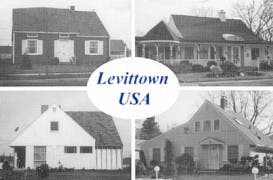
In my opinion, the building of Levittown was a much greater and more meaningful achievement than the building of the pyramids or the World Trade Center. The Levitt & Sons Cape Cod and Ranch is the embodiment of a better life for tens of thousands of working families.
The pyramids were monuments to narcissism and idolatry; an empire squandering its wealth to erect tombstones to men foolishly imagined to be gods. And nobody called the World Trade Center "an icon of freedom" before Sept.11, 2001. It was, at best, a tourist attraction more for its massive size than aesthetic value and, at worst, two office buildings where multinational conglomerates changed trillions of dollars in a world where hundreds of millions go without adequate food, water, shelter, or medical care.
If we really want to picture true icons of freedom, they're to be found in Currier & Ives prints, Norman Rockwell paintings (of which one of my former Levittown neighbors posed), re-runs of Leave it to Beaver, or in the houses of Levittown's residential streets. It's to be found in the appliance repair shop owned by the fellow who lived around the corner, the take-out restaurant owned by that immigrant family in town, or the few small farms or factories owned and operated by one family.
Granted, some of these are only aesthetic creations and merely genre intended to resonate with our values; examples of our mythos. But what are these values so inextricable from the words "freedom" and the "American Dream, anyway? Aren't they just aspirations? And doesn't that make them, even beyond their pure and idyllic state, intrinsically valuable?
There never was a New Jerusalem of Christian piety except as an idea and yet that idea settled New England and most of Long Island in colonial times. There never was a New Athens of cultural and scientific enlightenment except as a quixotic pursuit and yet it put brave men's signatures - including two Long Islanders - on the Declaration of Independence. Maybe the ruins of Hiroshima and Dresden, no less than the subsequent Soviet occupation of eastern Europe, made "the Good War" less than a holy quest (were not the Crusades themselves tainted by un-Christian conduct?).
But America in 1945 nevertheless truly was the liberator of peoples - just ask orphans, refugees, and Holocaust survivors. Perhaps, too, the Federal Housing Authority's insistence on racially discriminatory clauses in Levitt & Sons' contracts (Clause #25), made the "American Dream" of a house in the suburbs a bitter disappointment to African-American GI's but that notwithstanding, Levittown really did, as my friend and local historian Daphne Rus once said, "represent seemingly limitless possibilities."
It's difficult today to imagine what Levittown meant to our pioneers. It was estimated that by V-J Day the U.S. needed at least five million new homes to give shelter to GI's living in drafty attics, dank basements, tool sheds, old barns, and worse. Between 1945 and 1950, "To Let" advertisements in newspapers often drew in scores of potential tenants and urban legends arose of people perusing obituary columns in search of possible vacancies and police officers at homicide scenes inquiring as to the availability of the victim's lodgings.
Even Levitt & Sons, as production reached a record 18 houses per day, could hardly keep abreast the demand and new home buyers were frequently directed to the construction site where they could watch - and photograph - their houses being built.
When I think of families moving into their new Levittown homes, I think of those first crude thatched-roof dwellings erected by the Pilgrims that first winter in the New World or the log cabins of the West two centuries later. Looking for an icon of freedom? Look no further than your front door.
Want to learn more about the history of Levittown and the surrounding communities? Visit www.levittownhistoricalsociety.org