The critics of suburban life are doubtless as old as the suburbs themselves, although we have few records of what the urban proletarian of antiquity might have thought about the Roman Empire's comfortable patrician life in suburbium.
Needless to say, as with all visionaries, the great suburban planners were astonishingly innovative people whose visions had their limits; plans had unintended consequences, and those whose critics ranged from luddite crank to more serious sociological consideration.
Thus in the early 19th Century, Hezekiah Beers Pierpont's development of Brooklyn Heights - and the influx of Yankee entrepreneurs from old Puritan stock - was protested by one Jacob Pritchen who tread around that erstwhile village attired like his colonial Dutch ancestors.
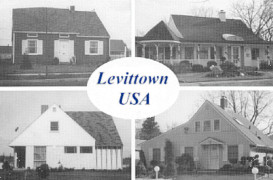
In England, where the term "suburbia" first appeared in print in 1895 to describe the specific cultural attributes of the suburbs (the actual term entering English in 1380 via Wycliffe as "subarbis", possibly from the Old French "subburbe") concerning about traditional settlement patterns being adopted appeared in E.M. Forster's 1910 Howard's End: "into which country will it lead, England or suburbia?" And, of course, Lewis Mumford called the new Levitt Development in 1947 a "treeless communal waste" midwifing, in the process, the entire cliché-ridden cottage industry of post-WWII critics.
On the main, however, critics notwithstanding, the sprawl of the suburbs was considered less chaotic than the more random urbanization that appeared with the Industrial Revolution. Hezekiah Beers Pierpont's Brooklyn Heights, Valentine Hicks' Hicksville, Alexander T. Stewart's Garden City, and William Levitt's Levittown were far superior to the kind of unplanned development that occurred in Manhattan's crime-infested Five Points District (as depicted in the 2002 film, The Gangs of New York) and in the slum that grew up along the banks of Brooklyn's Gowanus Canal and introduced a youth named Al Capone to the underbelly of urban life.
Suburbia will continue to spawn harsh critics and fierce defenders as it becomes the dominant socioeconomic paradigm on the planet precisely because it is a work-in-progress ever evolving to meet changing requirements. Brooklyn Heights was a child of the steamboat, Garden City and Hicksville of the railroad, and Levittown of the automobile. The age of globalization and the Internet will sire other modes; somewhere in China or India there's a development waiting to become as influential and as much a household word as Levittown became in the quarter century after World War II.
What we might take away from this is the realization that Levittown didn't stop being built after 1951 when Levitt & Sons erected House #17,447 on Tardy Lane in Wantagh. It's still evolving, struggling to survive, and whilst its future doesn't have to be that of suburban Detroit with its row-upon-row of boarded-up, weed-choked suburban homes, it certainly won't be some 1950's-esque version of Colonial Williamsburgh either.
The nostalgia-animated defenders of Eisenhower era Levittown might well be as mistaken as their critics because those people I dubbed "the prophets of suburbia" didn't look nostalgically to the past for answers but to a future that they created.
Preserve and cherish our history we must and that's why we have a Levittown Historical Society. But always recall that our past has always been about looking into the future.
Want to learn more about the history of Levittown and the surrounding communities? Visit www.levittownhistoricalsociety.org