Question people about the advantages of Big City life and invariably they point to the many cultural institutions and attractions. Inquire after the advantages of life in the countryside and one is serenaded with musings about scenic beauty, quiet, and freedom from the disadvantages of the Big City. (Of course people who dwell in congested urban areas or who toil in isolated rural locales are seldom harbor such a romanticized evaluation).
But when one asks the same question about the advantages of suburbia, it always boils down to a better place in which to raise a family. Now I don't doubt that there are rural settings and urban settings ideally-suited to the family. Vermont and Singapore, respectively, come to mind. There is, however, something quintessentially family-oriented about the suburbs, the modern incarnation of the Victorian ideal of domesticity. "Suburbia's raison d' etre", wrote Time/Life in This Fabulous Century (1970), "was good schools, community life, and healthy surroundings. It all added up to kids".
Indeed, when we consider that raising offspring and enhancing their survival is the very reason any society - elephant herd ,ant hill, bee hive, human culture - exists in the first place, suburbia ranks high on the Darwinian imperative scale.
Of course, we don't dwell in a society peopled largely by evolutionary biologists although we probably should because I've seen little over the years to refute Robert Triver's basic contention in 2001 that "sooner or later political science, law, economics, psychology, psychiatry, and anthropology will all be branches of sociobiology" however much hyperbole might be present herewith.
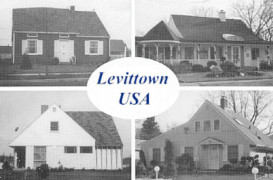
We tend, therefore, to see the maximization of inclusive fitness in terms culminating in what we call "the American Dream" and no time in U.S. history was that ideal more self-conscious than in the suburban boom of the 1950's and 60's of which Levittown ushered-in. By 1960, there were 35.5 million Americans between five and fourteen years of age and wags were calling pregnancy "the Levittown look".
This maximization of inclusive fitness has been assailed in recent years with socioeconomic upheavals that have undermined the stable middle class suburban polity that was "a given" in the 1950's and 60's when the U.S. economy was experiencing historically unparalleled expansion and couples were marrying in their early twenties and raising four or more children. Outsouring, corporate re-structuring, globalization and runaway housing costs and income deflation have eroded those once confident presuppositions.
Perhaps, too, suburbanites have forgotten that a better life for their children does not come from electronic gadgets, video games, TV viewing, consumer goods, and the worship of pop culture celebrities and professional sports teams but from a community strengthened by citizens, sports leagues schools, libraries; from knowing - and caring - more about one's neighbors and one's neighbor's children than about sitcom characters.
In the end, the success of the great suburban experiment which is now sweeping the developing world, will depend upon the extent to which we sustain political, economic, and social institutions that give our children a better place in which to raise a family and maximize their own inclusive fitness because societies that do not transmit their genetic endowment, no less than cultural heritage, to another generation , join the ichthyosaurus into extinction.
Want to learn more about the history of Levittown and the surrounding communities? Visit www.levittownhistoricalsociety.org