Every era," wrote the 19th Century Irish poet and zoologist, Arthur O'Shaughnessy, "is a dream dying and a dream coming to birth.”
Indeed, the sense that something that once seemed so permanent and now is fleeting, and its bittersweet nostalgic accompaniment, has oftentimes provided just the retrospection required to inspire preservation of the past and, consequently, a more contextual appreciation of our headlong rush to meet the future.
Late in the 19th Century, for example, Americans sensing that new blood and a new cultural hegemony was afoot via mass immigration, industrialization, and urban growth, felt compelled to hold on to the early American past. This era bequeathed us such organizations as the Daughters of the American Revolution (1890), the United Daughters of the Confederacy (1894), and the Mayflower Society (1897).
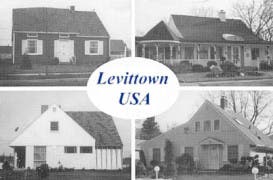
These institutions are legacy organizations focused upon preserving American history through the lens of their direct ancestor's contributions. Local historical societies do something akin, albeit with respect to place rather than lineage but no less with a sense that the present is sorely missing the past. This has been a recurring theme in Levittown.
Speaking of 1950 when he first moved to Levittown, Tom Carroll told Leslie Bennetts, a contributing editor at Vanity Fair that "there was more camaraderie between people back then. Now everybody's got two or three cars in the driveway and there are shopping malls all over the place. You don't have to get involved with your neighbor....when people come in, they don't know what Levittown used to be." [Memories Magazine, June/July 1990].
The lamentation, no less than Levittown's 40th anniversary, prompted the eccentric and entrepreneurial Carroll to join forces with local citizens in 1988 to establish the Levittown Historical Society. The sense of loss came with the 1970's and 80's as inflation, taxes, and housing costs multiplied far beyond anything people in the 1950's could imagine - the much-publicized May 10, 1989 visit by Gov. Mario Cuomo to the Schiller family who moved out of Levittown because of property taxes being the symbolic milestone event.
Certainly such a sense of loss isn't new. The explosive creation of Levittown between 1947 and 1953 altered an entire landscape and way of life in the old Jerusalem/Island Trees area that harked back generations. It came as a shock to many. In a December 12, 1951 interview in the Nassau Star-Review, Mrs. Alfred Badolato observed that "the most striking thing about Levittown is the change....almost overnight from a countrified section into a virtual city. Four years ago, it was a potato field with a few houses."
Most salient was her nostalgic tone: "I liked it better than." Levittown in the 1950's and 60's self-consciously saw itself as the epitome of the "American Dream" and perhaps O'Shaughnessy was right about the endless, almost karmatic, cycle of dreams. Nostalgia, even quixotic at times, does connect with something deep in our nation psyche. "America," wrote John Brooks in The Great Leap: The Past Twenty-Five Years in America (1966), "has an old habit of regretting a dream just lost and resolving to capture it next time."
Certainly after experiencing 16 years of economic depression and world war, people were ready to recapture their "American Dream" and Levittown offered the perfect opportunity to do so.
Want to learn more about the history of Levittown and the surrounding communities? Visit www.levittownhistoricalsociety