Kids & Family
The Jud Crandall Set
A look at three local historians who have made an impact in our community.

These days it seems like everyone around here is an out-of-stater, future out-of-stater, immigrant, or unemployed 40-year-old Master's degree living with Mom and Dad.
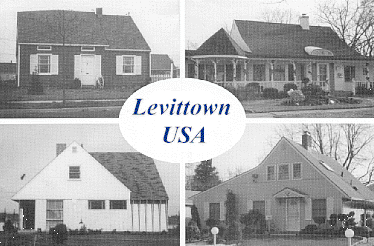
Becoming scarce as hen's teeth are the folks who have lived on the same street or in the same neighborhood most of their lives and have seen it all come an go. It's getting on in years and the old-timers who proverbially recollect "when all of this was just farms" and when Levitt & Sons came to town are vanishing. They are whom I call the Jud Crandall set - after that octogenarian in Stephen King's Pet Sematary who knew all the secrets of his Maine town, including what happens to people and animals buried in the haunted old Indian burial ground deep in the woods.
I know many such people but the ones of most note are those who became local historians in our area and it is to them that we are everlastingly grateful. Every generation has had them, of course, but several stand out because they lived long enough to witness the dawn of suburbia, observe its impact after decades, and see it in the last years of the 20th Century as it transitioned into the post-modern Cyber Age. They would include people like Dorothy Horton McGee, Alonzo Gibbs, and Robert Cushman Murphy, but I'll mention just three historians who happened to be personal friends of mine: Richard Evers, Bill Clark, and Steve Buczak.
Find out what's happening in Levittownfor free with the latest updates from Patch.
Richard Evers (1922-2010) - Richard is forever remembered by the Hicksville residents as the community's most popular social studies teacher who included Billy Joel amongst his many students - and consequently the inspiration for the latter's We Didn't Light the Fire - as well as a community activist, devote Roman Catholic, and World War II veteran involved in veteran's affairs. He was also one of the co-founders of the Hicksville Gregory Museum and a board member there until his death as well as a co-founder of the Hicksville Historical Society.
Dick's exuberant and superlative-festooned style of writing local history had a powerful moral element running through it. If the schools, churches, businesses, and civic organizations constituted the anatomy and physiology of the town, than its families and community values and individual sense-of-place in society was its DNA and that - although not in such an overt biologically analogous manner - was an animating principal in his understanding of history.
Find out what's happening in Levittownfor free with the latest updates from Patch.
His four-volume The Economic History of Hicksville, which he co-authored with his wife Anne, traced the community's development from rural and agricultural at the turn-of-the-century to suburban and retail/manufacture-based in the middle decades, to the dawn of the Internet and "service economy". It celebrated the community's ingenuity and astonishing growth but was candid in its critique of certain forms of 20th Century "progress" from the impact of Big Business and Big Government to the alienation of youth wrought by consumerism and "the counterculture".
Visions of America: Hicksville, one of those photograph-rich local histories from Arcadia Press and Dick's last book, is one of the most popular and has an inescapable Norman Rockwell quality to it that suggests he and Anne were as much endeavoring to show a Hicksville in days gone by (like Dorothy Rettberg Brown's Good Old Hicksville) as of an America that seemed to have slipped out of our fingers.
Bill Clark (1917-2005) - With the exception of vacations and service in the Pacific during World War Two, Bill Clark lived all his life in Hicksville; growing up on a farm on Old Country Road where Anton's Catering Hall now resides. Bill seemed to know everybody in town and, even into his 80's, had an encyclopedic memory augmented by the fact that he was a shutter bug from youth.
Many historians concern themselves with monumental events and heroic figures; Bill concentrated upon nostalgia, memorabilia, and ordinary people and collected commonplace items that were as ubiquitous in the lives of people a few generations ago as they are rare curiosities - items frequently exhibited at the Hicksville Gregory Museum where he was something of a fixture for many years until his passing. In the 1990's and early 2000's, Bill's "Jottings from Yesteryear' column in The Hicksville Illustrated and Mid-Island and Levittown Times was an extraordinary view of the change in everyday scenery with its before/after photographs spanning the 1930-2000 period.
Steve Buczak (1924-2012) - Raised on an East Meadow farm, Steve Buczak's future was determined by two things: youthful love of aviation and photography. By the age of 15 he was already piloting a Piper Cub out of a little rural airstrip called Nassau Airport (now the site of St. Bernard's Church) and photographing the landscape below with its checker-board of potato fields and pre-Levitt & Sons housing developments.
After service in WWII as machine-gunner on a B-17, which saw more than thirty combat missions including "softening-up" German positions on D-Day, Steve came home to his family's window cleaning business which flourished when Levitt & Sons began planting rows of houses where hitherto there had been rows of potatoes. His photographs of the old airfields and farms in his childhood neighborhood have appeared in several local history books including his History of East Meadow and Lynne Mattareese's The History of Levittown, New York and in 1988 he was one of the co-founders of the Levittown Historical Society.
Airman that he was, I like to think of his approach to history as a kind of mission because nobody better documented the landscape and stage upon which the drama of the suburban building boom would be performed and that was especially important because that landscape expanded such beyond imagination throughout his life.
Want to learn more about the history of Levittown and the surrounding communities? Visit www.levittownhistoricalsociety.org