Health & Fitness
Time Travel in a Levittown Backyard
A look at the history of Levittown from a local historian.

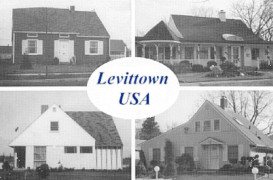
Over the years, I've oftentimes wondered what it would be like to travel backwards in time to a summer day in the middle of the 17th Century and stand in what became my Levittown backyard whereupon, in the 1970's, we enjoyed block parties, pool parties, barbeques, rumble-fumble, and climbing the weeping willow under whose long fronds our German shepherd, Sam, took lazy siestas in his doghouse.
In the time of Oliver Cromwell, that 60x120 plot, slightly larger than the average Levitt parcel, was in the heart of horizon-to-horizon, windswept meadow; the swaying prairie of the Hempstead Plains. Upon its gentle knoll, it descended some forty meters to a rill that was called Big Hollow Creek and would become the pathway of Violet Lane. To the southeast, a stab of dark green would delineate the pitch pine trees of an ancient grove at Hempstead Turnpike and Jerusalem Avenue called "the Island of Trees".
On bitter winter days when the snow drifts, howling wind, and the clanging branches of our maple made memories of the smell of apple blossoms and azure skies stroked with wispy cirrus clouds seem like a distant dream, I'd imagine standing here, in this exact spot, in 30,000 B.C. I'd gaze northwards to that massive wall of ice on the horizon; a towering glacier looming over a frozen wilderness for Levittown had once been arctic tundra. To my back, the Atlantic Ocean was yet another fifty miles away but along its fringes, where New York City - bound cargo ships now glide - meadows and great stands of cedar trees and pine that constituted the habitat of the mastodon.
The land that became my Levittown backyard north of Hempstead Turnpike passed through many hands since the Stone Age culture of the Massapequan was joined by literate Englishmen with mechanical contrivances and large draft animals. It was part of the December 13, 1643 Hempstead Purchase between fifty Englishmen led by Rev. Robert Fordham and John Carman and representatives of the Merrick, Massapequan, and Rockaway. One of those proprietors, Capt. John Seaman, would negotiate the acquisition of lands that comprise Seaford, Wantagh, and southern Levittown on February 12, 1664. And five years later, one of the original Hempstead signatories, Robert Williams, would purchase what became Hicksville from the Matenicock.
But my backyard, however, was part of commonly-held grazing land and would remain so until 1869 when the Town of Hempstead sold some 7,170 acres to Alexander Stewart who'd build Garden City and own a swath of land running all the way to Farmingdale for his Central Branch of the LIRR. Service began on this line on May 26, 1873 and from the vantage point of my future backyard, I'd have been able to see the impressive coal-burning mechanical beasts belching smoke and billowing steam.
In 1892, Stewart's heirs placed these acres of land into a holding company called the Merillon Estate. Some would be rented out to potato farmers whose families came down from Hicksville but most of the land north of Division Avenue between what's now Old Farm Road and the Hicksville border was undeveloped acreage that Levitt & Sons purchased in 1943.
The tranquility of this ancient place that became my Levittown backyard was broken in the summer of 1908 when an army of laborers arrived to build the Vanderbilt Motor Parkway a few hundred feet away and, on October 24, 1908, a tent city would be erected here behind the wooden grandstand to accommodate the thousands of spectators who attended this Edwardian extravaganza. And, a few years later, Gulf fueling trucks ambled by to provide gasoline to the little aircraft that took off and landed just a few hundred meters to the northeast.
It was sometime late in 1947 that wooden skeletons appeared from the south; frames transformed into rows of suburban homes in a flash to be, in turn, joined by the next row of frames encroaching ever closer. And closer still. The process occurred with astonishing rapidity that to merely gently nudge the throttle on the Time Machine was to be suddenly standing in the middle of staggered rows of Cape Cods and, with still another nudge, to see lawns, hedgerows, fences, and backyard trees burst into existence.
I apply the throttle yet more...seasons become years, years become decades, decades become centuries, and landscapes flash into existence, vanish, and are replaced. States and dialects wax and wane. Oceans and glaciers take their turns. New species evolve. The sun appears larger and blood red. Eons spend themselves. There's a time after time to the consummation of all things but that's not for me to know right now.
Want to learn more about the history of Levittown and the surrounding communities? Visit www.levittownhistoricalsociety.org