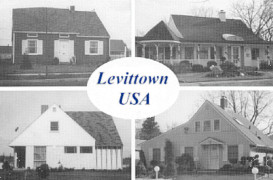
Levittown residents on Horn, Potter, Blacksmith, Tanager, and Spindle, and Hicksville residents on Friendly and Palermo lanes will doubtless be interested to learn that between 1929 and 1950, their properties were part of the one hundred acres of land that encompassed the grounds of the Long Island Aviation Country Club and the club's well-to-do and internationally famous membership.
In the year between the two world wars, many small rural airfields dotted the windswept grassland and potato fields that spread across the heart of Nassau County - the most noteworthy being Roosevelt Field, named for Theodore Roosevelt's son Quinton who trained there and was later killed in areal combat over the battlefields of France shortly before the Armistice. It was the place Charles Lindbergh departed from on May 20, 1927, bound for Paris, celebritydom, and the history books. But the surrounding communities had heir own little aviation facilities even if these were often little more than a dirt landing strip and a wooden hanger.
Three had operated in the future Levittown area in those early decades of the 20th Century and they included the aforementioned Long Island Aviation Country Club, the L.W.F. Field (now the site of Target and environs) and Nassau Airport (now the land along Hempstead Turnpike between Center and Roxbury lanes).
Indeed, the original St. Bernard's church building had been the converted aircraft hanger of the last; purchased by the Archdiocese of Brooklyn in 1947 along with the Dutch colonial style Robricht farmhouse which now serves as the church rectory. Of these. the Long Island Aviation Country Club had been the most upscale and famous with its overnight lodgings, swimming pool, tennis court, garden, bar, and 200'x400' aircraft hanger.
What made the club so attractive was, as Spencer Gregg wrote in the November 1939 issue of Popular Aviation, is that one could sit in the lounge and "see everyone who is anyone in aviation" socializing there on a regular basis. It had been the haunt of such barnstormers as Ruth Nicholas, James Doolittle (who led the famous 1942 bombing raid on Tokyo), and Douglas Fairbanks Sr. as well as Charles Lindbergh who, by opening day in June of 1929, was a celebrity of such magnitude that he upstaged such honored guests as Japanese ambassador Matsudaira Tsuneo, and F. Trubee Davison, Assistant Secretary of War.
In 1931, Lindbergh taught his wife Ann, daughter of the U.S. ambassador to Mexico, how to fly here. Now this section of Island Trees, as northern Levittown and southern Hicksville were informally called and had probably been thusly named even before a 1747 land deed put it on paper, was flat and open as the day - coincidentally, two hundred and seventy-nine years to the day that Lindbergh's solo flight -that Robert William's and Pugnipan of the Matinecock Indians established what would become the Town line in 1653. Ideal country for such aircraft as Lockheeds, Electras, Aeroncas, Cubs, and Taylorcrafts. Ideal, too, for building suburban subdivisions when Levitt & Sons purchased the entire country club property in 1950.
As a curious footnote, when Levitt & Sons acquired the clubhouse, they dismantled it and sold it off for scrap and some of it ended up on Hicksville's Cliff Drive and Field Avenue; incorporated into residential buildings.
Want to learn more about the history of Levittown and the surrounding communities? Visit www.levittownhistoricalsociety.org