Neighbor News
LIRPC and Suffolk County IDA Present Workforce Report
New report reveals priorities to upskill workforce for economic growth, career development, and opportunity for all
As Long Island recovers from the COVID-19 pandemic, a skilled and well-trained workforce can drive a strong, resilient economy for growth. Meanwhile, the resurgent efforts for racial equality create renewed momentum to ensure everyone in our community has the same opportunity for economic success.
These two challenges provide an unprecedented opportunity for Long Island to implement a workforce training and development strategy to meet current and future market demand with an exceptional workforce, drive the region’s growth and global competitiveness, and help bridge the economic divide. Further, during the 2020 State of the State address, New York Governor Andrew M. Cuomo announced expanding the state’s $175 million workforce development initiative as a statewide priority for economic growth.
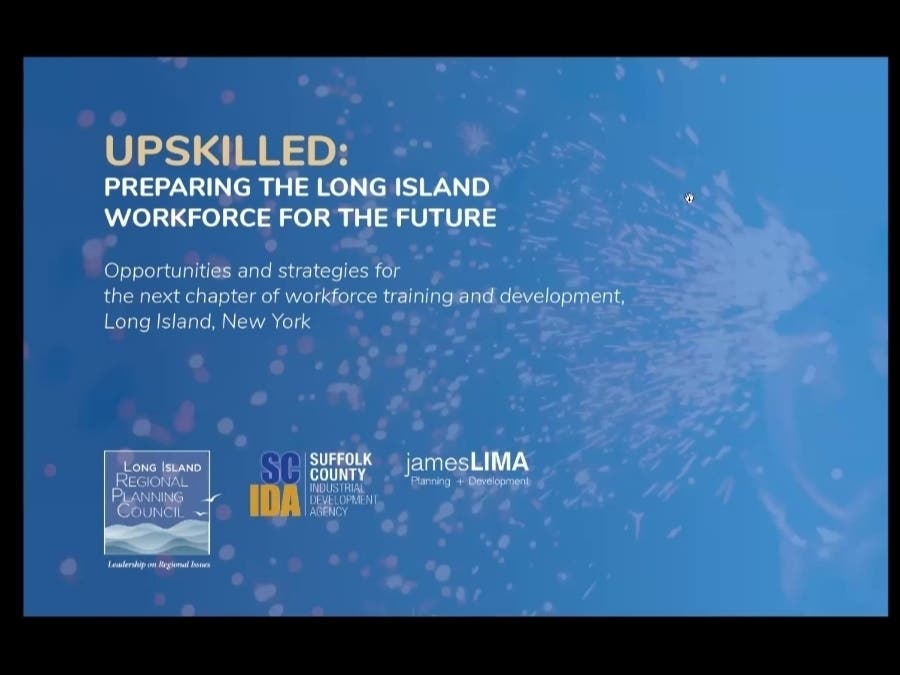
On June 18, the Long Island Regional Planning Council (LIRPC) and Suffolk Industrial Development Agency released the comprehensive study “Upskilled: Preparing the Long Island Workforce for the Future.”
Find out what's happening in Long Islandfor free with the latest updates from Patch.
“The report outlined the opportunities and strategies for the next chapter of workforce training and development on Long Island,” said LIRPC Chairman John Cameron. “Long Island has an overdue need to create a unified strategy to upskill the region’s workforce and create true economic opportunity. Responding to the realities of the post-pandemic world and the workforce impact on Long Island intensified these needs.”
LIRPC commissioned the report from James Lima Planning + Development, a firm that has advised major Silicon Valley companies on building out their campuses and ecosystems. The firm undertook economic and demographic research to set the stage for high-impact regional workforce development to ensure the skills of the area’s workers match the talent needs of the region’s fastest-growing business sectors.
Find out what's happening in Long Islandfor free with the latest updates from Patch.
Key opportunities the report identified include:
- Focus on workforce development in “tradable sectors,” which export goods and services to other regions. Tradable sectors are critical for economic development by bringing new dollars into the region, providing better-paying jobs, and defining a place’s competitive advantages. Only 23% of Long Island’s workforce is employed in tradeable sectors today. The eight key tradeable sectors identified for growth on Long Island are aerospace, biopharma, business services, construction, distribution, financial services, food processing, and IT & instruments.
- With 77% of the current workforce employed in local services, provide significant retraining opportunities to build a sufficient pipeline for the high-growth industries in tradeable sectors.
- As Long Island’s population becomes more diverse, workforce development can offer a solution for equitable economic development, preparing all Long Islanders for career trajectories with good earnings potential, regardless of age and ethnic or educational backgrounds.
- This report envisions economic and workforce development as a unified strategy that thrives on multi-institution, cross-sector, and bi-county collaborations.
“As we work to recover from the COVID-19 pandemic there has never been a greater need for investments in workforce development and training to provide greater opportunity for workers and bring our economy back stronger than ever,” said Suffolk County Executive Bellone. “This report outlines a clear path forward to achieving our goals of a vibrant, diversified economy that focuses on equal opportunity for all.”
“Long Island’s need for workforce development is tremendous,” said Theresa Sanders, President and CEO of the Urban League of Long Island, Inc., LIRPC Board Secretary, and member of Governor Andrew Cuomo’s New York Forward Re-Opening Advisory Board for Long Island. “Working collaboratively to address our opportunities in workforce development will not only help us recover from the pandemic economic challenges, but also strengthen the region to ensure we are well-positioned with programs that create better jobs and career paths while lifting all demographics economically.”
“The demand for workers in sectors like advanced manufacturing, technology, and energy — where technology is rapidly changing and hands-on training is critical — far exceeded our capability to deliver work-ready candidates before COVID. Those industries continue to hire even now and the need to accelerate time to get people into the workforce is even greater. Having a space where industry and education can collaborate, train and incubate talent is essential to recovery,” said Rosalie Drago, Commissioner of the Suffolk County Department of Labor, Licensing & Consumer Affairs.
"The pandemic is testing our nation's economic strength, and Long Island is not immune to these challenges," said Kelly Morris, Deputy Executive Director, Suffolk IDA. "Fortunately, the Suffolk IDA and our economic development partners on Long Island and in New York State have been making a concerted effort in the area of workforce development for quite some time. This report is a major step forward in informing the process to ensure we are providing our innovation economy with diverse and skilled workers, and subsequently, guaranteeing we reach new heights post-pandemic."
“This report will play a significant role in shaping an inclusive, long-term workforce development strategy for our region,” said HIA-LI President and CEO Terri Alessi-Miceli. “The HIA-LI endorses this study’s focus on the promotion of ‘tradable’ industries. Fifty-eight percent of the business done at the Long Island Innovation Park at Hauppauge represents tradable sectors, which is more than double the regional average. We stand ready to help expand the overall ratio of tradable businesses across Long Island.”
“When a region is preparing for long-term economic success, it is imperative to attract and retain knowledge workers,” said Joe Campolo, Board Chairman of HIA-LI and Managing Partner of Campolo Middleton & McCormick. “Long Island is competing with regional economies nationwide to attract and fortify a number of key industry clusters. Workforce development efforts will help ensure our most vital sectors can tap this talent and ensure Long Island’s future.”
“It is critically important for Long Island’s future that we align workforce development with industry needs and increase our involvement in high-growth tradable sectors to propel economic prosperity for everyone. Further, as we focus on economic recovery from the pandemic, the report provides a ‘shovel-ready project’ to help fast-track our way to a vibrant economy,” said LIRPC Executive Director Richard Guardino.
"As organizations and communities continue to adapt to the social and economic implications of COVID-19 and racial injustice, this report can inform regional efforts to protect, prepare, grow, and upskill the region’s workforce, one of the most important assets of Long Island’s economy," said James F. Lima, President of James Lima Planning + Development.
The report’s release was the next step toward the development and implementation of a workforce development plan for Long Island. The foundational principles set forth in the report will guide programmatic and policy decisions, opportunities of actionable next steps, and components that illustrate productive configurations of the regional workforce development system. Phase two of the report will include an implementation strategy, covering multiple recommendations such as location, size and scale, facility type, academic partners, funding, curriculum, and operating budget.
The full report is available on the Long Island Regional Planning Council website at www.lirpc.org.