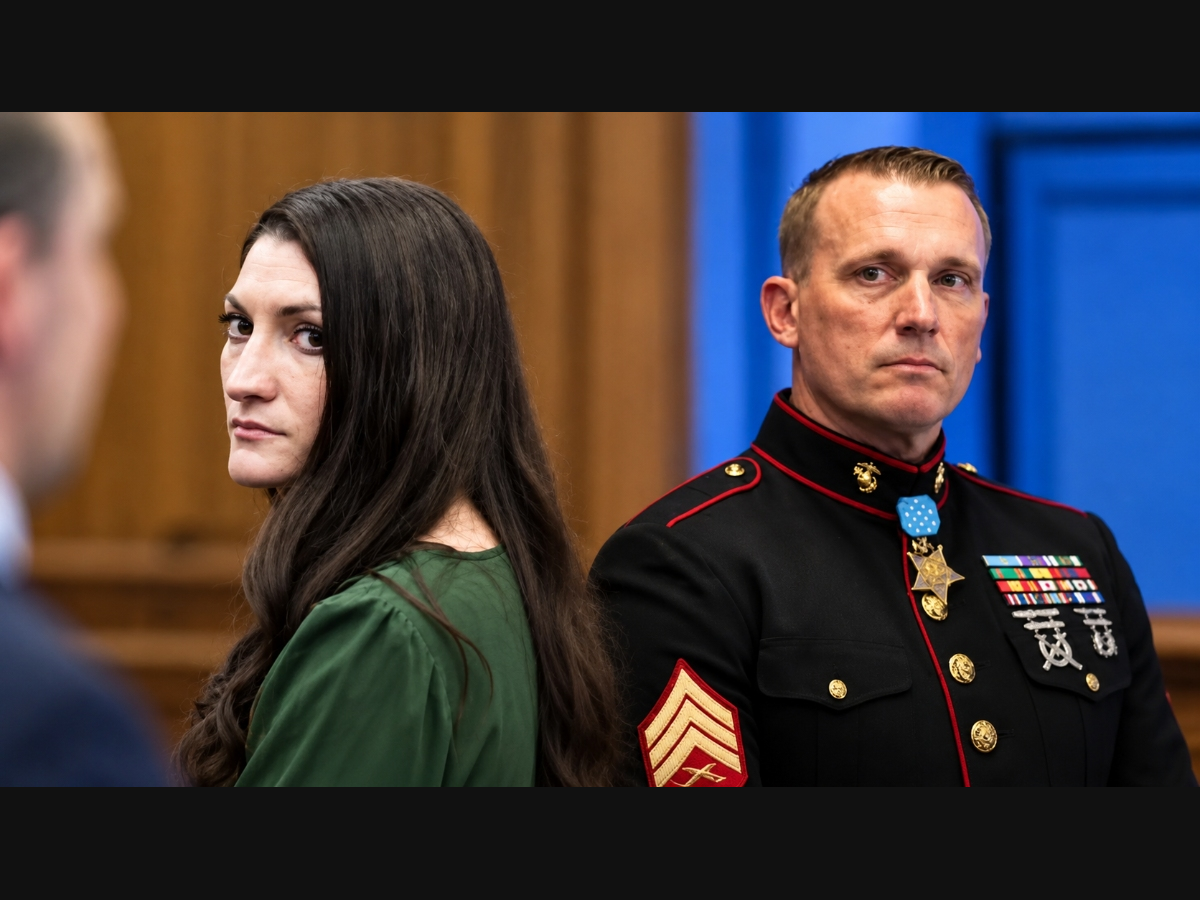
This man is a hero. You do not join the Marines, you become a Marine, and that honor carries with you until the day you die. Sgt. Dakota Meyer received the Medal of Honor from President Barack Obama in 2011 for running back into an ambush in Afghanistan, five times, to pull out the wounded and the dead. Fifteen years later, he is still one of the clearest examples I know of how one person can make a difference.
Here is what he did this week.
On Friday, a judge in Plymouth, Massachusetts, declared a mistrial in the case of Lindsay Clancy, the Duxbury mother who killed her three children, ages five, three, and eight months, in January 2023. Nobody disputes that she did it. The question at trial was whether postpartum psychosis and the medications she was taking left her unable to know right from wrong. After roughly 38 hours over seven days, the jury told the judge it could not reach a unanimous verdict. She will be back in court on September 29 to find out whether she is tried again.
Find out what's happening in Long Islandfor free with the latest updates from Patch.
That same day, a Fox News reporter described the defense lawyer pointing to the mascara on his suit as proof of how much his client was crying and thinking about her children. Meyer, appearing on the same program, refused to go along with the frame. His answer was that nobody should care how she is feeling, that empathy was being asked for in place of justice, and that the children were the only innocents in the room. He said it plainly: "She knew what she was doing."
You can agree or disagree with him. Plenty of people did both within the hour. What matters to me is that he said it at all, in a moment when the easier move was to nod along and talk about mental health in the abstract.
Find out what's happening in Long Islandfor free with the latest updates from Patch.
There is another part of this that matters to me, and it cuts against my own side of the aisle. The Democratic Party and the liberal legal tradition have long argued that the law is a living document, meant to be read through the changing understanding of a society and its circumstances. I have spent most of my career cautioning against taking that idea too far. But strip it to its core and the principle is this: the letter of the law is not the last word on what is right. Meyer applied that principle exactly as it should be applied, because he did not argue the statute. He argued the children.
What is legal and what is right are not always the same thing. There are moments when the letter of the law, the facts in front of us, and our basic understanding of right and wrong do not line up neatly. Those are precisely the moments when judgment, character, and courage matter most, and when they are hardest to find.
The oath we take in uniform, whether it is a badge or a set of dress blues, is supposed to rise above the politics of the moment. It is supposed to mean something when the situation is ugly, when the honest answer is uncomfortable, and when saying it out loud carries a cost. Meyer paid that cost on live television and will keep paying it in the comments for weeks.
I want to add one thing that comes from my work since I retired, because I think it explains why this moment landed the way it did.
I spend my days studying what artificial intelligence can and cannot do. Ask any of the major AI systems about this case and you will get a careful, balanced answer that acknowledges the tragedy, honors the complexity of postpartum illness, and takes no position. That is not wisdom, it is the absence of anyone standing behind the words. A machine cannot be shamed, and it cannot lose a friend, a job, or its good name for what it says. It has no moral, professional, civil, or criminal accountability for its output, and so it has nothing to risk and nothing to spend. Courage is what you pay when you say the true thing anyway. That is a human transaction, and it is the one thing no software will ever do for us.
That is why a named human still has to sit at the center of every consequential decision, in a courtroom, in a squad car, or in front of a camera. Not because machines are bad at reasoning, but because they are incapable of caring what it costs.
If there is a finer recent example of one person standing in that space and reminding the rest of us what moral courage looks like, I have not seen it.
Thank you, Sgt. Dakota Meyer, for speaking when it would have been easier to stay silent, and for reminding us that one person can still make a difference.
*Retired Police Officer Basil C. Puglisi
P.S. This is written for all those who still serve and are bound by policies that keep them from speaking up or sharing their point of view. I know what that silence costs. I carried it for twelve years.