Neighbor News
OpenAI Picked the Electricity Story. The Duttons' 1923 Rebuttal Is Hard to Ignore. (Yellowstone vs AI)
Distribution of access is not distribution of power. Real augmentation requires authority, not just access, and the plan does not meet that

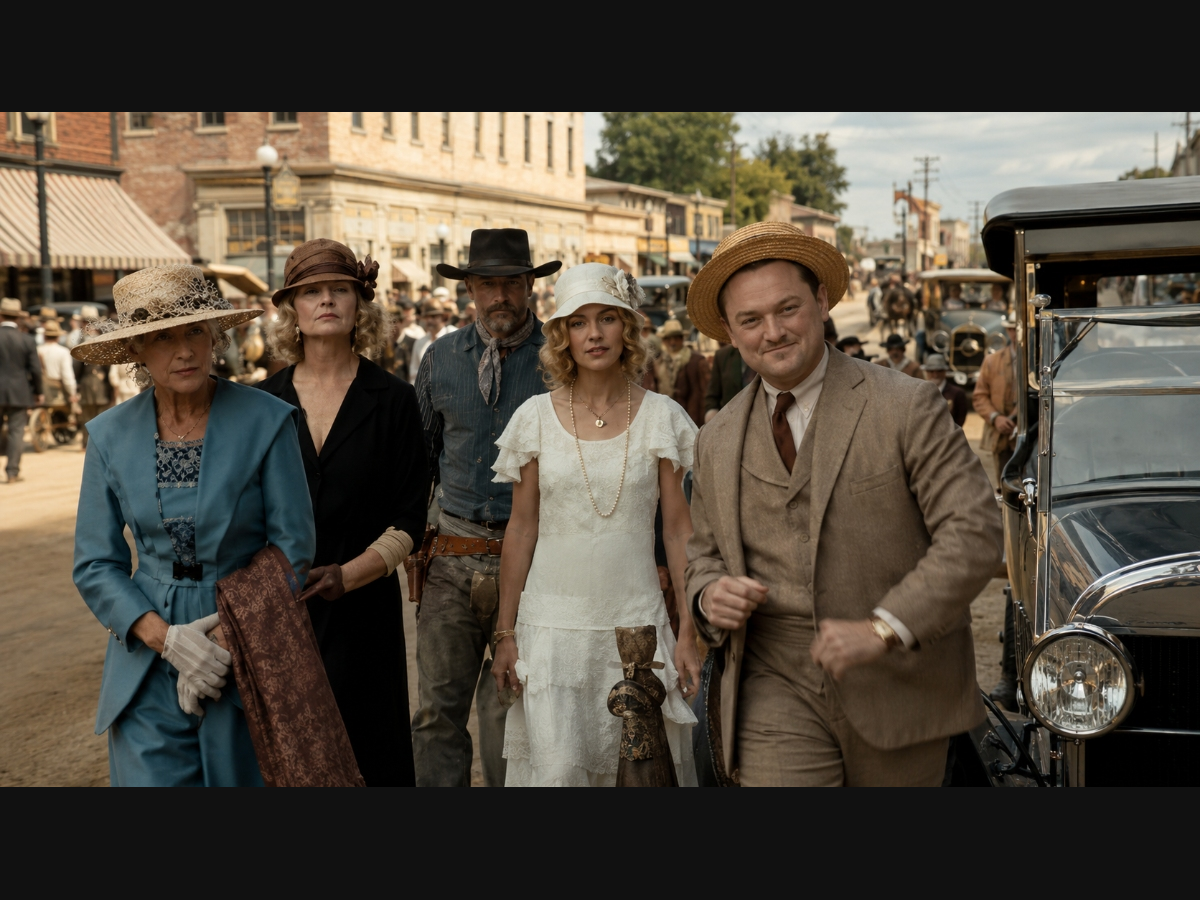
On June 8, 2026, OpenAI published a plan titled "Built to benefit everyone," signed by Sam Altman and Jakub Pachocki. It opens with a familiar image: electricity reaching a rural American town in the 1920s, the day extended by light, the hardest household labor reduced by pumps, appliances, and refrigeration. The argument is that AI will follow the same arc, and that access, once it spreads widely enough, becomes prosperity. The same week, a different scene from the same decade was moving through feeds, this one written for the television series 1923.
In the episode "The War Has Come Home," the Dutton family takes the buggy into town and stops at a storefront, where a salesman is showing a washing machine and a refrigerator, and where they learn that electricity will soon reach the valley they live in. He explains the motor and the cold compartment, the conveniences that supposedly hand time back to the family. When they ask what the machines cost, the salesman explains that the appliances are rented and the power is sold. Jack Dutton names the arrangement, that the company sells the current and then rents everything that runs on it. John Dutton Sr. sees the other side of the ledger, that once the family buys in, "we're not working for ourselves anymore." The scene is fiction. The accounting is not.
The OpenAI plan says many of the right things, and they deserve to be represented accurately rather than caricatured. It rejects full automation as a goal. It argues that as systems grow more capable, the human role grows more important, setting direction, making tradeoffs, and applying judgment. It warns that concentrated power creates fragility while broadly shared power makes societies more resilient. It even concedes that the incentives around commercial and national competition are hard to escape. That last admission is the honest one, and it is also the problem.
Find out what's happening in Long Islandfor free with the latest updates from Patch.
The question that decides whether AI extends people or displaces them depends on neither raw capability nor stated good intentions. The operative variable is method, not technology.
The same frontier models can be built into two very different architectures, and the divergence is a design choice rather than a property of the technology. One treats AI as a replacement for human labor; the other treats it as infrastructure for human capability, which is what augmentation means in practice: the system extends what a person can do while that person keeps binding authority at the decision point. What separates the two is not the model. It is who holds the checkpoint, who owns the model and its updates, and what the incentives reward. Both run on the same code, yet only one keeps the human as a developing participant, and the choice compounds across time. A plan that promises the second while building toward the first has not resolved that tension; it has postponed it.
Find out what's happening in Long Islandfor free with the latest updates from Patch.
Read the plan's own goals against that distinction. The first is an automated AI researcher, which the plan says would run in tandem with OpenAI's own researchers and remain steerable, accountable, and connected to people, with a significant fraction of the company's research expected to run on AI systems by March 2028. Taken at face value, that is augmentation. Yet in tandem under one company's control still shifts the origination and iteration of research away from unaugmented human teams, and it does not, on its own, place binding authority anywhere a person outside that company can reach.
The third goal is a personal AGI for every person on Earth, and it is presented as empowerment. A personal instance could extend its user, which would be augmentation. The catch is the delivery. The underlying model, its updates, and its safety cases stay under one organization, so the arrangement distributes access while the standard, the cadence of changes, and the off switch stay in one place. The same answer meets the broader objection that open weights and wide API access already spread power. They spread access, and sometimes capability, but whoever trains and serves the model still owns the reasoning standard and the ability to change it or withdraw it. That is empowerment language wrapped around replacement structure, and it delivers a subscription, not a stake.
There is a cleaner way to see the gap. In the standard taxonomy, Ethical AI sets values, what a system should do; Responsible AI shapes machine behavior, how it should operate; and AI governance exercises human authority, the question of who decides. The plan speaks fluently in the first two registers, values and behavior, and it is mostly silent on the third. The first two rely on voluntary corporate compliance, and only the third builds structural accountability. A values document and a behavior document amount to a commitment, and a commitment is not a checkpoint. A checkpoint is the only thing that holds when the promise meets the competitive pressure the plan itself admits is hard to escape.
The timing sharpens all of this. The same day the plan went out, OpenAI announced that it had confidentially submitted a draft S-1 to the Securities and Exchange Commission, a step that gives it the option to pursue a public offering, with timing undecided. In late 2025 the company completed a recapitalization that placed its for-profit business under a public benefit corporation, OpenAI Group PBC, controlled by the nonprofit OpenAI Foundation. On the build itself, Altman described a 30 gigawatt, $1.4 trillion infrastructure ambition in late 2025, and by early 2026 reporting indicated a target closer to $600 billion in compute through 2030, with that same reporting describing a shift toward renting much of the capacity rather than building it. A document warning that concentrated power creates fragility arrived beside one of the largest concentrations of capital and compute in the history of the industry. When control over decision systems gathers inside a small number of corporations, the digital equivalent of "too big to fail" moves from finance to cognition. A promise to distribute the benefits does not, by itself, distribute the authority.
This is where the Dutton family was right, and where the distinction the plan blurs becomes the whole point. Distribution of access is not distribution of power. Renting everyone a personal AGI spreads the appliance. It does not spread ownership of the current, the standard, or the off switch. The question the family asked, who are we working for, is the same question governance asks in plainer terms: who decides. If the answer sits inside the company that also sells the service, the benefit can be wide while the power stays narrow.
A real answer is structural, and it is unglamorous. It requires a human who holds binding authority at the decision point, a sign-off that a release date or a latency target cannot override. It requires more than one independently trained model in any workflow that touches a real decision, so that no single architecture owns the way machines reason, because concentration in the development pipeline produces convergence in the output. And it requires accountability that does not rest on a company keeping its word, something as concrete as a public log of the model changes that move a decision threshold. None of that works against AI. It is simply the engineering that makes a promise of broad benefit safe to believe.
OpenAI chose the electricity story, and it is a good story. Light at night was real, and so were the appliances, and so was the prosperity, arriving eventually and unevenly. But the writers of 1923 understood something the plan leaves out. The salesman is not lying about the washing machine; he is quiet about the meter. The future the plan describes is not inevitable, and it will not arrive on its own terms. It is a choice between two architectures built from the same code, and the difference is whether the people it benefits also hold the power to govern it. The Duttons asked who they were working for, and the plan still has not answered it. We already know how that scene ends when no one asks who owns the light.