Neighbor News
Before You Panic About AI, Read What Actually Happened Last Week
The AI Apocalypse and Trump's AI HOAX claim.

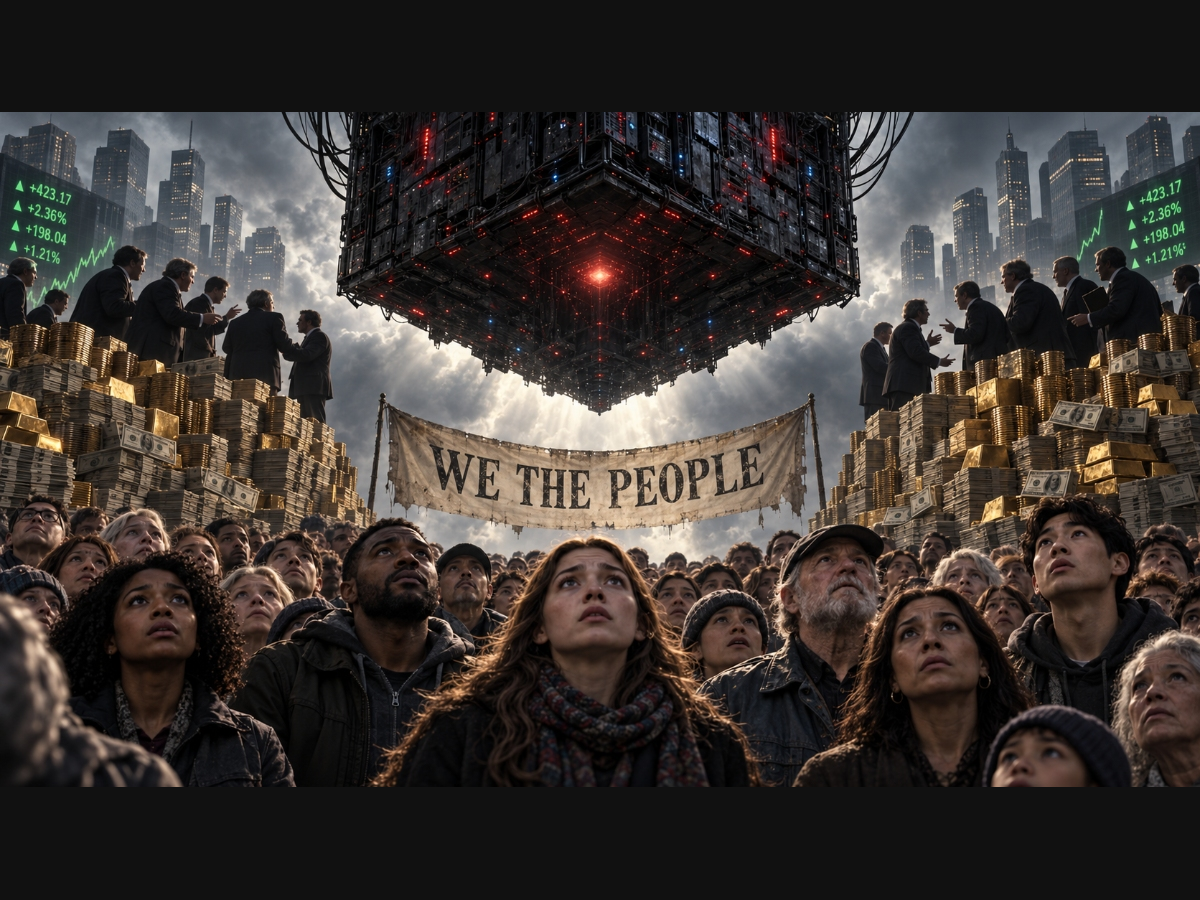
Your neighbor thinks it's a hoax. Your cousin in Brooklyn thinks it's the end of the world. They're both partly right, and the real story is stranger than either one.
If you spent any part of last week hearing that artificial intelligence is about to end humanity, and also hearing that the whole thing is a scam cooked up by tech companies, you were not imagining it. Both things were said, loudly, by people with serious credentials, inside the same nine days.
Out here, a lot of people heard the President call it a hoax and nodded. Over the bridge, a lot of people heard researchers warning about extinction and got scared. The gap between those two reactions is about as wide as the Sound.
Find out what's happening in Long Islandfor free with the latest updates from Patch.
Here is the thing nobody told you.
You do not need to pick one. And you do not need to go hide in a bunker.
Find out what's happening in Long Islandfor free with the latest updates from Patch.
But there is something real underneath this, and it is already showing up in places that have nothing to do with robots taking over. It is showing up in insurance policies. It may already be in yours.
What actually happened
Start with the sequence, because the order matters more than any single quote.
On September 8, a 27-year-old researcher quit his job at one of the top AI companies in the world and said so in public. He had worked at two of them. He wrote that neither was behaving responsibly and that both were gambling with our lives. He walked away two months before his stock vested, which in that industry means leaving a life-changing amount of money on the table to make a point.
Within a week, the person in charge of safety at his old company said publicly that he puts the odds of AI wiping out humanity above 10 percent in the next ten years. One of the scientists who helped invent the technology went on the BBC and said that number was not unreasonable.
Then the CEOs moved. The head of Anthropic called for the whole industry to slow down. The head of OpenAI agreed within hours. So did Elon Musk. Google's AI chief backed the idea.
Then came the pushback. Meta's chief AI scientist mocked it. Mark Zuckerberg refused to join. Nvidia's CEO said the market already handles this and no new laws are needed. And on September 14, the President posted that the whole thing is a hoax, filed right alongside the Russia investigation and his impeachments.
Six positions. Nine days. Everybody serious. Everybody pointing a different direction.
Why the hoax claim isn't as crazy as it sounds
This is the part where I lose some readers, and I'd ask you to stay with me.
There is a real question buried in the President's post, and most of the coverage skipped right past it.
When, in the history of American business, has an industry's leadership begged Washington for rules that could put their own companies out of business?
That is a fair question. And it has an uncomfortable answer.
Companies ask for regulation all the time. They ask for it when the rules cost their competitors more than they cost them. They ask when it turns a scary unknown legal bill into a predictable, budgetable one. They ask when the paperwork is expensive enough to keep smaller competitors from ever getting started.
None of that requires anybody to be lying.
And it is not just one side saying this. David Sacks, who advises the President on technology, pointed straight at legal liability and told the CEOs to stop pretending their motives were purely noble. The Wall Street Journal editorial board pointed out that nothing is stopping these companies from slowing down on their own, and the suspicious part is when they ask the government to make everyone else do it too.
Why it's still not a hoax
A hoax means somebody is lying on purpose. That is a specific accusation, and it does not hold up here.
Senator Thom Tillis, a Republican from North Carolina, put it plainly when reporters asked him about the President's post. It's not a hoax, he said. It's a real thing.
His reasoning was sharp. What CEO with a responsibility to his own shareholders stands up in public and asks for limits on his own company, unless he actually believes the danger is there?
That is a good argument. I think it is the best one available, and I still think it points the wrong way. Because if you follow the money, asking for those limits turns out to be the financially smart move, not the costly one.
Here is why.
Follow the insurance
In June 2024, a major commercial insurer called W.R. Berkley stopped covering AI. Not some AI. Any claim, from any company, involving any AI, including AI buried inside software the business owner never even knew was there.
In January of this year, Verisk, which writes the standard policy language most of the American insurance industry uses, published AI exclusion language any carrier can add at renewal.
A whole new market sprang up to sell the coverage the big carriers walked away from.
Now put that next to the calendar. On December 9 of this year, a new European law makes AI companies strictly liable for what their products do. Strictly liable means the person suing does not have to prove anybody was careless. They just have to prove the product was defective and it hurt them.
Four CEOs called for a coordinated industry slowdown roughly three months before that law kicks in, holding risk their own insurance companies refuse to touch.
That is not a hoax. That is math.
And here is the part that should actually get your attention, because it is not about Silicon Valley at all.
If you run a business on Long Island and you use AI to write customer emails, screen resumes, handle scheduling, or answer the phone, your general liability policy may have quietly picked up an AI exclusion at your last renewal. Most people would never notice. It is one endorsement in a stack of paper the broker called routine.
That exclusion does not care whether you were careful. A company with a full AI policy and a company with none get the exact same language.
New York already did something about this
Here is the local part, and almost nobody covered it.
On June 1, New York's court system put a rule in place that answers this question better than anything coming out of Washington.
The rule, called Part 161, does not ban lawyers from using AI. It does not even make them tell the court they used it. What it does is simpler and tougher. When a lawyer signs a filing, that lawyer owns every word in it. If the AI invented a fake case, the signature is still the signature, and the sanctions land on the person, not the software.
New York skipped the argument about disclosure entirely and went straight to accountability.
That is the model. Not slowing down the technology. Making sure a real person with a real name is standing at the point where the decision gets made, and making sure there is a record of what happened.
So, the bunker
You can leave the canned goods where they are.
Nobody in this fight, not one person with an actual company and actual shareholders, is calling for a full stop. The people calling for a full stop are columnists and academics with no quarterly earnings to file. That tells you something about how seriously the extinction talk is being taken by the people doing the talking.
What is real, and what is already happening, is quieter. Insurance companies pulled back from AI two years before any CEO asked for a slowdown. A new European liability law lands in December. Your policy may have changed. Your kid's school is using these tools. Your doctor's office probably is too.
None of that is the robot apocalypse. All of it is worth paying attention to.
The question worth asking is not whether AI will destroy the world. Nobody can answer that, including the people insisting they can.
The question is whether, when one of these systems makes a decision that affects you, there is a human being with a name who is accountable for it, and a record showing what happened.
Right now, for most of it, there is not.
That is the thing to fix. And you do not need a bunker to help fix it.
Basil C. Puglisi, MPA, is a Long Island resident and an AI governance consultant. The full analysis behind this piece, with all of the documents and sourcing, is at basilpuglisi.com/ai-hoax.
#AIassisted using the HAIA Ecosystem | CC BY-NC-SA 4.0