Seasonal & Holidays
NYC's Newsworthy Stories Of 2021: COVID, Cuomo, Adams, Floods
Take a look back at five stories that gripped New York City during 2021.


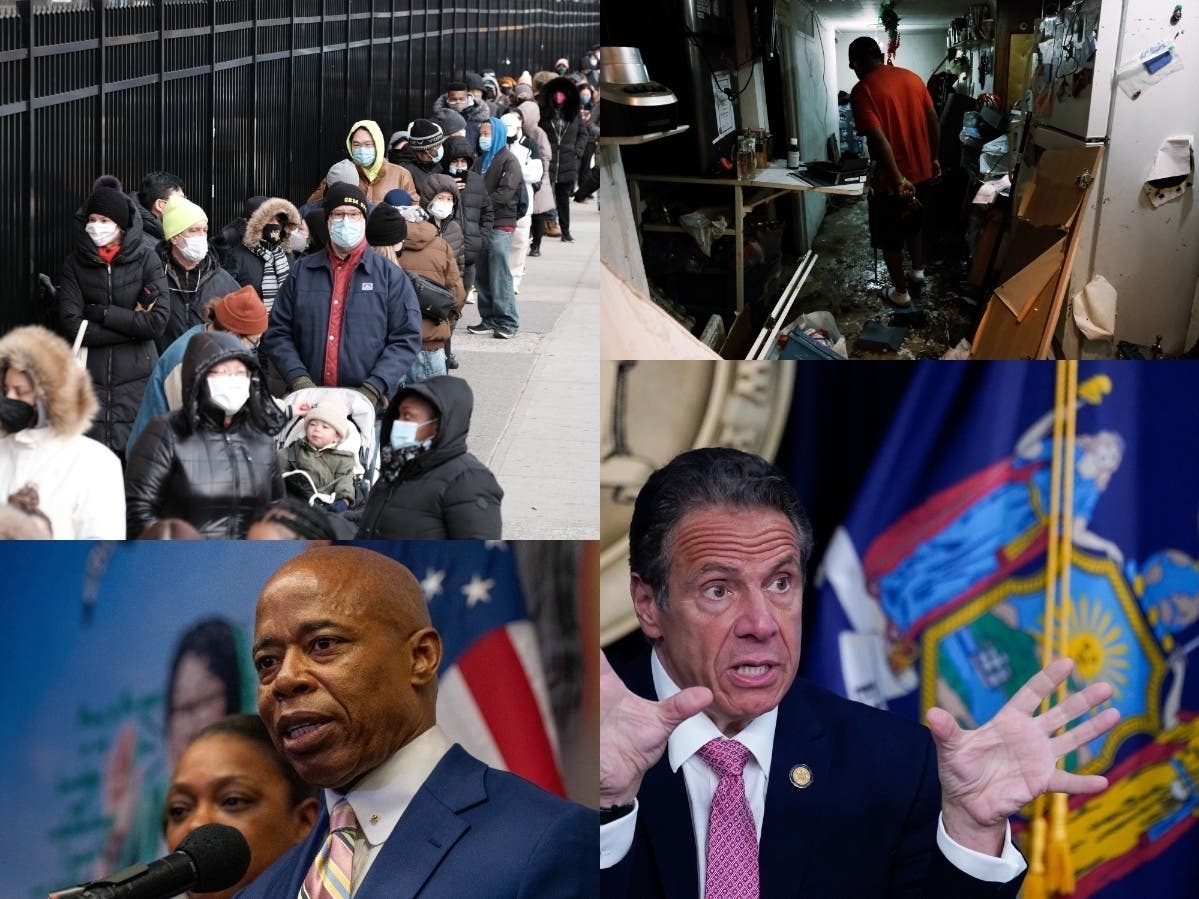
NEW YORK CITY — New Yorkers who hoped 2021 would be a return to pre-coronavirus pandemic "normal" certainly had a wild ride.
COVID-19 levels seesawed between highs and lows, a swirl of scandals forever loosened the grip former Gov. Andrew Cuomo had on the city and New Yorkers chose a new mayor to take over for Bill de Blasio.
Join Patch for a look back on another historic, impactful year in New York City.
Find out what's happening in New York Cityfor free with the latest updates from Patch.
Vaccinations, delta, mandates, omicron
The year began in the midst of a monster COVID-19 holiday surge and a potentially game-changing vaccination program just beginning.
Find out what's happening in New York Cityfor free with the latest updates from Patch.
The vaccination drive had a rocky start — few people were eligible at first, supplies kept running out and the pace was achingly slow.
But eventually things picked up enough that by the spring indoor dining had returned, schools reopened, masking restrictions lifted and more than half of New Yorkers were vaccinated.
The spring gave way to a hoped-for "hot, vaxxed summer." More and more places became only for people who received a jab of coronavirus vaccine — including a line-up of star-studded "homecoming concerts" — and coronavirus levels fell.
But a spike in cases from the highly contagious delta variant and lagging vaccinations prompted de Blasio to enact a spate of ever-strict mandates designed to encourage more shots.
The mandates began with one for health care workers and eventually culminated in a rule that encompassed all municipal employees, including teachers, cops and firefighters
"Climbing the ladder" is what de Blasio called it — and he credited the moves with getting the city's workforce 94 percent vaccinated. By the year's end, he reached the highest rung: all private employees.
That final mandate proved controversial, but soon New Yorkers had another worry: the omicron variant.
Omicron dovetailed with a holiday surge of mostly delta COVID-19 cases. The resulting spike in coronavirus infections — tens of thousands a day, in fact — prompted fear in New York City, flashbacks to March 2020 and so-far-unrealized worries of revived restrictions.
Eric Adams win the mayor's race
"I'm the mayor," Eric Adams told a crowd of cheering supporters on Nov. 2.
Adams, the borough president of Brooklyn and a former NYPD captain, had reached that Election Day triumph after a year-long contest.
He started the race as a front-runner, but had to battle against former presidential candidate Andrew Yang and spate of other Democratic challengers in a crowded primary.
Their primary battle served as a referendum of sorts on de Blasio's eight years as mayor. During one debate, most candidates pointedly refused to ask for de Blasio's backing.
Adams jockeyed early on for the top spot with Yang, who advanced a similar broadly appealing moderate and tough on crime agenda. And Maya Wiley, who held a strongly progressive platform, gained steam.
But it was Kathryn Garcia, who grew support by stressing her technocratic competence, that eventually put her neck-and-neck with Adams.
In the end, Adams won a narrow victory over Garcia after successive rounds of ranked-choice voting — and one major error by the city's Board of Elections.
Adams quickly consolidated support after his primary win — so much so that his Republican rival Curtis Sliwa repeatedly, and colorfully, had to stress there was still an election in November.
But Sliwa never had a chance — barely an hour after polls closed, the race was called in Adams' favor.
Adams will be the second Black mayor in the city's history. He pledged to be a "GSD mayor" — an acronym for "get sh-t done" — and hasn't been shy about what he'll build on de Blasio's, and what he'll leave behind.
Cuomo's downfall
As one Patch story put it, New Yorkers could be excused if they thought the city had two mayors: Bill de Blasio and Andrew Cuomo.
Cuomo was never shy about wielding power in the New York City, from embarking on massive construction projects to enacting coronavirus lockdown measures.
His rivalry with de Blasio often turned petty and, in the mayor's telling, "hurt" the city.
That all changed as Cuomo faced a swirl of scandals.
First, revelations came out that confirmed accusations his administration hid the true number of nursing home deaths during the coronavirus pandemic. Then, a number of women accused him of sexual harassment.
The accusations in March loosened tongues of officials long-frustrated by Cuomo's heavy hand, if not outright bullying.
Cuomo, who denied the accusations, resisted calls to resign and implored New Yorkers to wait for the results of an investigation by Attorney General Letitia James.
So for five months, Cuomo went on as governor. Then in August, James dropped a bombshell — a 165-page report that found he sexually harassed 11 women and his administration fostered a toxic workplace that enabled the harassment to occur.
Cuomo tried to argue the probe was flawed and a political hit, but the damage was done. One-time supporters peeled off and an impeachment inquiry became inevitable.
Then Cuomo did what had seemed unthinkable — he resigned.
"I think given the circumstances the best way I can help now is I step aside and let government get back to government," he said. "And therefore, that's what I'll do."
Gov. Kathy Hochul took over and, besides being New York's first woman governor, hit a reset on what had been a dysfunctional relationship between the state and city.
De Blasio twisted the knife on his long-time rival after speaking with Hochul.
"It was just a good, healthy, sane — I emphasize the word 'sane' — conversation which I truly appreciate," he said.
Cuomo's woes didn't stop. Albany authorities filed a forcible touching charge against him in October. Prosecutors walked back on the charges, but a criminal case still looms.
Hurricane Ida floods NYC
A blow from the remnants of Hurricane Ida left at least 12 dead, brought the wettest hour in New York City's history and flooded subways, streets and apartments.
The devastating storm Sept. 1 startled New Yorkers who only had a few hours warning, if that. And even then, its severity caught the city utterly by surprise.
Hochul, de Blasio and other elected officials said the following morning — as city dwellers sifted through their flooded apartments — that Ida presented a glimpse of a bleak future in which climate change makes once-unprecedented weather events commonplace. Indeed, the city broke several rainfall records in the days before the storm.
Climate change became a tangible reality for New Yorkers.
"Even the morning after we're still uncovering the true depth of the loss, the human loss," Hochul said.
Patch documented the toll exacted on families in Inwood.
One family's apartment was one of four below sidewalk level on Nagle Avenue that was flooded and destroyed the night of Sept. 1.
A man had to break a window to escape, a dog survived by floating on a couch, a cat drowned and everything was covered in sewage, Patch reported.
A family fled to a friend's house across a sunken inner courtyard that quickly turned into a lake of sludge.
"My God, we lost everything and now what will become of us? We have nowhere to go," one told Patch.
Scaffolds remain
Some things remained stubbornly unchanged in New York City, despite all the changes over the past year.
Patch took a deep look one of these problems: scaffolding, also known as "sidewalk sheds."
Roughly 500 sidewalk sheds across the city have been up more than a year, according to data. Those included a West Village building's two-decade-old, on-and-off scaffolding.
One Harlem building has been covered by scaffolding for 15 years.
"People move here and they don't even know what the building looks like," a resident, Mike Dorset, told Patch.
There is a fix — a long-stalled bill to enforce a 90-day limit to take down scaffolding.
"With over 300 miles of scaffolding crowding City sidewalks, hurting local businesses, and ruining quality of life, the time is now to enact this reform," Council Member Ben Kallos said
Get more local news delivered straight to your inbox. Sign up for free Patch newsletters and alerts.