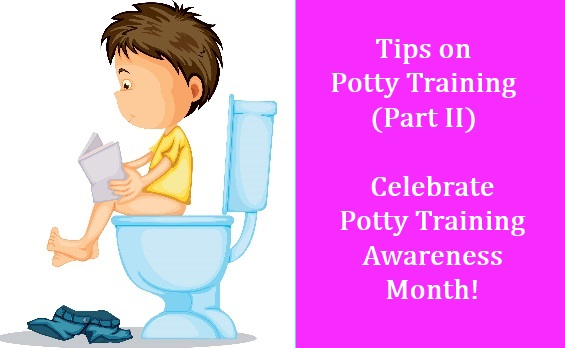
Our earlier blog focused on “hindsight,” otherwise known as the toilet training experiences I had with my own children. To recap, start toilet training based on what your child can do, NOT by age. Once you have identified that your child is ready, teach him the words you want him to use regarding toileting (ex: pee or urinate). One time, a family wanted me to use the words “urinate and defecate.” These are words for little ones, but the child managed to learn both the words and the process. Also, talk to your little one about the sensations of elimination, such as “When your diaper is wet, it feels warm.”
Do kids really need a potty chair? While this isn’t necessary, I find that little ones prefer to have their feet on the floor because it helps them to feel more stable. Being able to have their feet on the floor also helps them bear down during a bowel movement. I bought one for my daughter after a negative “potty experience.” My mother-in-law was holding my daughter on the big toilet one day. After my daughter was successful, my mother-in-law was so excited that she started to clap her hands! Well, in the celebration, my daughter slipped into the toilet and got her bottom wet! She wasn’t happy and the joy turned to tears.
Tips for Success:
- Acknowledge all progress with a hug, a kiss, and a few words of praise. But don’t overdo and don’t let go to clap!
- NEVER criticize or punish your child when unsuccessful.
- Maintain a good humored and casual attitude.
- Some children may want a parent or caregiver to keep them company while in the bathroom. Others, like my two-year-old granddaughter, may “want their privacy!”
- Remember: this is just another developmental task for the child to accomplish. Do not engage in power struggles.
Toilet training can be frustrating for both you and your child. Try to make it as relaxed and fun as possible. Over the years, I have noted that there seems to be this “sweet time” of opportunity between the ages of 24 and 36 months. Before 24 months, some aren’t physically ready. After 36 months, children learn to use toileting as a "bargaining tool.”
Find out what's happening in New Rochellefor free with the latest updates from Patch.
There are some great books about toilet training that you can read to your child. Some examples are:
- Everyone Poops by Taro Gomi
- Once upon a Potty by Alona Frankel
- A Potty for Me by Karen Katz
- The Princess and the Potty by Wendy Cheyette Lewison (my granddaughters loved this one!)
After four children and five grandchildren I can say with confidence that ALL children are individuals, and each learns at his or her own speed. In the meantime, remember what my mother-in-law always said, “When they walk down the aisle they won’t be wearing diapers!”
Find out what's happening in New Rochellefor free with the latest updates from Patch.
If you missed our first blog on the topic, you can find it here.
Donna Morrison is an seasoned mom, grandma and early childhood expert. She currently serves as the Director of Early Childhood Programs for The Guidance Center of Westchester.