Politics & Government
Few Options For Storm-Rocked Hashamomuck Cove Residents
A taxing district could be the only way to find solutions as lawmakers show little support for local sponsorship.



SOUTHOLD, NY — After years of swirling debate and raging storms that have left residents of Hashamomuck Cove facing dire circumstances they say could mean the loss of their homes, a roundtable to discuss possible solutions ended with homeowners looking at an erosion control taxing district as what seems as though it may be their only option.
After the recent "bomb cyclone" slammed the North Fork, a fishing shack that has stood since the 1920s at Hashamomuck Cove was smashed, battered and completely washed away. Bulkheads were destroyed, homes severely damaged — and residents cried out for help at a town board meeting.
Residents, led by Lynn Laskos, had asked for a roundtable discussion on a plan pitched by the United States Army Corp of Engineers before the town board made any decisions regarding signing on as a local sponsor.
Find out what's happening in North Forkfor free with the latest updates from Patch.
That meeting was held Wednesday at the Peconic Lane Community Center, with Southold Town Supervisor Scott Russell and members of the town board, New York State Assemblyman Anthony Palumbo, Suffolk County Legislator Al Krupski, Mark Woolley, representing Rep. Lee Zeldin, members of the ACOE, the New York State Department of Environmental Conservation, the Suffolk County Water authority, both town and county officials, and a large contingent of Hashamomuck Cove residents all in attendance.
Lynn Laskos, who has led the call for help at Hashamomuck Cove for years, was unable to attend due to a prior commitment and could not be reached for comment.
Find out what's happening in North Forkfor free with the latest updates from Patch.
Russell and the town board discussed signing on to a beach replenishment project as a local sponsor at Tuesday's work session. Board members said they felt the financial price tag was too high. Russell, however, said his decision was based on the fact that the town should not put the cost of replenishing private property on the backs of taxpayers.
"It is important for me to stress that the issue isn’t about the cost for me. It is that I do not support the use of taxpayer dollars to pay for the restoration of private property at any cost," Russell said. "I understand that there is a separate goal and that is to protect County Road 48. To me, the optimum word is 'county'". The road, he said, "is not owned by or maintained by the town which means it is for the county to address. The town does not have and should not have any role here."
Suffolk County Commissioner of Public Works Gil Anderson and Suffolk County Chief Engineer Bill Hillman agreed that the county had no current plan to sign on as a local sponsor to the project pitched by the United States Army Corps of Engineers.
Anderson said the county DPW would do whatever was necessary to protect the road, but said there was no intent for the county to sign on a local sponsor. "My main concern is County Road 48. We are not expecting to be a local partner," he said.
Suffolk County Legislator Al Krupski, when asked by resident Kathleen Phelan if the idea of the county acting as a local sponsor was off the table, said he hasn't said "no" yet, but added that it did not mean that he'd agreed. The ultimate decision, both Krupski and Anderson said, lies with Suffolk County Executive Steve Bellone.
The meeting began with Stephen Couch, deputy chief, planning division, ACOE, discussing the "Coastal Storm Risk Management Feasibility Study," which is currently in draft form.
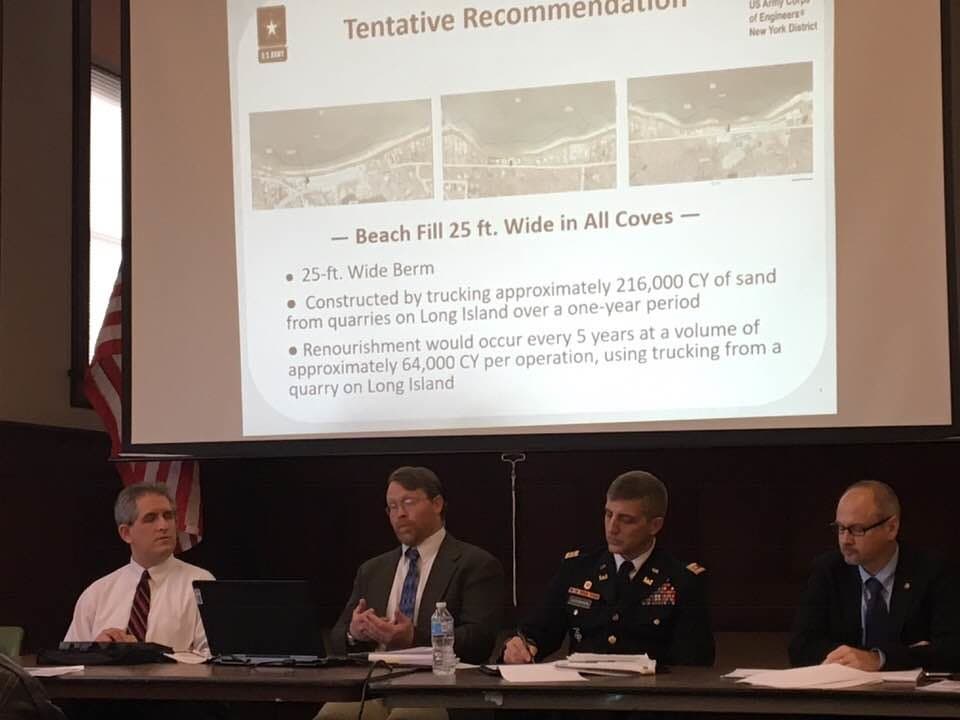
Couch gave a presentation, beginning by stating that the day was not meant to focus on final results, but instead, to give details of the proposed project as they currently exist. Some details, he said, could change as the ACOE moves forward.
"The main purpose of this is to initiate some discussion on local sponsorship," he said.
The Army Corps of Engineers, he said, cannot commence with the project without a local sponsor.
The ACOE, he said, works with New York State, which must also identify a local sponsor.
According to research, Couch said the three coves, including the town beach cove, Hashamomuck Cove and the cove where the Sound View is located, when confronted with continued storm activity, all have a "high risk" of damage to homes and businesses as the shoreline continues to erode and sea levels rise.
Damage to private property comprises 60% of damage seen so far, Couch said. Other risks posed include an impassable County Route 48, he said.
"There is a real threat to the road and public infrastructure that exists in Hashamomuck Cove," Couch said.
The tentative plan
Couch gave a background of important project dates beginning in 2014, then gave the ACOE's tentative recommendation, which would be a beach fill, with a 25 ft. wide berm in all coves, constructed by trucking in approximately 216,000 cubic yards of sand from quarries on Long Island over the course of a year. Renourishment would then take place every five years at a volume of approximately 64,000 cubic yards per operation, using trucking from a quarry on Long Island, he said.
The proposed cost of the initial construction would be $14,560,000, with 65% of that federal, 24.5% state, and 10.5% covered by local government. The local government's share of the initial cost would be $1,529,000, Couch said.
Then, he added, re-nourishment costs every five years would be $3,640,000, with the town's portion $546,000, Couch said. He added that renourishment could be needed as much as every seven years but as little as every three to four years, based on the area's history.
That number could change, but not dramatically, but did not include costs related to operation and maintenance, which would need to be paid for by the local sponsor, Couch said.
A local sponsor would need to enter into a local project partnership with the NYSDEC, agreeing to provide local cost share and all necessary real estate to build and maintain the project, idemnify the state and federal governments, operate and maintain the project and maintain public access.
The letter of support would be non-binding, Couch said; the commitment to fund would come with the execution of the local PPA.
For homeowners, perpetual beach easements would be necessary for all parcels where sand will be placed, and the Army Corps would need to obtain real estate to provide public access to all areas of the project, Couch said.
"We're not taking your land. You still own your property," he told homeowners, adding the public was not allowed on the property beyond the easement, which would remain in perpetuity.
Operation and maintenance costs for the town could include administrative — maintaining public access to the project area, prohibiting any excavation, alterations or construction, assuring that there's no drainage onto the beach, removing all trash and debris from the beach, permitting the Army Corps and state access to the project and participating in an annual inspection — maintenance, such as grading and reshaping the beach to its original elevations to mitigate erosion, erecting sand fencing to keep sand from blowing, bi-annual inspections for beach-width measurements, and reporting.
The group then explained the law pertaining to flood control and coastal emergencies and the eligibility requirements under which the Army Corps would pay 100% of storm damage. Those eligibility requirements include when a storm exceeds project design level, the project has been maintained and inspected and repair of damages is economically justified.
Sue McCormick of the NYSDEC agreed that she could not proceed without a local sponsor.
And, the panel added, the local sponsor has to be willing to embark upon eminent domain proceedings because without 100% of easements, the project cannot be built.
McCormick added that if there was a storm and the decision has been made to go with the Army Corps, Federal Emergency Management Administration funds could not be sought. "You can't double dip into two pots," she said. But properties adjacent to the project could still pursue FEMA funding.
The Army Corps is still finalizing project details, with a final report expected this summer and, if all moved ahead, a local sponsor was found, and approvals were met, construction projected to potentially begin in fall, 2020.
During the question and answer period, Hillman pointed out that 216,000 cubic yards of sand would mean just short of 7,900 truckloads full of sand, heading to the project site, with some of that distance and impact on local roads. Every five years, another 4,300 trucks could be expected for the renourishment, with 80,000 lbs. of sand, heading back empty. "That's a lot of trucks," Hillman said.
He added that costs to the town or county due to any litigation over eminent domain or other issues could be significant.
Councilwoman Jill Doherty asked about who would pay to repair the roads impacted by the trucking of sand.
McCormick said the area impacted by the project is photographed before and after but it's difficult to prove on a roadway that damage was caused by the project due to normal wear and tear.
Couch said after work in downtown Montauk due to Sandy he did not recall any issue with road damage.
Krupski spoke and said a lot of issues had not been quantified that would need to be before the county could sign on as a local sponsor. He suggested the Montauk shoreline hardening project be considered to help give examples of how the Army Corps would react in different scenarios.
He asked at what point the local sponsor would have to pay for damage to a project after the Army Corps had completed the work; the ACOE maintained that the projects were not directly comparable since geo textile bags were used to cover the sand in Montauk.
Russell said: "The question is who makes the decision on when more sand needs to be brought in — and who will pay for it." He said costs in Montauk that were once thought to be $100,000 per year had escalated to $1 million. Local sponsors "could find themselves in that kind of hole," he said.
The Montauk project has no renourishment component and is different than Hashamomuck Cove, McCormick said.
"One commonality is expectation of cost and actual cost," Russell said.
McCormick said operation and maintenance costs, not renourishment, are costs handled by local sponsors and that cost share is annualized, so one year it may cost as much as what was budgeted for 10 years, in the case of a major storm.
"Who can predict what Mother Nature will do?" she asked.
"That's the crux of the issue. Who can predict what Mother Nature will do?" Russell said.
Councilman Jim Dinizio questioned the additional, unseen maintenance costs of the project, including potential eminent domain legal expenses. He also questioned the environmental impacts of 216 cubic yards of sand washing into the Long Island Sound.
As long as the same grain sized sand was used, Couch said he believed there would be "no long term impacts."
Dinizio said building a sand bar would impact the shoreline further west. "We're not in a vacuum," he said.
Krupski also discussed the issue of access and parking.
Couch said the access plan requires access points every half mile and parking but said that most might be centered at the town beach, with less impact in the area of residential homes at Hashamomuck. Not all details were finalized, he said.
One component of the plan is that the beach would have to be public and open to all but that the town could set fees and hours of use for that public usage. "Public does not mean free," he said.
Doherty said increased public access would mean additional policing and cost.
Russell asked why the initial 50-ft. berm plan was not an option any longer; Couch said the tipping point was the challenges of trucking in 500,000 cubic yards of sand.
Councilman Bob Ghosio asked why trucking in sand was proposed and not revetment or shoreline hardening; Couch said this was the most cost effective option.
Kevin McAllister of Defend H20 emphasized the importance of beach compatibility, "key" to the project.
McCormick said project biologists said there was to be no dredging of the Sound.
"But dumping of dredge spoils in the Long Island Sound is okay?" Southold Town Engineer Jamie Richter asked.
Ghosio asked, if there was no support for state or local sponsorship, what options remained.
McCormick suggested erosion control taxing districts, such as what exists in Bridgehampton, Sagaponack, North Sea, and Quogue.
Couch said the ACOE could also go with a locally preferred plan; or that towns could just reject the ACOE plan and turn to FEMA.
Also discussed was a continuing authority plan, for smaller sized projects, and a shorter process.
Doug Hardy said the plan was temporary. "In 2065 the Army Corps walks away, when the sea level will be approximately one foot higher and Southold Town will be stuck again," he said.
"Any solution is temporary," Couch said.
Resident David Corwin expressed the frustration of homeowners that the town and county were not expected to serve as local partners.
Palumbo asked if there was any way for a municipality to appeal for economic hardship, stating that Southold Town was in a far different position than South Fork towns to handle catastrophic storms.
One resident asked if the town had considered the loss in property taxes lost if the houses were gone; Kate Phelan said that number was over $1 million. Russell said the town's portion was closer to $240,000.
Dinizio said not everyone's house would be lost and some could be moved back. He maintained that the board needed to make a decision based on numbers and taxes didn't factor into the decision.
When asked about County Road 48, Krupski said it's a major artery and would never be abandoned by the county.
"We will do whatever we have to to protect the highway," Anderson said.
"The only ones with skin in the game is myself and my neighbors," one resident said.
Russell said he'd organize a meeting in the coming weeks to help educate residents on how to set up a taxing district. Others asked how soon a taxing district could be formed; Russell said he didn't see it happening in the spring of 2018 as an act of the state legislature would be needed.
"But it's better than no sponsor at all," he said. An autonomous taxing district, Russell said, would need to be created by state law. The district would need its own commissioners and would be responsible for managing the district, administration and formulating their own budgets. In that scenario, the town would only serve as a tax collection agent but would have no role in administering/managing the district, similar to a park district or fire district, he said.
Patch photos by Lisa Finn.
Get more local news delivered straight to your inbox. Sign up for free Patch newsletters and alerts.