Politics & Government
Supervisor Russell Outlines Reasons For Possible Moratorium On New Wineries, Breweries, Distilleries
BREAKING: Scott Russell suggested Tuesday that a working group might convene to discuss questions before any movement toward a moratorium.


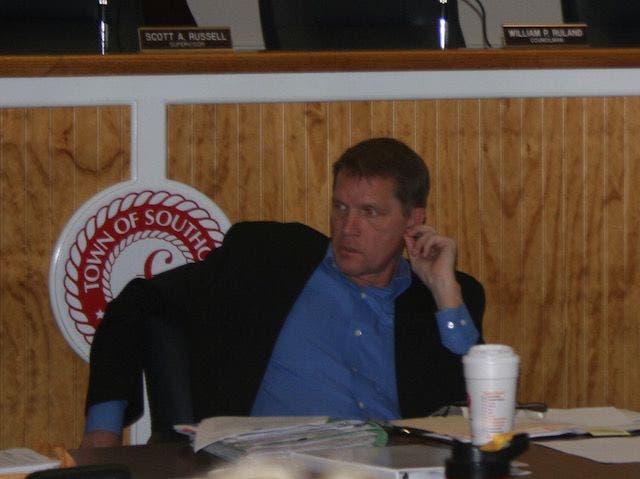
SOUTHOLD, NY — A small crowd turned out Tuesday morning as Supervisor Scott Russell outlined a new proposal for a moratorium on wineries, distilleries and breweries in Southold Town.
Russell began by explaining that he first met with the town's ag advisory committee and the Long Island Wine Council and then, had a meeting with key town staffers last week about the idea for a possible moratorium.
Russell said his intention was to present his ideas to the Wine Council in written form, and then, have the group come back to him with their own issues, input and concerns to be addressed.
Find out what's happening in North Forkfor free with the latest updates from Patch.
Once that input is received, the supervisor said he'd distribute it to the board so we "have an understanding of some of our goals."
Russell then laid out his reasoning for why he believes a moratorium would be helpful.
Find out what's happening in North Forkfor free with the latest updates from Patch.
First, he said, the town has no definition of "winery." While the New York State Department of Agriculture & Markets does, he said, the town code "simply refers you to Webster's", a dictionary definition.
In addition, the supervisor said, there is no definition for "brewery" of "distillery" in the town code; New York State Governor Andrew Cuomo, he said, "is putting a lot of emphasis on promoting breweries and distilleries."
And, Russell said, there is no definition currently for a tasting room in the town code. "The problem is, if it's not in the code, it's presumed to not be allowed," Russell said. "We need to change, if we are going to look at new models, at some of the proposals that are starting to come through."
Other definitions needed included one that would provide clarity for ag retail; currently, he said, there are "inconsistencies in the code," with wineries allowing retail sales on site. Breweries and distilleries could presumably want the same, Russell said, but while the light industrial zones currently allow for retail in the halo zones for every business, they do not allow that use for wineries, he said.
The whole code, Russell said, needs to be revisited.
Traffic patterns and other quality of life concerns also need to be carefully weighed, Russell said.
"Unfortunately, we have a lot of issues with country roads, limousines, buses that are too big. They're not just going to wineries, breweries and distilleries, but they do fuel a lot of that and we need to look at the infrastructure of the town and maybe start limiting where they can go," Russell said.
Another issue is whether alcohol can be sold at a farmstand, Russell said.
The thought, the supervisor said, is that a moratorium is needed because the issue is global and comprehensive and all changes should be included on one document.
"The problem is this one-at-a-time, past and glue approach hasn't worked," Russell said. "You don't see the cumulative impact of all those changes. Everyone has a right to see where we're going from a global perspective."
For example, he said, in order to get a brewery license in New York State, 20 percent of those hops have to bought from New York State growers; the concern is whether or not the town would want to allow for retail uses if production isn't taking place in Southold, he said. Currently, winery and farmstand code in town requires on-site production.
Public input is also critical, the supervisor said.
"There are costs whenever you expand industry," he said.
In addition, Russell said, while he does not believe NYS Ag and Markets should "dictate zoning. . .we can't ignore them, either."
Justice Louisa Evans asked if there are any applications currently before the town; Russell said he thinks there "are a few pending" for all three uses.
The supervisor said he'd also like to take a look at the town's special events legislation.
Councilman Bill Ruland said he's "not a big fan" of a moratorium but that he'd like to see a group discussion with goals of what the town would like to accomplish set out.
Councilman Bob Ghosio said it's "an important conversation to have," not just for quality of life, but for health and safety. His concern was with applications that might be currently in the pipeline. Russell said any applications currently in the pipeline could potentially be exempt from any moratorium.
The planning department, Russell said, expressed the belief that a moratorium was "the way to go" as they are dealing with the issues more than anyone else.
The supervisor suggested a working group be convened. When recommendations are received from the Long Island Wine Council and the Long Island Farm Bureau, those issues can be discussed.
Sal Diliberto, former president of the LIWC, refrained from comment after the meeting; he said his comments would be made directly to the town board.
At the work session, he said, "From our point of view, the specific purposes" for a moratorium, "are what we really want to see."
Last week, with an eye toward putting the brakes on a rapidly changing landscape on the North Fork, Russell first announced plans to ask the town board whether they would support a moratorium on all new wineries, breweries and distilleries in town.
"I believe that we have needed a moratorium to update a very outdated insufficient code for some time. I have been raising these issues since the State of the Town address," Russell said. "Southold really needs to take charge of our future and adopt code that ensure we stay on that path. These industries are growing and there are new applications seemingly every day. We need to plan for them and make sure that such growth doesn't erode the quality of life this community is entitled to."
He added, "We need some clarity. And we need to stop and factor in the growth of new industries such as breweries and distilleries," he said.
Current code, Russell add, doesn't allow for such uses in agricultural zones and a discussion needs to be had regarding whether or not they should be allowed, and what zoning is most appropriate.
When asked about the proposal, Ali Tuthill, executive director of the Long Island Wine Council, said, "At this point we don't have enough information to make an official statement."
Russell added, "I look forward to having the Wine Council as partners as we draft new code. I have already asked them for suggestions on what they would like to see addressed."
The Long Island Farm Bureau responded last week: "We at Long Island Farm Bureau are very concerned at the possibility of a moratorium on craft beverage businesses. We plan to work with Southold Town to explore proactive and educational approaches to address some of the concerns regarding wineries, breweries, distilleries and cideries. The craft beverage industry is an area of agriculture that has a lot of interest and has received enormous support from New York State. It would be disappointing to see the growing sector stunted by a moratorium," said Jessica Anson, public policy director, Long Island Farm Bureau.
Russell said there's a need to look at the industry and how it impacts the entire community, including such concerns as traffic and quality of life concerns. "I think we can promote and support the industry and at the same time make sure we develop good code that balances the needs of the industry with the overriding concerns of the community."
No action will be taken at Tuesday night's town board meeting, Russell said.
Get more local news delivered straight to your inbox. Sign up for free Patch newsletters and alerts.