Politics & Government
Police Chief Outlines Immigration Policy Rewrite; Councilman Puts Human Face On Trump Support
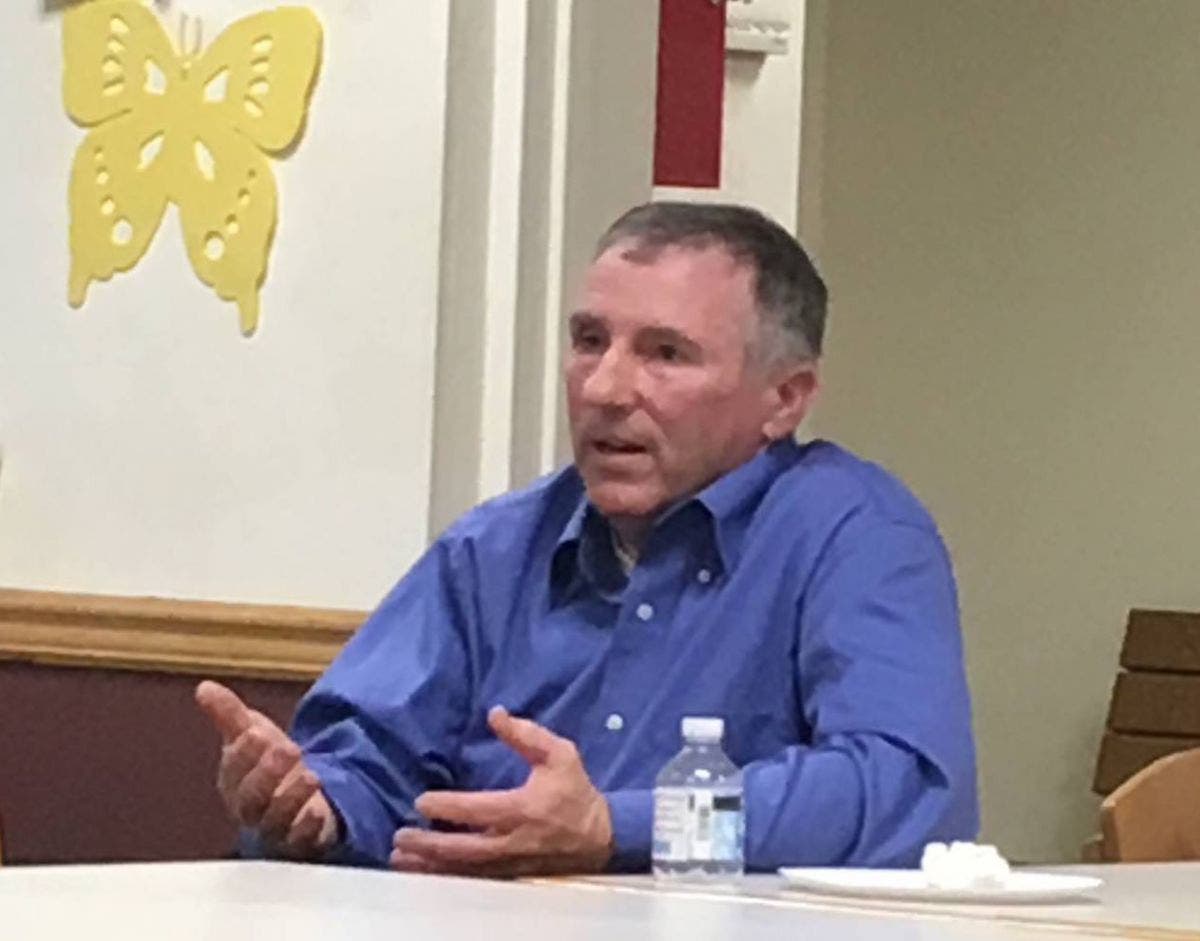
"The other side of the story is very real." Southold Town Councilman Jim Dinizio, who says businesses can't compete with illegal immigrants.


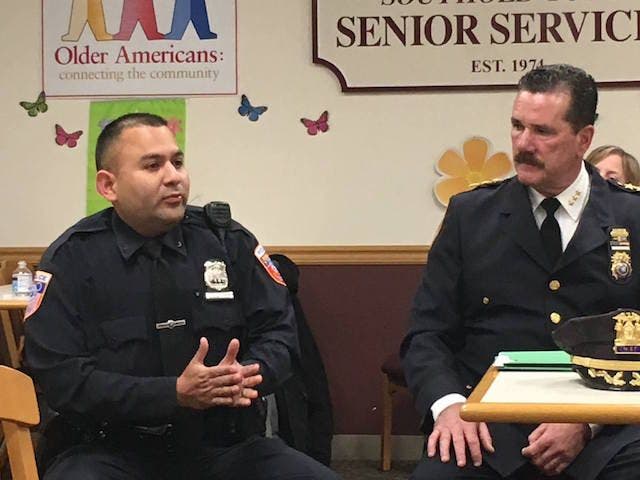


MATTITUCK, NY — Southold Town once again took steps to open the lines of communication between police and the community at the third "Synergy" meeting held Thursday night at the Human Resource Center in Mattituck.
The event, attended by elected officials including Southold Town Supervisor Scott Russell and Councilman Jim Dinizio, brought together police and the community to discuss fears and concerns, as well as solutions.
Russell began by thanking the Southold Town Anti-Bias Task Force, one of the "hardest working" groups of individuals in town.
Find out what's happening in North Forkfor free with the latest updates from Patch.
He said the Synergy events were critical, "especially in these times."
Sonia Spar, co-chair of the ABTF, agreed and said a message of respect was imperative.
Find out what's happening in North Forkfor free with the latest updates from Patch.
The event was once again moderated by Suffolk County Community College's Jim Banks, coordinator of multicultural affairs, and also chair of Southampton's anti-bias task force. The public brought up issues they found troublesome and discussed how to address them.
"We are not going to agree on every point or perpective," Banks said. "It's our way to establish communication with law enforcement and engender some improvement, as well as see what kinds of solutions we might come up with to address those particular concerns."
One man asked about communication with local schools. Southold Town Police Chief Martin Flatley said there was good discourse between school officials and the police department, with programs in the schools. The town, he said, also has a job shadowing program every year where kids can come and observe police officers. Talks are given in schools on drugs use and how to identify signs of drug use, Flatley added.
The DARE program, Flatley said, is still in force, and while it may seem to some that the program starts early in sixth grade, it's important to get the prevention message across when kids are young and and foster positive ties with law enforcement.
Dave Bergen, Suffolk County Community College Associate Dean for Educational Resources, asked about gang presence in local schools.
Flatley said there are some concerns in school district, students "who are 15,16, the prime age for recruitment." Calls have come in a few times when some have "noticed what they thought was gang activity," he said. Flatley added that recently, Suffolk County Police led a presentation on gang activity for teachers, staff and administrators so they know what to look for regarding gang activity and how to report it.
Information on gangs and gang activity is kept in an in-house database, Flatley said.
Another woman asked what the top three concerns students and faculty have, and if police had noticed an increase in "fear and vulnerability in some students because of the current challenging environment we're living in."
Flatley said the issue was a significant topic of conversation at the second Synergy meeting held in Greenport; the chief said there are definitely fears in the immigrant communities. "Families have been put in the position of having to make arrangements or children, should they be deported. It's upsetting, I'm sure, to families and everyone in the school district." Greenport, he added, has larger Hispanic student populations, so concerns are more prevalent there, but there have been some students worried in Mattituck, too.
Rewrite of immigration policy
Flatley said one important focus of the Synergy meetings is to help the community to understand an important message. "We're here to serve and protect. We're not here to target any segment, including immigration. We're here as your local police officers, not here as an arm of the federal government right now."
That's an important message to spread, because the public needs to feel safe if they are a victim or have witnessed a crime, he said.
To that end, Flatley said the police department has rewritten its immigration policy; the specifics, he said, would be spelled out shortly.
Recently, Flatley told the town board that he'd participated in a webcast that all chiefs of police were invited to participate in that was presented by the New York Stat Attorney General's Office offering guidance on immigration issues.
"As a result I, along with other chiefs, have rewritten our Department General Orders on the handling of immigration issues," Flatley said.
He presented those orders to the town board and the Greenport village board in an executive session and the public will be able to access that order with a Freedom of Information Request moving forward; the media will also outline the details when available, he said.
The document should be distributed to officers on Friday, he said.
One basic tenet of the document, Flatley said, is that Southold Town will "not be entering into any agreement with the federal government to do immigration work. They are still out here and we will share information when appropriate but we are not set up to do immigration work." To enter an agreement with the federal agreement, the police department would have to train with Immigration and Customs Enforcement and be able to let them supervise the town's enforcement, specialized enforcement the Southold Police Department is not set up to handle.
The document also sets up rules for what happens when an undocumented person is arrested. An undocumented person will only be held on an ICE retainer if there is a judicial warrant for that person; a document signed only by an ICE official is no longer enough to hold a person under the Fourth Amendment, he said.
A person can be detained if they have been deported and re-entered the country illegally, or convicted of certain crimes or pose a threat to national security, Flatley explained. The document sets out how to cooperate with ICE officials and under what circumstances, he said.
"It's not a crime in this country to be undocumented," Flatley said.
Russell said while it's not a crime, "it's a civil violation and there's a legal component to that."
Part of the rewrite addresses street encounters, Flatley said.
"Officers should not stop and interrogate or investigate solely on immigration status," he said.
Russell said the town didn't create the policy but simply outlined the law. "We're a criminal police force that focuses on crime, not civil issues," he said.
Spar said having conversations such as those at the Synergy events is important so the community at large feels protected by police and the stance of the town and police department is understood.
Others added it would be helpful to have that stance and policy outlined on the town's website.
"We need white men to address people of color," Banks added.
Russell explained that while there is often a misconception that the police force and town employee roster is largely comprised of white individuals, there is a civil service exam that must be taken and a list that must be adhered to, a list that is "color blind."
Banks said minorities should be encouraged to take the test. Russell and Loretta Hatzel-Geraci of the North Fork Parish Outreach and the town's ABTF reminded that the town offered a free seminar on how to navigate civil service requirements and get on the list last year, with another in the planning stages.
Others asked questions about an individual arrested who has no identification. Flatley said it's not a crime to have no ID but a person cannot go before a judge before they've been identified; a new scanning technology helps to track down a person's identity if they've been arrested before, he said.
When asked how police would respond to neighbors who complained about "foreign people" next door making noise, Flatley said police would not check on immigration status. "They take care of the root of the complaint," such as noise, he said.
Other questions from the audience involved bullying, dirt bikes and domestic violence calls.
East End united
Banks discussed recent a recent Unity event in Southampton; Southampton residents are working on establishing a welcoming community, he said.
"It's contagious. When people want to be spirited in terms of helping others who may be in crisis," he said.
He added that the New York Civil Liberties Union has brochures and cards for immigrants, detailing their rights.
Hatzel-Geraci said a similar Unity Town Hall event was recently held in Riverhead.
She said in the community, the general public might "not agree with our stance. . .Some are outspoken, and think we should be reporting all undocumented persons. I'm just wondering how prepared we are, the police department and town, to defend our position?"
Russell said there's been some "misunderstanding" of what the town's policy is, which is " to stay the course. We have no intention of declaring ourself a sanctuary city. We don't have the manpower." There had been some misunderstanding, he said, "that we were some quasi-sanctuary city. That's just not the case."
Katharine Schroeder asked how to change the minds of some members of the public who are convinced "the illegals are draining the economy," or others who may believe taxpayers have to pay to educate the children of undocumented immigrants or bear the financial burden of undocumented immigrants' hospital bills. "They're so angry," she said.
"We'll never ameliorate the hatred and racism", Banks said. "But we need to put a lot of energy into recognizing this is a global issue and we have to work every day of our lives to teach pluralism, acceptance and fairness. Some people are un-teaching it, as well. The best way to teach love is to be loving."
Spar added that when elected officials and police use language that's humanizing and respectful, it has a "multiplying effect. Words lead to actions."
Banks said adults who ridicule a particular culture are setting an example their children may follow. Spar said individuals are afraid to even celebrate their unique cultures such as Cinco de Mayo.
"We need to be able to tell people to feel proud of who they are. We all have own heritage, our particularities, that make us who we are."
Banks spoke about a positive ticketing program that would reward youth for positive behavior.
"The fear is both ways"
Southold Town Jim Dinizio, who has said many times that he supports President Donald Trump, said the fear goes both ways.
The grandson of immigrants, Dinizio said he was there to shed light on "the other side of the story."
Many businesses that for years, succeeded and employed a staff that was able to send their children to college, are now gone "because of less expensive labor. Because they would not break the law" and hire undocumented workers, he said.
In his alarm business, Dinizio said, he has to compete with those people who are hiring the undocumented workers for less. "Try to see the other side of the story. The other side of the story is real," he said.
Banks said automation and other issues had come into play, not just immigration, in shuttering many longtime businesses.
Dinizio said his mother grew up Irish in West Dublin in Greenport. "It wasn't a fancy place with million dollar homes, it was where the Irish lived across the tracks." America, he said, has long been a melting pot. He said he's the first to enjoy a Cinco de Mayo celebration, just like San Gennaro festivals. But, he said, "Some people have been hurt by the policies that our own government refused to enforce. That’s where the problem is. If people have a forum they need to hear the other side."
Banks said the focus needs to be on identifying solutions.
Some said a list should be made of the five top goals, others said children needed to be taught young about tolerance. Another suggested the town offer cultural sensitivity and diversity training.
"I don't like the world tolerance," Banks said. "I like 'celebration.' Let's celebrate diversity."
Flatley said the town does offer that training, Russell said the town mandates cultural literacy but the training should be offered again. The supervisor also attended an Erase Racism event with members of the ABTF.
Spar suggested police attend the ABTF's annual picnic for an activity with the children, Banks said the county police could also help. Spar added that communication is important, so the public can understand all the efforts the town is making to work toward unity.
Get more local news delivered straight to your inbox. Sign up for free Patch newsletters and alerts.