Community Corner
'We're Drowning In Our Own Urine': East End Officials, Residents Talk New Action Plan to Tackle Nitrogen Overloading
Participants came from all corners of the East End to discuss a new study that some say could mean a solution to nitrogen in local waters



Swimming, fishing, clamming, boating — all are longtime activities integral to the North Fork canvas, the very heartbeat of the area’s long history as a tourist destination, with a thriving maritime economy. The joys and economic promise of local waters are the reason so many have long chosen to live and work in Southold’s cherished corner of the world.
But today, the area’s very core is threatened by nitrogen loading in bays and waterways. Nitrogen overloading, caused by aging septic systems, pesticide use and farming runoff, among other reasons, poses a very real threat to the East End’s way of life.
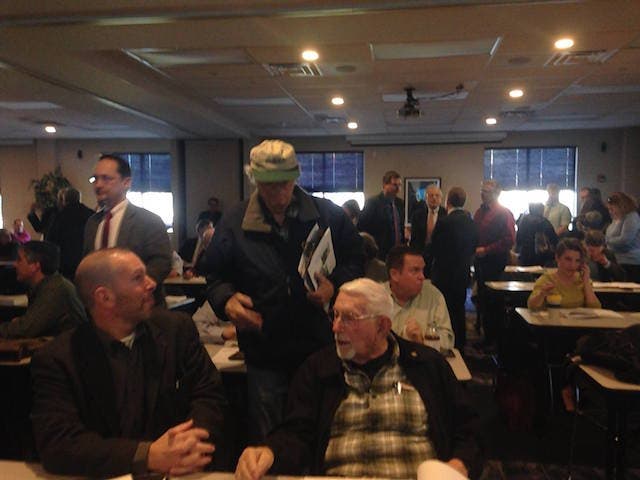
To that end, more than 100 concerned residents, elected officials and environmentalists packed the Suffolk County Community College Culinary Arts and Hospitality Center in Riverhead on Tuesday for a meeting on the New York State Department of Environmental Conservation and Long Island Regional Planning Council’s draft scope on a Long Island Nitrogen Action Plan.
Find out what's happening in North Forkfor free with the latest updates from Patch.
David Bergen, Associate Dean at SCCC, said the program was critical to the East End and all of Long Island.
Meetings were also held in western Suffolk and Nassau Counties.
Find out what's happening in North Forkfor free with the latest updates from Patch.
And the key word, all involved said, was “actiion.”
James Tierney, Assistant Commissioner for Water Resources for the NYSDEC, said the standing-only room crowd was testament to the critical nature of the issue. The goal, he said was to determine how “we can, together, attack the nitrogen problem in a deep, serious and meaningful way — and get actual results, sooner than later.”
Although the overall timeline for the “locally-owned, developed and delivered” plan is four years, the aim is to focus on short-term goals.
“This is not a study to be placed on a shelf. This is an action plan,” said John Cameron, chairman of the Long Island Regional Planning Council. “We are looking for early action, no regret items.”
The first phase, he said, will include data collection, including studies that have been done on the East End, to determine where the problems lie. Stakeholders will need to work together, lending their voices to the discussion, he said.
“Sewering everything” isn’t always the answer, Cameron said, especially on the East End. “We need innovative and strategic ways to change the paradigm,” he said.
Describing organic and inorganic contamination, Cameron said nitrogen is complex and can “travel” with other chemicals such as pesticides and personal care products. “It’s important we deal with it now and address the overall problem or we will not be sustainable and, in the future, the environment and the economy will continue to degrade.”
Peter Scully, regional director of the NYSDEC, said sewering isn’t a realistic solution on the East End, but added there is a need to move away from cesspools and look toward innovative advanced wastewater treatment system pilot programs, such as 19 currently in the ground.
The approximately 272,000 cesspools that predate septic systems need to be replaced with advanced wastewater treatment systems, he said.
He discussed a potential countywide wastewater management district but said without new funding sources, the problems would not likely be addressed.
An overview was given of the LINAP, which will provide an assessment of conditions based on existing data, including groundwater quality and quantity and surface water quality. The plan will aim to determine nitrogen load reduction targets as well as alternatives and strategies to meet those targets; the scope may be modified as conditions evolve, the document states.
First steps include watershed analyses, sub-watershed delineation, development of nitrogen loading estimates, characterization of waterbody residence times, identification of tiered priority areas, estimation of preliminary load reductions for surface waters, evaluation of development of load reduction goals for public water supplly wells, review of wastewater alternatives and preparation of a draft wastewater plan.
The full term plan will include a more rigorous analysis, detailed modeling, water quality and ecological endpoints and cost analysis.
Working groups will be formed, with public input critical, all agreed.
Comments on the draft scope are due by February 19.
Elected officials, residents and civic leaders waited up to three hours for their chance at the podium, echoing a deep and abiding concern for the health of the East End’s water bodies.
Suffolk County Legislator Al Krupski said no one should be surprised by the large turnout. “The people who live here want to be sure their quality of life is maintained and improved,” he said.
People are afraid of sewering because it will mean increased density, Krupski said, adding that the draft scope of the plan should state that there will be no increase in density.
Also, the plan needs to look at local drainage codes, Krupski said, important because rainwater needs to be recharged.
Modeling can’t be done with old information and outdated data, Krupski added. “We have to look at current land use and practices that are way different from my father’s and grandfather’s generation.” Preservation past and future needs to be taken into account, he said.
Southold Town Supervisor Scott Russell said there’s been a lot of discussion about an “action” plan. “Everyone wants to take action but what we need to do, needs to be driven by science. There’s a lack of data.”
While there is a need to identify problems and solutions, Russell said implementation would be “a very expensive proposition.”
To that end, he noted that the Community Preservation Fund is set for extension, with up to 20 percent utilized for nitrogen reduction.
In addition, he said, “We’d like to see financial commitment from the state of New York.”
A proposed $5 billion environmental protection bond needs to be put on the ballot in November, Russell said.
Riverhead Councilwoman Jodi Giglio pointed to the large number of manufactured home parks that sit adjacent to rivers. After last year’s fish kills, Giglio said those homes, as well as new properties proposed in Riverside revitalization efforts, could hook up to Riverhead Town’s sewer district if Suffolk County made a commitment to take the county center and jail off the Riverhead’s sewer system.
Robert Hanlon, president of the Orient Association, stressed the urgent need for action.
“We’re drowning in our own urine,” he said.
Orient, he said, is a small island tethered to Southold by the causeway .”We stand on land fed by a shallow aquifer soaked with nitrogen laden waste.” Nitrogen, he said, threatens water, shellfish, recreation, jobs and the public’s health.
Despite years of discussion, thus far, there has been no meaningful implementation of solutions, he said. “We’re still moving in the wrong direction.”
Failing septic systems — that the county still okays for rebuilding — farming runoff and fertilizer all need to be addressed with solutions, including education, best practices, and the replacement of outdates cesspools, Hanlon said.
“We need help. The people of Orient are ready and willing to take steps to save our water resources but we need the town, county and state to help us to do this — now.”
Kevin McAllister of Defend H20 applauded the efforts of all on the plan. “We don’t need a study that goes to another study or kicks the can down the road.”
At the end of the day, the answers will come down to local action and “require courage and political decisions,” he said, especially in regard to implementation of fertilizer laws and advanced wastewater treatment systems.
Public participation is integral to the process, he said.
Bob DeLuca, president and CEO of Group for the East End, said the need exists to deal with the issue of grandfathered flow projects approved years ago and to look at cesspool phaseouts. That said, he added, “I’m very hopeful for the future.”
Southold Town Engineer Michael Collins said while there has been a lot of discussion based on “sound science, that science needs to include monitoring. What’s been lacking in the past is we do not have a good measurement of exactly what’s going into our water. Our models are guesswork, at best.”
He added, “It’s one thing to talk about no-regrets actions, but the biggest regret we will have is if we spend the money and we spend it in the wrong way. We’re only going to get one bite at this apple. Monitoring is the key to getting this right. We have to commit to it for the full life of the program.”
Representatives from East End civic groups, the seafood industry, and the landscaping industry also spoke, with landscapers asking to be included in the dialogue so all could work together.
Rob Carpenter of the Long Island Farm Bureau asked that the draft reflect all the strides that have been made in regard to best practices for golf courses and lawn fertilizers. He said missing from the draft is mention of wildlife, such as geese and deer, that contribute greatly to nitrogen loading.
Adrienne Esposito of Citizens Campaign for the Environment said all levels of government need to say “no” to a recent decision by the United States Army Corp of Engineers to continue dumping dredge spoils in the Long Island Sound, a significant source of nitrogen. “The Long Island Sound is not Connecticut’s dumpster,” she said.
Dick Amper, executive director of the Pine Barrens Society, said the plan was “good government. It’s not a study, it’s a plan. And it’s not merely regional, it’s a local plan. I am optimistic,” he said.”The biggest challenge Long Island fces is the capacity to restore our water quality and it starts here. This is a very, very promising project. If it works out this is going to be one of the greatest accomplishments in the history of Long Island.”
Get more local news delivered straight to your inbox. Sign up for free Patch newsletters and alerts.