Home & Garden
Crude-Oil Train Safety Along the Hudson River: Inspections, Response
Gov. Cuomo announced a series of actions; Riverkeeper accuses him of helping oil transport instead of protecting communities.



Another round of targeted crude oil tank car and rail inspections across New York uncovered 93 defects, including seven critical safety defects—one between Haverstraw and Newburgh—that required immediate corrective action, and two hazardous materials violations, state officials reported today.
The inspections March 11 and 12 are the latest in a series of actions that state agencies are taking at the direction of Gov. Andrew Cuomo to protect New Yorkers from the potential dangers associated with the transport of crude oil by freight rail companies.
“Our administration is continuing to hold crude oil transporters to the highest standard of safety, and this latest round of inspections shows that our efforts are making a significant difference when it comes to protecting New Yorkers,” Cuomo said in a press release. “The importance of these inspections is underscored both by the recent rash of derailments and explosions involving crude oil trains in other states, as well as the current lack of tough regulations, which only Washington has the authority to impose. In the meantime, we will continue to remain vigilant and work with all partners to make sure that crude oil is transported safely across the state.”
Find out what's happening in Nyack-Piermontfor free with the latest updates from Patch.
State and federal teams examined 453 crude oil tank cars and approximately 148 miles of track in these inspections, officials said.
Environmental advocacy group Riverkeeper, which has been calling for urgent repairs to deteriorating tracks and rail bridges along the Hudson River, was not impressed. Riverkeeper boat Captain John Lipscomb said:
Find out what's happening in Nyack-Piermontfor free with the latest updates from Patch.
What about the rest of the crude oil rail in the state? Extrapolating from the defects found with 453 cars and only 148 miles of rack yields an enormous number of defects, some critical, still rolling through our communities and along our rivers.
According to the state:
- NYSDOT and FRA track inspectors examined approximately 22 miles of track and two switches along the CSX mainline from Newburgh to Haverstraw. The inspectors found one critical defect – deteriorated cross ties along a short section of track – which has since been repaired. The inspectors also found four non-critical defects, including loose switch bolts and insufficient ballast.”
Riverkeeper responded:
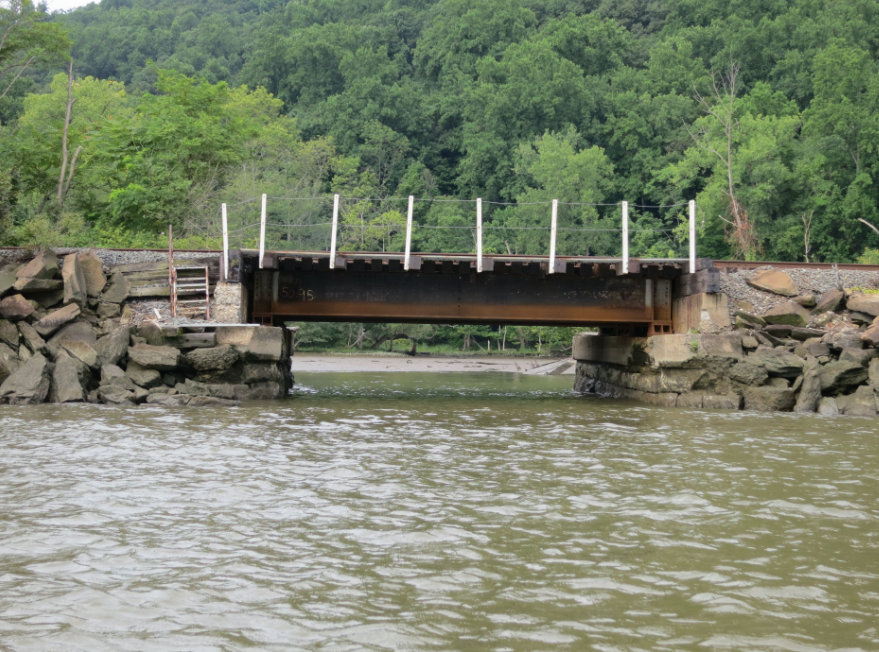
We have documented two degraded rail bridges in this section which were brought to the attention of the FRA by Sen. Charles Schumer. The same bridges were featured in a prime time WABC-TV investigation. A bridge engineer was interviewed and stated that the worst of the two bridges should be taken out of service “immediately.” To our knowledge the Senator has never received a response and these bridges are not discussed in the state’s blitz advisory,” Riverkeeper responded. “Were these bridges inspected or not? If so, did they pass? We, the Senator and WABC would like to see the FRA or NYSDOT inspections report on these bridges, and for that matter, all the rail company owned bridges in NYS over which crude oil passes.
...Note that inspections don’t guarantee at all that there will not be an accident here. In several of the recent derailments and explosions we’ve read in the press that the rails where these accidents occurred had recently been inspected.
According to the state:
“To date, state agencies are working to implement all 12 state government recommendations and have completed five. Specifically, New York State has taken 66 actions to better prepare state and local responders in the event of a crude oil incident as detailed in a progress report released earlier last December.”
Riverkeeper responded:
A fire chief from Maine who responded to the Lac Megantic derailment and fire recently talked to Rockland first responders about what Lac-Megantic was like: he asked “How big is six city blocks for you guys? A lot of buildings are going to be destroyed. A lot of people are going to die.” That’s the perspective of a trained professional who has seen an accident versus a politician’s spin.
In his 2015 Opportunity Agenda, Cuomo detailed proposals to protect New York from the boom in crude oil transportation including to:
- Hire eight new employees for DEC and six for the Office of Fire Protection and Controldedicated to oil spill planning, training and response;
- Increase the fees for oil transported through New York to 13.75 cents per barrel. This is an increase from 12.25 cents for oil imported into the state, and 1.5 cents for transshipped oil, irrespective of whether the oil remains in New York or is transferred on to another State;
- Increase the Oil Spill Response and Prevention Fund by 60 percent, from $25 million to $40 million to ensure the solvency of the fund and provide the necessary funding for staff and associated preparedness costs;
- Move administration of the Oil Spill Fund from the Comptroller’s Office to DEC. This will create efficiencies in the operation of the fund and ensure more money goes to cleaning up spills as well as planning and preparedness operations;
- Establish the New York State Foam Task Force. The State will pre-deploy foam, firefighting equipment, and supplies along rail lines statewide. The State will provide standardized training and support to local agencies to deploy and operate the equipment necessary to fight flammable liquid fires. The State will also continue to increase its own foam capabilities to better supplement and support local resources at any major crude oil incident; and
- Coordinate State, local and industry planning and preparedness. The State’s inter-agency working group will further integrate response planning at the local, county, state and federal levels, and improve coordination of the railroads and terminal operators involved in the shipment of crude oil across New York.
Riverkeeper responded:
...Two trains carrying 3 million gallons each roll down the Hudson Valley through numerous communities and right next to the Hudson every day. At any moment a derailment, spill and fire might occur which could look EXACTLY like the one in Lac Megantic or the derailments and spills into rivers which we’ve seen lately (or much worse).
And $40 million is chump change. The Kalamazoo spill and the Lac Megantic spill cleanups are each over a BILLION now, and climbing.
...Finally, as the Governor touts his inspections let’s not forget that the Governor has given NYS tax dollars to CSX to add passing lanes at Ravena and at other locations across the state. Why are tax dollars being given to multi-billion dollar companies to add capacity for oil trains in our state?
... He isn’t protecting us from the risk of crude oil transport – he’s facilitating it.
Get more local news delivered straight to your inbox. Sign up for free Patch newsletters and alerts.