Schools
Ossining Senior Receives Rising Scientist Award for ADHD Research
John Sukumar was one of five students in the New York metropolitan area to be honored by the Child Mind Institute and CUNY.
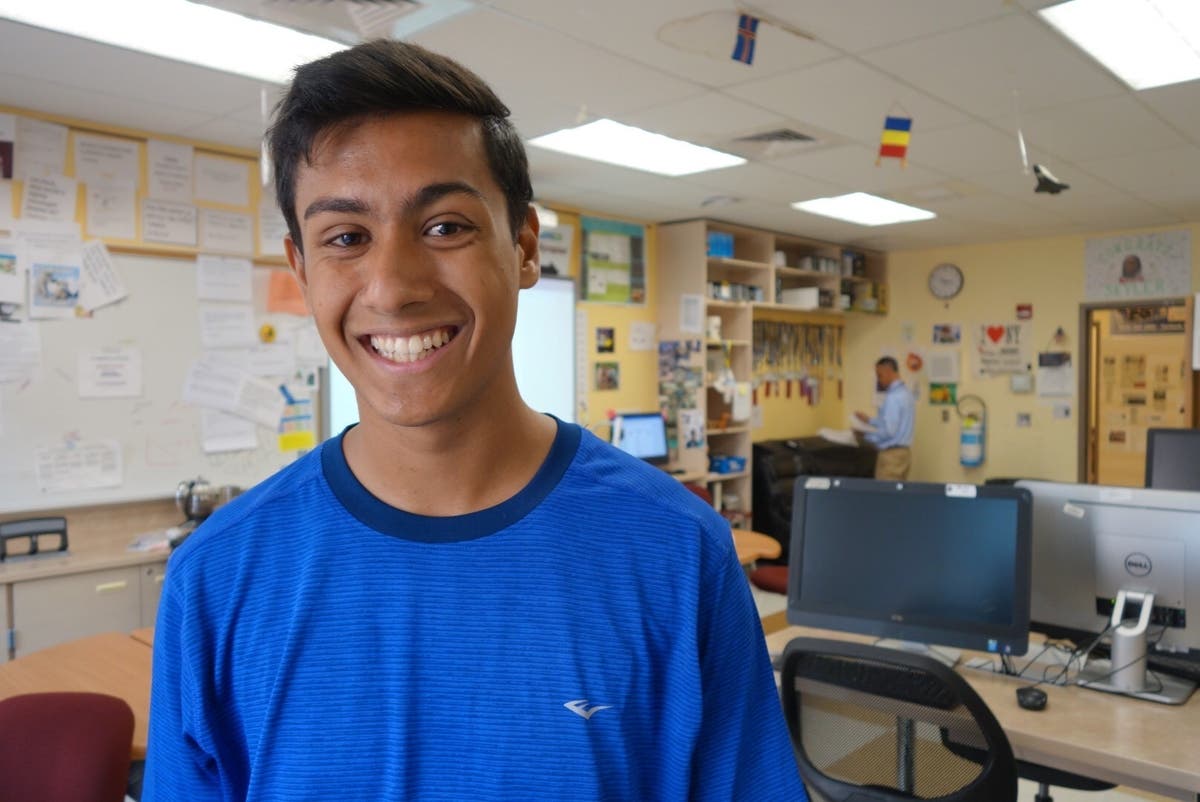

Ossining High School senior John Sukumar received a Rising Scientist Award this month from the Child Mind Institute and the City University of New York for his research on attention deficit hyperactivity disorder.
The Child Mind Institute and the CUNY Graduate Center's Advanced Science Research Center recognize students each year who show exceptional promise in the fields of child and adolescent mental health and/or pediatric neuroscience. John is one of five high school students in the New York metropolitan area to receive a 2018 Rising Scientist Award. The honor includes a $2,000 college scholarship.
This year’s awards were given out at the Child Mind Institute’s “On the Shoulders of Giants” symposium Oct. 18. The 2018 Rising Scientists join 46 prior award winners who have gone on to study at some of the nation’s most prestigious academic institutions.
Find out what's happening in Ossining-Croton-On-Hudsonfor free with the latest updates from Patch.
“Each recipient of the Rising Scientist Award shows drive, commitment and vision for the future of mental health and neuroscience,” said Dr. Harold S. Koplewicz, the Child Mind Institute’s co-founder and president. “At such a young age, these impressive students already have the motivation and the promise to make strides towards changing the way we look at and treat mental health disorders.”
John’s research is on the ability of some people with ADHD to “hyperfocus” on a topic or activity without getting distracted. It is more common for people with ADHD to have trouble focusing on topics for extended periods of time. Because hyperfocus runs counter to the typical symptoms, it is poorly understood and often underrepresented, he said. It isn’t even listed as an official ADHD symptom.
Find out what's happening in Ossining-Croton-On-Hudsonfor free with the latest updates from Patch.
John was diagnosed with attention deficit disorder in 10th grade, and he has the ability to hyperfocus. His mother initially didn’t think he could have the disorder because he was able to focus for hours and hours. “I realized then that it (hyperfocus) was something I had experienced quite often,” he said.
John decided to look into this topic when he began OHS’ Science Research Program. He found that while anecdotally, a sense of urgency and a challenging task are commonly observed factors in inducing hyperfocus, there was no research to back this up. He hypothesized that these two factors would be essential in creating hyperfocus. He recruited volunteers for his study and set up three trials of 40 people each. Each test was at a faster speed than the previous one.
He used the Stroop Effect Test, in which names of colors are printed in colors that don’t match the name – for example, blue could be printed in brown text. That makes it more challenging for someone to correctly identify the name of the color that the word spells out.
“The test is really good at picking up on attention because if you’re more able to focus on what you’re seeing, you brain is better able to pull the two pieces of information apart and correctly press the right answer,” John said.
Based on previous research, he anticipated that the brain would rev up as the test became more challenging, and people who can hyperfocus would perform better than people without the ability.
“My hypothesis was that if you have ADHD and hyperfocus, these gear shifts and time-constraining circumstances would be able to induce hyperfocus and improve accuracy as it speeds up,” he said.
His results, however, were a little inconsistent and didn’t turn out exactly as he had expected. But the scores showed that hyperfocusing strongly correlates with ADHD, he said.
John’s mentor is Dr. Darya Zabelina, who teaches psychological science at the University of Arkansas.
Outside of academics, John is on the cross-country, winter and spring track teams. “I like being in shape. You’re using your whole body,” he said. “I find that especially when I’m running, my hyperfocus is automatically there.”
He is in the process of applying to colleges. So far he is undecided on a major. “I want a chance to look at everything,” he said.
Like his older sister, Claire, John was homeschooled until ninth grade. While the initial transition to OHS was challenging, homeschooling gave him the chance to pursue things he was interested in on his own time.
“I think that’s helped me, especially with my research program, be able to think creatively and break through barriers,” he said.