Schools
Ossining Students Mix Play-Doh, Electronics and Popsicle Sticks in Summer Academy
This is the third year of the summer program, which is funded by the Ossining MATTERS educational foundation.
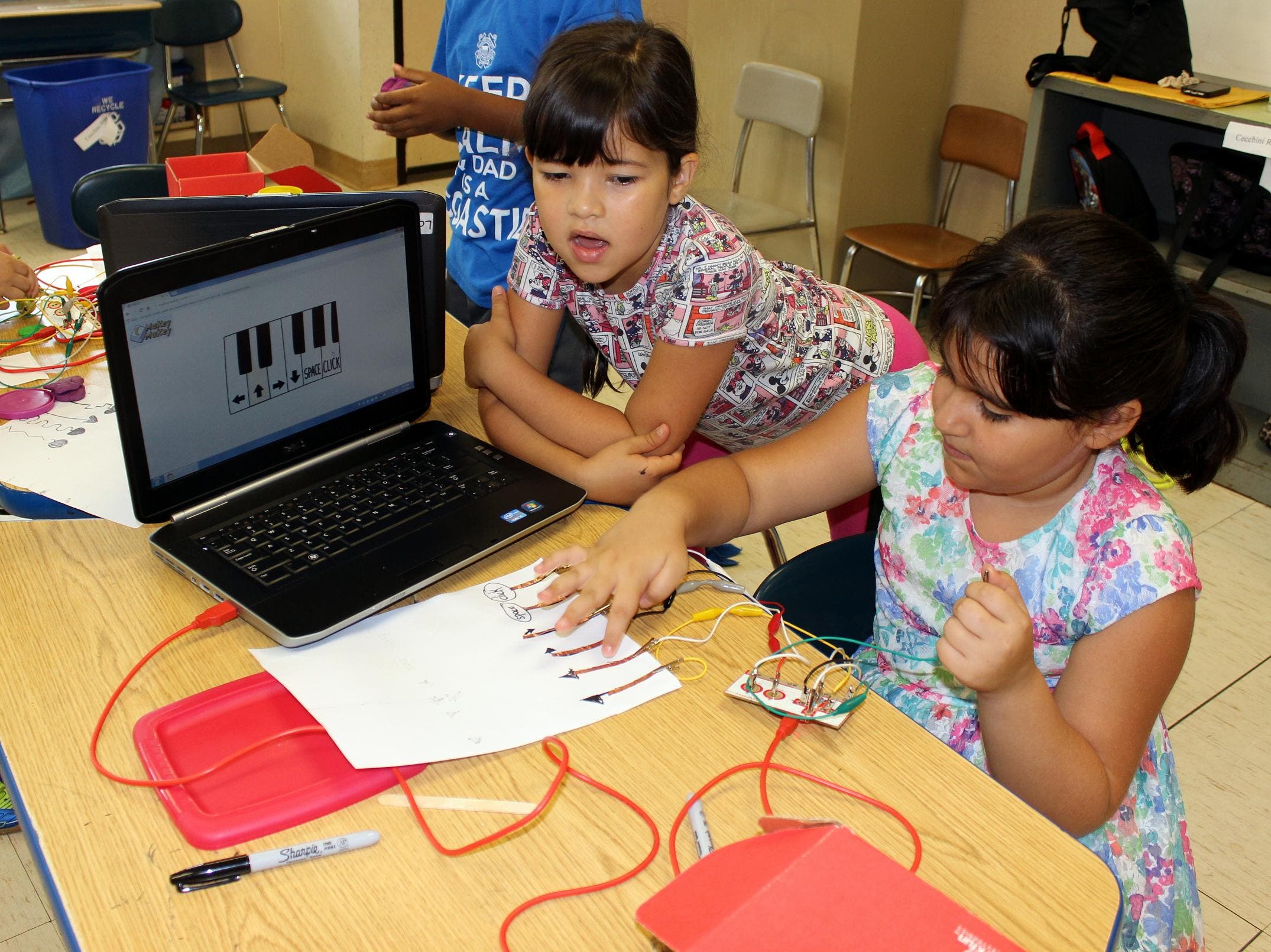


Nothing was wrong with the laptop keyboards the third- and fourth-graders were using at Brookside School, but they eschewed them just the same. Instead, they plugged wires into the computers and attached alligator clips at the other end to tomatoes, squash, Play-Doh and other objects to play an on-screen piano and video games.
After placing copper tape over “piano keys” she had drawn on a piece of paper and holding one end of a wire to complete the circuit, 8-year-old Isabella Cedo tapped out “Twinkle, Twinkle, Little Star.” The song, which she had just learned how to play, came from an on-screen piano designed by Makey Makey, the invention kits the children were using.
Isabella was one of 45 students in Ossining’s Summer Programming & Innovation Academy, whose goals include developing critical-thinking and problem-solving skills and encouraging creativity and innovation. This was the third year of the two-week program, which was funded by the Ossining MATTERS educational foundation. The academy has been growing every year, said Jeremy Luft, the district’s director of technology.
Find out what's happening in Ossining-Croton-On-Hudsonfor free with the latest updates from Patch.
Isabella said the summer academy was “very interesting” and she learned a lot. “You could use your imagination and build anything,” she said.
Her partner, 8-year-old Paulina Correa, said she enjoyed the program because “you can meet lots of friends and sometimes you could meet old friends.”
Find out what's happening in Ossining-Croton-On-Hudsonfor free with the latest updates from Patch.
Their group spent the first week building animals out of WeDo Robotics Construction Sets and the second week learning how to work with Makey Makey Kits.
In the second week, fifth- and sixth-graders built structures out of Popsicle sticks and used littleBits electronic modules to provide lighting, power a windmill and rotate a weathervane. They spent the first week creating animation.
Seventh- and eighth-graders used Tinkercad to create and print 3D designs that included replicas of the Titanic, a student’s house and two treehouses connected by a bridge. The first week, they created robots they used to knock down objects.
Ron Whitehead, who taught the class of fifth- and sixth-graders, said the children were very engaged in the projects. “Even yesterday, during break, they didn’t want to take a break,” he said last week.
Sofia Rajput and Caera Matthews, both 10, constructed a bridge and a created a structure with multiple Jewish stars made of Popsicle sticks glued on top of one another. The stars were topped by a red roof and a blue windmill. The girls used littleBits to light up the bridge and power the windmill.
Marie Felipe, 10, and Anna Mkandawire, 11, were part of a team that built a barn and a doghouse out of Popsicle sticks. They shaped a dog out of Play-Doh and added a number of embellishments, including paper flowers glued to Popsicle sticks and anchored by Play-Doh. They used littleBits to rotate a weathervane atop the barn.
“I like how we get to use electronics to make houses and stuff and we can make things out of Popsicle sticks, which is a strange combination but you can make a lot of things out of unlikely things,” Marie said.