Schools
Ossining Students Tackled Science Experiments, Met with Mentors on Engineering Day
IBM scientists helped students conduct experiments and encouraged them to pursue careers in the field during AMD's annual Engineering Day.
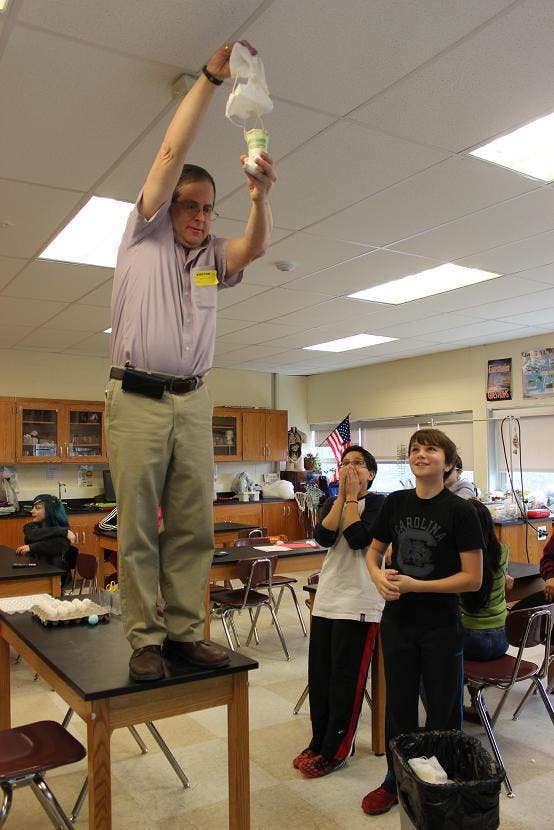


As eighth-graders crafted Life Savers, straws and paper into “puff mobiles” they could blow across the floor, seventh-graders down the hall at Anne M. Dorner Middle School Thursday tried to cushion raw eggs with enough tissue, cotton balls and marshmallows so they wouldn’t break when dropped.
Matt Thoennes, an IBM senior engineer, climbed atop a desk in a science lab and dropped the egg contraptions onto plastic sheeting taped to the floor. “Do we have a survivor?” he asked each time, as one of his colleagues fished the “eggonaut” out of its wrappings to see if there had been any leakage.
Four out of nine times, the answer was yes. But the team that “spent” the least amount of money on supplies – plastic straws cost $5 each in the game, for example – won the challenge.
Find out what's happening in Ossining-Croton-On-Hudsonfor free with the latest updates from Patch.
The classroom experiments, along with mentoring sessions in the library, were part of AMD’s annual Engineering Day. Eighteen scientists and engineers from IBM’s Thomas J. Watson Research Center in Yorktown Heights spent the day working with more than 1,000 sixth-, seventh- and eighth-grade students.
Engineering Day is one of a number of the school district’s initiatives to encourage more students to pursue careers in math, science and technology.
Find out what's happening in Ossining-Croton-On-Hudsonfor free with the latest updates from Patch.
Event organizer Alan Bivens, senior manager of cloud systems and analytics at Watson Research Center, said it’s important to bring the message to children that they can have fascinating and lucrative careers creating and improving technology people use on a daily basis.
During a mentoring session in the AMD library Thursday, several students asked Bivens to explain something he had invented. He described technology that can sense whether there are areas of a computer system that are overtaxed and redistribute the work to compensate for that.
Nearby, children crowded around a 3-D printer and handled some of the designs Jason Pelecanos, who works in speech research at IBM, had printed out. They included a plastic glow-in-the-dark bracelet, chess pieces and a white octopus figurine whose surface turned pink when he shone a ultra-violet light on it.
“It’s a very, very exciting time for the revolution in 3-D printing,” said Pelecanos, for whom 3-D printers is a hobby.
While the 3-D printer was churning out plastic items, they learned such printers can create metal parts for airplanes, cement and even food. “Nicole, there’s a printer that actually prints chocolate!” one girl told a friend.