Schools
Science Contest Finalist IDs Genes That Cause Allergic Diseases
The Ossining High School senior had a personal connection to his research topic.


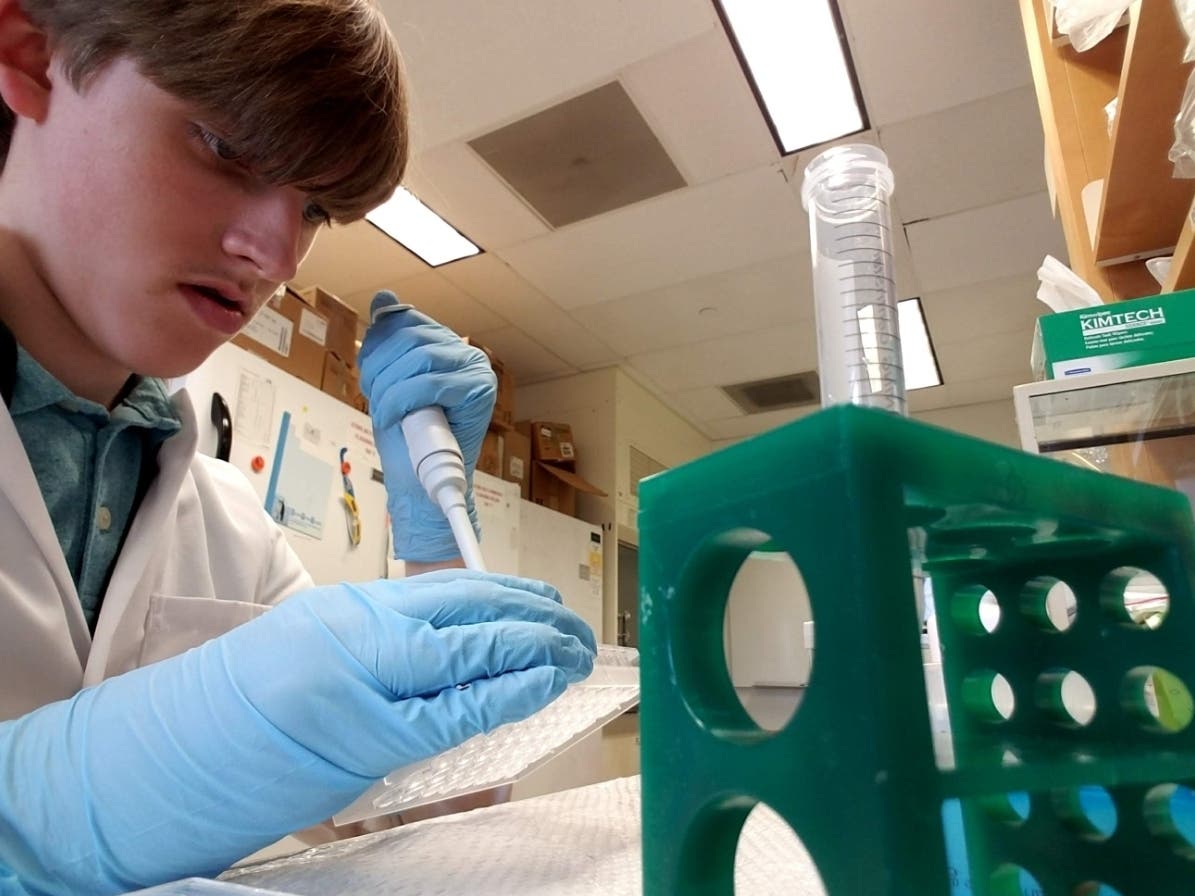
OSSINING, NY — An Ossining High School student who wanted to take a close look at allergies is a finalist in the Regeneron Science Talent Search 2021, the nation's oldest and most prestigious science and math competition for high school seniors.
The work he did could lead to an effective long-term treatment for allergic diseases, contest officials said.
Michael Pavelchek conducted lab and computer research that identified two genes responsible for the production of certain cells (the IgE antibody secreting plasma B cells) that cause allergic conditions, such as asthma, rhinitis and eczema. His project Title: Swap70 and Myc Promote Sequential Switching to High Affinity IgE in Allergic Asthma.
Find out what's happening in Ossining-Croton-On-Hudsonfor free with the latest updates from Patch.
Pavelchek is among the 40 finalists selected from more than 1,760 highly qualified entrants from across the country based on the scientific rigor of their projects and their potential to "become world-changing scientists," contest officials said. SEE: 3 Hudson Valley Seniors Named Regeneron Science Contest Finalists
Find out what's happening in Ossining-Croton-On-Hudsonfor free with the latest updates from Patch.
Just by merit of being named finalists, Pavelchek and his 39 confreres will be awarded at least $25,000. The final competition among the 40 coming up will lead to awards for the top 10 winners ranging from $40,000 to the top prize of $250,000. That's in addition to the $2,000 each student received for being named a Scholar, which also included $2,000 for each of their schools.
He hopes to major in biomedical engineering in college, while continuing to study allergic diseases.
Pavelchek talked to Patch about taking Ossining High School's 3-year science research course, which led to the award.
Patch: What made you decide, as a sophomore, to go that route?
Pavelchek: Prior to applying to the program my strongest interests had always been related to science. Specifically, having an interest in getting to perform my own research experiments. The program is so much more than just the research aspect. The program really develops you as a professional no matter what field you end up pursuing.
Patch: Would you recommend it to 9th graders trying to decide what their high school career will look like?
Pavelchek: The presentation skills, writing skills, and really the community and friends you'll make throughout the program and laboratory are invaluable. I would highly recommend the program to any freshmen who are looking to develop themselves and want the experience to pursue research in a topic of interest, whether it be a behavior project that looks at office productivity or a biology project looking at cancer.
Patch: When and how did you figure out your research topic?
Pavelchek: Going into the program the summer after my freshman year I knew I wanted to focus on something related to immunology and allergies. I decided to focus on allergic asthma, something that I had been diagnosed with as a child. After having confirmed with my mentor the opportunity to attend her lab during the summer I began looking at some of the recent publications from my lab. From there I learned about two cell subpopulations and how one produced the IgE antibody (the antibody responsible for inflammation in allergic asthma). I hypothesized that there must be differences in the genes between these two subpopulations that explained why one group produced the inflammatory antibody.
Patch: What was the most fun?
Pavelchek: The most fun part of the whole program and research, was definitely having the experience of going down to Manhattan during the summer, and getting to work in a real laboratory setting.
Patch: What was hardest?
Pavelchek: The hardest part I would say was learning how to use the online gene databases and learning to use the different bioinformatic programs for my project for the most part on my own.
SEE ALSO:
Get more local news delivered straight to your inbox. Sign up for free Patch newsletters and alerts.