Arts & Entertainment
When Filming In Brooklyn is Too Much of a Good Thing
A series of incidents—and news reports—suggest that there's simply too many TV shows and films shooting in Brownstone Brooklyn

For any Brooklynite who’s ever had their car towed, or had to endure high-powered lights bathing their homes at all hours of the night, it might be difficult to appreciate the benefits of a film shoot in your community.
Yet intrusive movie shoots have become a common occurrence throughout Brownstone Brooklyn. Essential to the urban realism highly prized by current television and film producers is the stately architecture of neighborhoods such as Boerum Hill, Brooklyn Heights, Clinton Hill, Cobble Hill and Fort Greene.
Authenticity, however, has its price; numerous complaints from locals suggest that location scouts scale back their frequent use of Brooklyn as a 21st-Century version of the Hollywood studio backlot.
Find out what's happening in Park Slopefor free with the latest updates from Patch.
Trouble in Clinton Hill
Fort Greene Focus reported recently about film notices placed at various intersections of Clinton, DeKalb, Washington and Willoughby Avenues in Clinton Hill. Bonanza Productions, Inc., the production company for The Following—a TV show depicting a week-to-week hunt by an ex-FBI agent (played by Kevin Bacon) for a serial killer and his murderous cult—announced that they would be filming in the neighborhood “FOR THE LAST TIME.”
Find out what's happening in Park Slopefor free with the latest updates from Patch.
In apologizing for disruptions cause by previous filming, Bonanza offered the classic “let them eat cake!” trade off; a “food or dessert truck” made available to the community. Bonanza also claimed to have made contributions to local charities.
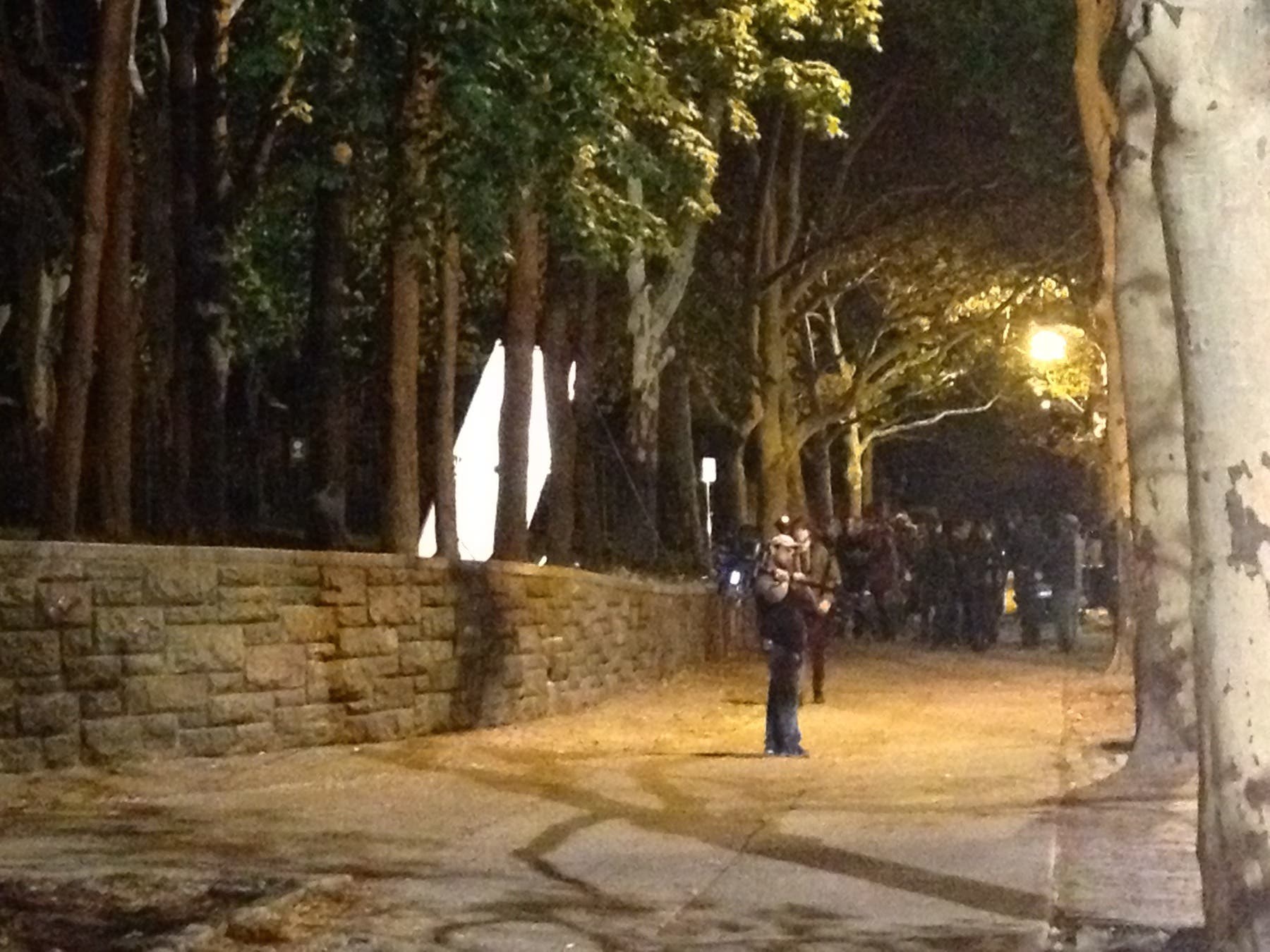
When production wrapped in Clinton Hill, however, Bonanza simply packed up it’s gear and moved to another part of the community: Fort Greene Park. Last Tuesday night St. Edwards Street near Myrtle Avenue was eerily illuminated as cameras rolled for an episode of The Following. Now in its third season, Bonanza location scouts have consistently used Brooklyn as backdrop. [Bonanza declined comment on repeated requests for information].
However this episode of The Following concludes, it’s likely that production will return to Fort Greene and—thanks to rules established by the NYC Mayor’s Office of Media and Entertainment—there’s often little that local residents can do to prevent a lucrative practice that many have apparently grown weary of.
Have Brooklyn’s Streets Become The Navy Yard’s Backlot?
Hyperlocal sites like Fort Greene Focus and Brooklyn Heights Blog as well as mainstream media including the New York Daily News have chronicled the troubles resulting from a local film industry closely aligned with Steiner Studios in the Navy Yard. Steiner, which works with many production companies, has greatly expanded its operations in Brooklyn over the last decade. Local film shoots have expanded exponentially as well, resulting in controversy.
A recent New York Daily News article detailed a contentious dispute between neighbors on a particular block in Clinton Hill over a production of “The Intern,” a movie starring Anne Hathaway and Robert De Niro. The News previously reported that in 2013-14, 29 TV shows were filmed in New York City including 14 in Brooklyn.
Brooklyn Heights Blog chronicled the displeasure of Heights’ residents with a series of recent shoots by Queens-born rapper 50 Cent, a story picked up by the New York Post.
The Boerum Hill Yahoo Group, an online forum for Boerum and Cobble Hill residents, recently crackled with dissent about lengthy film shoots for The Americans and The Slap, two television shows appearing on FX and NBC respectively.
There ARE Benefits to a Practice That Many Don’t Fully Understand
Howard Kolins, President of the Boerum Hill Association, argues that there are compelling reasons for inviting TV and film crews into one’s community, including money.
“TV and film production in New York City is a huge business…. that provides lots of paychecks for [local] people,” said Mr. Kolins. “However, when it comes into your neighborhood that’s not a factor for people who live here but are not involved with the film industry.
At a recent BHA public meeting, Kolins said that topic number one was the impact of recent shoots by The Americans and Slap and how locals might push back against intrusive film crews.
“The interesting thing to me as the head of a residential organization is that most of the residents don’t see the benefits, all they see is the inconvenience.”
Because film notices often get posted late, the first thing that people have problems with is parking, especially when a legally parked car is towed strictly for the benefit of the shoot.
But, as Kolins pointed out, there are quantifiable benefits. Slap, donated $500 to BHA, which he said is earmarked for people inconvenienced by the shoot.
Because The Americans held overnight shoots, their production company donated $5,000 to Gowanus in Unity Tutoring. Kolins said that $5,000 is a very large contribution; usually the contributions are in the range of $1,000 to $2,000, depending on how long and involved the individual projects are.
Local communities are not usually able to ban film activity unless, according to Kolins, there have been “many, many days of shooting.” However, residents can contact the Mayor’s Office of Media and Entertainment and request a moratorium on filming, which is what happened following The Followings’ last shoot in Clinton Hill.
It All Starts With The Mayor’s Office of Media and Entertainment.
Marybeth Ihle, Press Secretary and Communications Manager, Mayor’s Office of Media and Entertainment, explains that residents do have a say in how and when their streets are used for filming.
In an email Ms. Ihle stressed that her office “strictly limit[s] the amount of parking given to productions and send field representatives from our office out on location to monitor a production’s footprint.” Ms. Ihle also emphasized the direct local benefits of shooting in the City.
Despite the inconvenience, there are very good reasons for the Mayor’s office to protect the City’s robust film industry.
“The production crews on the streets of New York City are made up of New Yorkers earning a living by working behind the scenes on films and TV shows.”
According to Ms. Ihle, not only does New York City’s entertainment industry employ over 130,000 New Yorkers, it contributes approximately $7.1 billion annually to the City’s economy. Assisting 4,000 NYC businesses indirectly involved with filming, “the Mayor’s Office of Media and Entertainment works proactively to balance the needs of residents and business owners with the needs of film crews,” Ihle added.
“New York City is often the backdrop for television and film production, which leads to job creation, supports local businesses, and strengthens our economy,” said Council Member Laurie A. Cumbo of the 35th District, which includes Clinton Hill and Fort Greene. “It is also an opportunity to showcase our city’s beauty, creativity, and diversity.”
Believe It Or Not, There Are Options
Because production companies register with the Mayor’s Office of Media and Entertainment for permits, locals do have a say—albeit limited—in deciding if and when filming occurs in their community. Ihle’s office produces a “hot spot list” of off-limits locations determined by input from local elected officials, community boards and residents.
“Though these productions are instrumental to the cultural and economic development of our city, they should not occur at the detriment of our quality of life,” Ms. Cumbo said. “If New Yorkers are concerned about an ongoing production on their block, they should call 311 to connect with the Mayor’s Office of Media and Entertainment.”
Visiting the hot spot, a trapezoidal area from Lafayette Avenue To Fulton Street between Washington & Bedford Avenues—where The Following was filming in late October—is currently listed as off-limits.
Despite Obvious Benefits, Clearly a Larger Problem
Lucinda Rosenfeld, a Boerum Hill resident since 2001, described her experience with the recent television shoots in her community.
“Finding alternate parking places can be tricky when entire streets are off-limits and everyone is looking at the same time,” Ms. Rosenfeld said. “That’s probably the biggest nuisance in terms of filming in neighborhoods. Then the shoots tend to go on late into the night, [with] lots of bright lights and a noise that can be disruptive to those who sleep in the front of their buildings.’”
A writer and novelist by profession, Rosenfeld is supportive of industries that employ creative types. However, she expressed concern about repeated shoots in her neighborhood.
“I think there should probably be limits in terms of how many times a month one block can be asked to ‘host,” she said. “I think it’s all about balance. Two long days a month is probably the outer limit of what you should ask of the residents of one street [to endure].”
Her greatest frustration stems from the lack of notification when a shoot is scheduled.
“The NBC/Slap production showed up with barely a day’s notice the first time around. I would have liked more lead time so we could at least have figured out what to do with our cars.”
Andrew lllson, Assistant Location Manager for Essential Ingredients, a movie currently in production in Fort Greene, was frank about his experience shooting in various city neighborhoods. His shoot, in a rented storefront on the corner of Myrtle Avenue and Adelphi Street in Fort Greene, has been well received by locals.
“It’s been great actually. Everyone’s been really friendly,” lllson said. “[It’s] surprising because usually when we’re shooting around Williamsburg or Manhattan people instantly have this preconceived hate towards the film crews. They’re very rude to us and it’s well deserved because we intrude in a lot of neighborhood stuff.”
PHOTO CAPTION: The Following shooting in Fort Greene Park
PHOTO CREDIT: Michael Randazzo for Patch