Business & Tech
Fleeing From The Recession: Is There More Economic Promise Abroad?
Port Chester, like most of the country, is experiencing economic fatigue. Employers and workers alike are preparing for the worst; some are even considering moving to other countries.
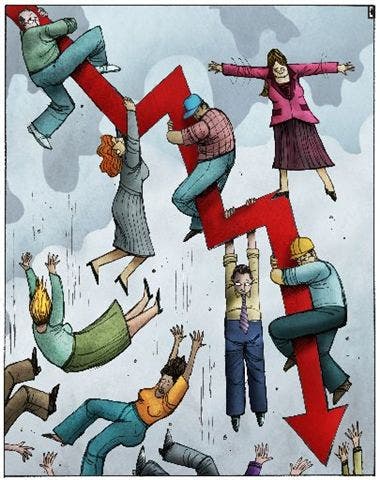
Whether you are a private individual or a business owner, economic uncertainty has become a part of America's new reality—and Port Chester is feeling it right along with you.
Even businesses with solid reputations like Chavin Restaurant on Main Street have had to adapt, creating a second menu that caters to patrons with less spending money. The menu offers entrees starting at $7.50, but the portions are smaller.
"We have a lot of couples coming in, ordering from the second menu, and sharing" said Adelaida Ostos, who works at Chavin.
Find out what's happening in Port Chesterfor free with the latest updates from Patch.
Shrinking incomes are also affecting other areas of life. Take the money-transfer industry, for instance.
In a recent Pew Research study, wire-transfers to other counties--which reflect remittance money being sent to family-members overseas--have decreased significantly for the past seven consecutive years. $10.63 billion dollars in wire-transfers were sent this year compared to the $11 billion sent last year. But what's shocking is that the amount sent in 2003 was substantially higher at 13.2 billion.
Find out what's happening in Port Chesterfor free with the latest updates from Patch.
Sources say wire-transfers to Latin America have picked up, but no one knows for how long. Rosa Vizhco, who works at a local wire-transfer agency, says that they've been able to maintain steady revenue for the past few months, but she expresses concern over what may turn out to be a "double-dip recession."
"People are out of work, so this doesn't help the situation," said Vizhco.
But even for workers who make a regular salary, the money doesn't seem to go as far as it used to. Ronaldo Castanela, who works in the kitchen at Copacabana Restaurant, says with the increasing rent and cost of living, he will probably return to his wife and children in El Salvador.
Although they use the 'dollar' in El Salvador as their unit of currency, there used to be a favorable exchange rate in terms of what could be purchased in El Salvador versus in the U.S. with the same amount of money. But Castanela says that's no longer true.
Another employee at Copacabana, Ricardo Santana, says he will probably go back to Brazil next year. Santana cites a stronger economy in Brazil and a more stable currency as the primary reasons.
Brazil, one of the BRIC (Brazil-Russia-India-China) countries many economists point to as having the greatest potential to grow during this recession, does seem to be doing something right. Brazil has greatly out-paced the U.S. in terms of manufacturing and exports.
According to some, it's Brazil's favorable economic policies that give it a competition edge. Eddie Lustosa, who was born and raised in Brazil, but now lives in the U.S., says that Brazil's income-tax policy allows workers to keep more of their pay-checks.
"In Brazil, taxes get taken out of your paycheck monthly, whereas here in the U.S. you make payroll bi-weekly," said Lustosa. He says Brazilian citizens having more disposable income is good for the economy.
If he was single, Lustosa says he would move back to Brazil in a heart-beat. As much as Lustosa would like to move, he won't because he has grown too accustomed to American culture. Besides, he says his wife and children wouldn't like it too much.
Someone else who isn't going anywhere, but has thought about it, is Peter Liu, owner of Euro Asian Bistro on Westchester Avenue. Growth at Euro Asian Bistro has been extremely positive with revenues increasing 15% since last year.
Liu, who grew up in China, says America is still a better place to be despite positive economic indicators in other countries because of America's long track-record of growth and rich heritage in free enterprise.
At the same time, many well-known economists and investors like Jim Rogers and Peter Schiff rave about economic opportunity in China, citing a pro-business environment that is in some cases more 'free market' than even the United States.
In the U.S., by contrast, Rogers and Schiff talk about regulations that not only stymie small business, but actually favor big business because they're the ones with the deeper pockets to be able to afford to pay all the compliance costs.
Despite all the talk, Lui says that he has confidence in the United States because of its hard-won resilience and opportunity.
"The American economy is more mature than the Chinese" said Liu. "In China, the government owns much of the money, but in America, the individual has the opportunity to make and have money."
But Liu maintains that our government needs to reassess its policies toward small business in order to spur job creation. Liu has a wait-and-see attitude regarding the outcome of the upcoming mid-term elections in November.
Although people may not be packing their things in the middle of the night to head overseas, it's alarming that Americans are even thinking that there may be more opportunity elsewhere. For the time being, Americans appear to be biding their time, but we could be in for some interesting times: An America where opportunity isn't as plentiful as it once was.