Schools
RVC Principal to Lawmakers: 'Slow Down' On Testing, Evals
South Side Middle School's Carol Burris sends letter to lawmakers


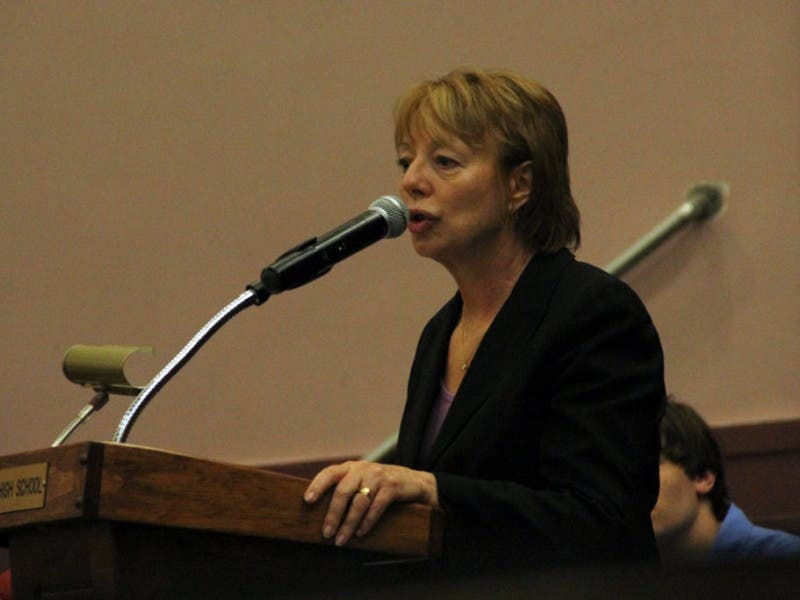
South Side Middle School Principal Carol Burris has written a stern letter urging every member of the New York State Legislature regarding Common Core testing and APPR.
The letter, published on her blog, was addressed to the entire New York State Assembly and Senate.
“I did not then, nor do I now, understand why you would want to be in the business of evaluating teachers,” she wrote, citing the decision in 2012 to create the APPR system.
Find out what's happening in Rockville Centrefor free with the latest updates from Patch.
“Teachers are employed not by the State of New York, but by their locally elected school boards,” she said, I do not believe that our legislature has created systems to evaluate police officers, school superintendents, firefighters, the custodians who work in government offices, SUNY professors, or the men and women who take tolls on our bridges and tunnels.”
Sign up for your local daily Patch newsletter and breaking news alerts here
Find out what's happening in Rockville Centrefor free with the latest updates from Patch.
Burris said she appreciated the predicament the legislature faced in 2012 with Race to the Top funding at stake, she insisted that leaders had established a “lopsided system.”
“Slow down,” Burris concluded. “Yes, APPR needs to be revisited. But this time, please take the time to listen to your constituents and experts.”
She finished with the warning: “Please do not make an awful evaluation system even worse.”
Here is the letter published to Burris’ blog:
Dear members of the New York State Assembly and Senate:
In 2012, the legislature dramatically changed the way teachers and principals were evaluated by instituting a system called APPR. That legislation created categories of performance, scoring bands and consequences for teachers rated developing or ineffective.
I did not then, nor do I now, understand why you would want to be in the business of evaluating teachers. Teachers are employed not by the State of New York, but by their locally elected school boards. I do not believe that our legislature has created systems to evaluate police officers, school superintendents, firefighters, the custodians who work in government offices, SUNY professors, or the men and women who take tolls on our bridges and tunnels. I suspect that you would recoil at the thought of legislating how every public servant is rated. And so you should. The good people of New York did not elect you for that purpose.
I appreciate the position that the legislature was in several years ago. The New York State Education Department was attempting to secure Race to the Top funds at a time when our state revenues were low. Due to pressure from the governor, the evaluation system was hastily created. Governor Cuomo insisted on scoring bands that would find a teacher “ineffective” overall, if they were found “ineffective” in student scores. That created a lopsided system. Teachers who had enough points to be “effective” in student scores, could still be found “ineffective” overall if they got fewer than 56/60 points in observations. A teacher could be rated “developing” according to test scores, but unless she received 59/60 points in what Cuomo refers to as “the subjective part” (which is what anyone who really understands teaching refers to as the “important part”), she would be rated “ineffective” overall. A teacher could even be “developing,” “developing and effective” in the three categories, and yet be “ineffective” overall. Superintendents were forced to compensate for those flaws when they negotiated their plans.
I will not bore you by citing all of the research that says that evaluating teachers by growth is neither valid nor reliable. Fully one-third of New York teachers move from one category to another each year on that measure. In addition, the New York State Education Department has changed the factors in the complex formula that it uses every year. The present model advantages teachers in urban areas, while the first model advantaged suburban teachers. By tinkering with the model, the state changes the results. This is not science nor is it objective. There is no evidence anywhere that it will lead to school improvement.
A brief jointly prepared by the American Education Research Association and the National Academy of Education warned against the use of VAM scores (which is the technical name of the “growth points”) and the American Statistical Society reported that using scores in evaluations can reduce quality. Tennessee, which was on the forefront of VAM, once used these scores as 50 percent of their teacher evaluations It was then reduced to 35 percent, and the present push by their governor is to reduce it further still to 10 percent. The New Jersey Assembly just passed a bill to exclude PARCC test scores from teacher evaluations — which were only 10 percent to begin with. Even the New York State School Boards Association, which had supported scores in evaluations, passed a resolution at its annual convention objecting to their inclusion. To raise the test score component to 50 percent would be irresponsible. Students would ultimately pay the price for bad policy, as curriculum further narrowed and test prep increased. Back in 2012, the legislature could plead ignorance. Now that action would be malfeasance.
Whether or not you support NYSUT and tenure, I think it is wise to stop and think before forging ahead and approving Governor Cuomo’s plan to increase the weight of test scores. In addition, requiring district to swap administrators to do observations is equally unwise and untenable. APPR is deeply flawed and it should be changed—but not in a rushed manner as part of the budget negotiation process.
The pressure to teach to the state tests is greater than ever before. Students and parents are reeling from the Common Core, Common Core tests and teacher evaluation based on Common Core tests. Support for these initiatives continues to fall in the polls.
You are at a fork in the road. You can be thoughtful in your review of APPR, keeping it out of the budget where it clearly does not belong, and listen to the parents, superintendents, teachers and principals who work in the districts you serve, or you can ram through another system and make a bad situation even worse.
I recommend that you think back to 2011, and compare then to now. Have our schools improved? Are parents more satisfied? Were the 60,000 “opt outs” last year a sign of approval or a message to change course? Is there any indication at all that learning has increased because teachers are now evaluated by test scores? Make no mistake–all of these issues are intertwined and they are the direct result of Albany and Washington taking an unprecedented role in directing rapid school change absent research.
Slow down. Yes, APPR needs to be revisited. But this time, please take the time to listen to your constituents and experts. Please do not make an awful evaluation system even worse.
Sincerely,
Carol Burris, Ed.D.
Principal of South Side High School
Rockville Centre, NY 11570
Photo: File
More on Patch:
- Customs Seizes $65G in Counterfeit Cash at JFK
- Cops Release Photos of Men Wanted for Spray Painting Cars
- Peter King Blasts Ted Cruz Over Presidential Bid
- WATCH: Time-Lapse of the First Day of Spring in Long Beach
- 20 Customer Service Jobs in Nassau
- Lake Grove Man Dies of Injuries Sustained in Crash Last Week
- Social Photos: Montauk Friends of Erin St. Patrick’s Day Parade
- Two Escape Dix Hills House Fire
- Police: Man Arrested After Leading Police on Chase From Jamesport to Southold
- Easter Egg Hunt This Weekend at Eisenhower Park
- Police: Officer Fatally Shoots Theft Suspect Fleeing in Stolen Car With 2 Kids Inside
- Wow Houses of the Week
- Two N. Lindenhurst 7-Eleven Employees Hurt During Armed Robbery
- Cops: Man Stole Wallet from Sleeping Woman’s Sea Cliff Home
Get more local news delivered straight to your inbox. Sign up for free Patch newsletters and alerts.