Health & Fitness
How Radically Conservative is the Supreme Court?
The Court's strip-search decision affects millions of Americans charged with minor offenses each year who now may be forced to strip naked by state officials.
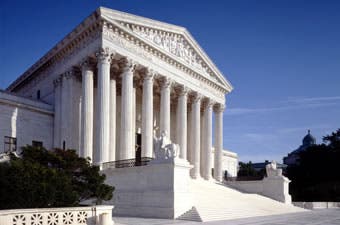
Yesterday, the Supreme Court decided that the 13 million Americans who are arrested and admitted each year to local jails and detention facilities – including the many millions charged with misdemeanors and petty offenses like shoplifting, failure to pay a fine, traffic offenses and civil offenses like contempt and failure to pay child support -- may all be strip-searched without any reasonable suspicion to believe that they are concealing contraband in their private parts, if they will be placed into the jail’s general population.
The vote was 5-4, with Justice Anthony Kennedy writing the Court’s opinion, supported by the Court’s other, more conservative Justices (John Roberts, Samuel Alito, Antonin Scalia and ClarenceThomas).
All three female Justices (Ruth Bader Ginsburg, Sonia Sotomayor and Elena Kagan) dissented, along with Justice Stephen Breyer, who wrote the dissenting opinion.
Find out what's happening in Ryefor free with the latest updates from Patch.
In 1999, I won a decision from a federal judge in the Eastern District of New York declaring the blanket strip search policy of the Nassau County Jail unconstitutional because everyone admitted to the jail was strip searched without any reasonable-suspicion inquiry. I then commenced a class action on behalf of the 17,000 people arrested on minor charges and unlawfully strip searched in that jail in the previous three years.
In 2003, Nassau County conceded liability to every member of the class for the unconstitutional strip searches. In 2006, a judgment of liability was entered on behalf of the class and every member thereof. In 2010, after a three week trial, the Court awarded general damages of $500 to each class member for the human dignity violation inherent in each unlawful strip search.
Find out what's happening in Ryefor free with the latest updates from Patch.
We are not talking about felons convicted of serious crimes and sentenced to state prison. We are talking about the other 13 million lodged, often temporarily, in county jails each year, many on minor charges, not yet convicted, arrested for the first time, who are stunned to discover that they can be forced to strip naked before a corrections officer in full uniform (and often others in the room), lift their breasts, lift their penis and testicles, turn around and bend over and spread their cheeks to permit an visual inspection of the anal and vaginal cavities.
For many years, beginning in the 1980’s, every federal Circuit Court of Appeals decided that such blanket strip searching of non-felony arrestees was unnecessarily humiliating and degrading, a gross invasion of privacy, and therefore a violation of the Fourth Amendment’s protection against unreasonable searches and seizures.
Lots of empirical evidence supported the proposition that these visual body-cavity searches of minor offenders rarely turned up contraband not discoverable without them. For example, in Nassau County, of 75,000 strip searches conducted on new admits over a five-year period, only 16 produced contraband- 13 of which would have been detected in a patdown or a search of shoes or outer clothing. In the three instances in which contraband was found on the detainee’s body or in a body cavity, there was a drug or felony history creating individualized reasonable suspicion. In other words, none of the 75,000 visual strip and body-cavity searches could be said to support the necessity of the jail’s suspicionless blanket strip search policy.
Over the years, professional correctional associations came to adopt standards that forbade suspicionless strip searching. Ten states prohibited them. Many jails, either voluntarily or through civil rights litigation in the courts, came to adopt a reasonable suspicion standard and did away with blanket strip searching of new admittees charged with non-felony offenses. Magnetometers (metal-detectors) came to be commonly used instead to screen new arrivals, with no diminution of institutional security. The issue seemed to be resolved.
Beginning in 2008, however, conservative judges in the Eleventh, Ninth and Third Circuits issued decisions endorsing blanket suspicionless strip searching for the first time, setting the stage for yesterday’s Supreme Court decision in Florence v. Board of Chosen Freeholders of County of Burlington.
Justice Kennedy’s decision for the Court hardly mentions the invasion of privacy inherent in the challenged strip-searching, nor does it discuss the empirical evidence necessary to resolve the question of whether such wholesale strip-searching of millions each year is necessary and justifiable.
Justice Breyer’s more persuasive dissent does, but unfortunately, the Court’s moderate wing has only four votes. The 2000 and 2004 elections of George W. Bush were watershed events, giving control of the United States Supreme Court to conservatives apparently inclined to radically remake American constitutional law.
The Citizens United decision removed limits on huge corporate and individual campaign contributions, further corrupting our politics. The oral argument on Obamacare last week revealed a willingness to curtail the federal government’s power to regulate interstate commerce, which for at least half a century had been thought to be virtually unlimited. Now, after Florence, millions of us have lost important constitutional protection against unnecessary and unreasonable searches and seizures.