Community Corner
Advocates Urge Hochul To Sign Unmarked Burial Grounds Protection Act
The proposed legislation protects not only Native burial sites, but also those of African Americans and Revolutionary War veterans.


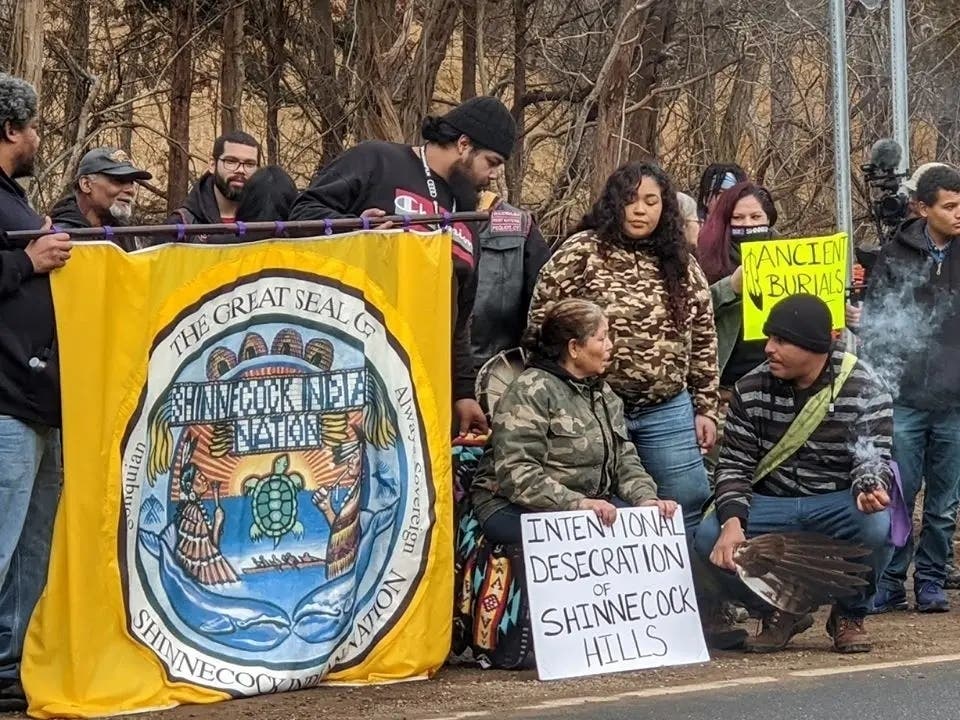
SOUTHAMPTON, NY — After years of crying out for change, the Shinnecock Nation has joined with more than 30 other organizations to urge Gov. Kathy Hochul to sign legislation that would protect unmarked, ancient burial sites across New York State.
A total of 37 groups signed the letter to Hochul. "New York State customarily leads; it does not follow. The Unmarked Burial Site Protection Act, when signed and implemented, will join New York to the family of states that protect ancient burial sites whose surface appearances may have disappeared over time but are nonetheless sacrosanct land worthy of respect and dignity," the letter said.
Neither the New York State Office of Historic Preservation nor the New York State Department of Environmental Conversation have the resources nor the expertise to singularly provide protection for these sites, advocates continued.
Find out what's happening in Southamptonfor free with the latest updates from Patch.
"As a result, private developers have unfettered discretion to destroy these grave sites without fear of reprisal. Federal and New York State laws, as they currently exist, do not apply to lands held privately. It is a gap in an otherwise significant body of enforcement that has paved the way for the appropriate handling of sacred sites and human remains."
The legislation, which passed the legislature during its last session, "closes that gap," the letter read. "Only New York, New Jersey and Wyoming fail to protect human remains found in unmarked burial sites."
Find out what's happening in Southamptonfor free with the latest updates from Patch.
The proposed legislation protects not only Native burial sites, but also those of African Americans and Revolutionary War veterans who were often buried in mass graves, the letter added.
"It is right that we do this," those who signed said.
The Unmarked Burial Site Protection Act would create a committee including the New York State archeologist; provides penalties for failure to report and failure to act in an appropriate and respectful manner; and provides a mechanism for the swift and appropriate disposition of human remains, helps prevent the desecration and theft of human burials, and gives the New York Attorney General authority to intervene when necessary.
"The states of Florida, Massachusetts and Washington have significant urban, rural and suburban populations, similar to New York, and their unmarked burial protection laws work well. If New York State can devise laws to protect wetlands and endangered species, should human remains command anything less?" those who wrote the letter said.
Included in those who signed were the Shinnecock Graves Protection Warrior Society, the Shinnecock Warriors of the Sunrise, the Shinnecock Kelp Farmers and 34 others.
Hochul did not immediately return a request for comment.
After months of protest by members of the Shinnecock Nation, the Southampton Town board acted in 2020 to protect sacred burial grounds from development and desecration.
At that meeting, the Southampton town board voted unanimously to approve the Graves Protection Act and the Shinnecock Hills Building Moratorium to protect areas believed to be ancient burial grounds after members of the Shinnecock Nation had long rallied to stop building in the Fort Hill and Sugar Loaf areas and other locations where their ancestors are buried.
The Graves Protection Act establishes protocols if human remains are encountered during construction activities — and the six-month moratorium halted new home construction or excavation within areas that included the Fort Hill and the Sugar Loaf areas of Shinnecock Hills and beyond to Peconic Road without first completing an archaeological review.
New York State is one of only a few states that lack the Graves Protection Act, town officials said.
The moratorium also affected other large-scale excavation projects in the areas, including accessory structures and swimming pools.
The moratorium was meant to allow time for the town to enact safeguards to prevent the inadvertent desecration of graves and archeological resources in the sensitive area.
"The sanctity of human burial sites must be protected," said Southampton Town Supervisor Jay Schneiderman at the time. "We need to be sure we are not disturbing our cultural heritage and destroying ancestral burial grounds."
In January, 2020 a crowd of more than 100 stood in solidarity with members of the Shinnecock Indian Nation engaged in the ongoing rally to save their ancestral burial grounds from development in the Hamptons.
According to Tela Troge, supporters arrived from sister tribes and also from various groups the Shinnecocks have been networking with; the Mashantucket Pequots sent a bus of their tribal members and tribal leaders from Connecticut, she said.
"We were able to block a couple of large pieces of excavator equipment from entering the site. No construction work happened today," Troge said at the time.
Earlier in the year, a large electronic billboard erected by the Shinnecock Indian Nation on Sunrise Highway that sparked outcry from some elected officials and residents was illuminated as a symbol of the tribe's fight to protect its ancient ancestral burial grounds from development.
The sign read: "Stop Desecration of Shinnecock Hills," along with a photo of an ongoing protest that been ongoing for months, with members of the Shinnecock Indian Nation speaking out to halt the desecration of their ancestors' sacred burial site by a development given the green light by Southampton Town.
In 2018, at a site on Hawthorne Road in Shinnecock Hills, tribe members said an ancestor's grave was desecrated when a skull, bones, and 18th-century glass bottle were unearthed during the construction of a home just minutes from the reservation.
After the remains were unearthed in 2018, Southampton Town closed on the purchase of property where the human remains were found; the Shinnecock Indian Nation raised an additional $50,000 for the restoration and preservation of the burial site, officials said.
According to Troge, Sugar Loaf is a New York State and Town of Southampton designated critical environmental area. "It is the site of Shinnecock's most sacred burial area in the Shinnecock Hills and the site of the Shinnecock Contact-era fort."
The Shinnecock tribe's fight to protect their sacred burial sites was the focus of a recent PBS documentary, "Conscience Point."
Pink Floyd icon Roger Waters, who has stood behind theShinnecock Nation in their fight for economic advancement, thanked Becky Genia for the documentary, "Conscience Point," which chronicles the struggles of the Shinnecock Indian Nation to preserve ancient burial grounds in the shadow of towering mega-mansions, golf clubs, and wrecking balls.
"We will do whatever we can to help you," Waters said. "I'm not going anywhere. I'm onboard for this and will be for as long as there is breath in my body."
Get more local news delivered straight to your inbox. Sign up for free Patch newsletters and alerts.


