Community Corner
In Environmental Win, Shinnecock Bay Lauded As New Global 'Hope Spot'
The bay in a now in a a league with locations such as the Galapagos, standing out as one of the most pristine on the globe, experts say.


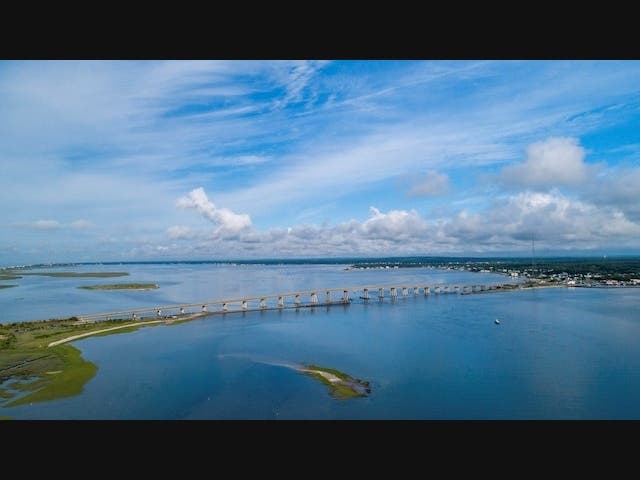
SOUTHAMPTON, NY — Shinnecock Bay has earned international recognition as one of the most pristine bodies of water in the world.
The bay has been designated a new global "Hope Spot," by Mission Blue, an international organization that supports the protection of oceans worldwide, a release from the organization said.
The distinction is the result of a decade of restorative and scientific work co-led by Ellen Pikitch, Ph.D., Christopher Gobler, Ph.D. and Bradley Peterson, Ph.D. in the School of Marine and Atmospheric Sciences, or SoMAS, at Stony Brook University, those involved said.
Find out what's happening in Southamptonfor free with the latest updates from Patch.
Hope Spots, Mission Blue said, are "iconic ocean regions that stand out as some of the most pristine on the globe."
The designation puts Shinnecock Bay in a league with internationally-recognized locations such as the Galapagos Islands, the Sargasso Sea, and the Ross Sea in Antarctica. The bay is the first Hope Spot in New York State, the only one near a major metropolitan region, and one of only three others on the eastern seaboard of the United States.
Find out what's happening in Southamptonfor free with the latest updates from Patch.
Dr. Sylvia Earle, founder of Mission Blue, reflected on the news: “What a concept, in the shadow of one of the most densely populated parts of the planet — New York City! While New York conjures up visions of skyscrapers and crowded streets, it is a great ocean state with a significant coastline, a rich maritime heritage and growing opportunities to view ocean wildlife from the shores and in the water.”
Mission Blue and its founder, the internationally renowned marine biologist Sylvia Earle, officially named Shinnecock Bay as a Hope Spot on Monday.
Pikitch, on behalf of the Institute for Ocean Conservation Science, nominated the bay for the global recognition and Ted Janulis, on behalf of The Explorers Club, served as second nominator.
The official naming took place at The Explorers Club, and acknowledged the work of Pikitch and her colleagues at Stony Brook University’s SoMAS, where a team of scientists, educators and students have worked together to revive the health, biodiversity, and aquaculture potential of Shinnecock Bay.
“The Hope Spot distinction for this unique bay on Long Island is the result of meticulous work and proof that the Shinnecock Bay Restoration Program has succeeded in bringing the bay back to the healthier state it was in many decades ago,” says Pikitch, the Endowed Professor of Ocean Conservation Science at Stony Brook University and SoMAS, and Director of the Institute for Ocean Conservation Science.
“Shinnecock Bay is arguably the healthiest bay in New York State, and our work demonstrates that people can reverse the damage done through nature based, scientifically guided restoration,” she continued. “We hope and expect that designation of Shinnecock Bay as a Hope Spot will inspire others to take action to restore other places to their original beauty, biodiversity, and health.”
Shinnecock Bay, she said, is a "hidden gem" of biodiversity that covers an area of 40 square kilometers and consists of 9,000 acres of open water, salt marshes, intertidal flats, and seagrass beds. The habitats serve as important nursery, feeding, and breeding grounds for many species.
Additionally, the Shinnecock Bay area and surrounding lands has a long history to the Shinnecock Nation, whose reservation is located on the far eastern part of the bay. Leaders of the Shinnecock Nation have endorsed the designation of Shinnecock Bay as a Hope Spot, the release said.
The creation of “hard clam sanctuaries” in western Shinnecock Bay is a pivotal part of the restoration effort of the SoMAS Stony Brook University team — and as result, the dangerous brown and red tides that had been occurring annually have not been observed for several years, Mission Blue said.
Landings of hard clams outside the sanctuaries have increased dramatically and are at a level not seen since the mid-1980s. And, numbers of fish in the bay, most notably forage fishes such as bay anchovy and menhaden, have escalated, all involved said.
Get more local news delivered straight to your inbox. Sign up for free Patch newsletters and alerts.