Community Corner
Rust Tide Spreads Across Entire East End
BREAKING: Rust tides can have severe impacts on the East End's fishing industry.


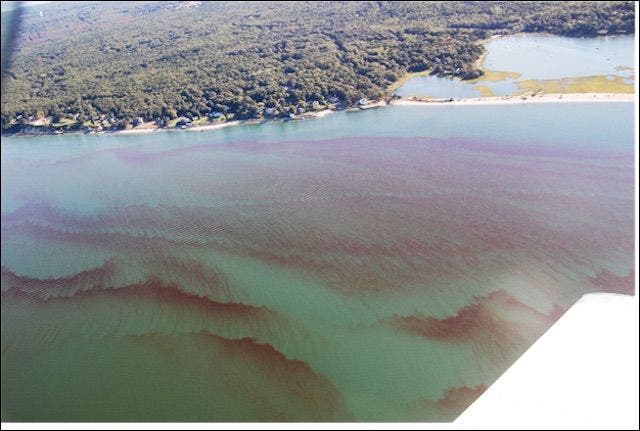
A toxic "rust tide" that began in locations including Sag Harbor and Three Mile Harbor has now spread across the entire Peconic Estuary on the East End, scientists say.
According to a release sent out by Stony Brook University Tuesday, monitoring by The Gobler Laboratory of Stony Brook University’s School of Marine and Atmospheric Sciences indicates that the rust tide has now spread from Riverhead to East Hampton at densities exceeding 3,000 cells per milliliter.
Densities of the rust tide algae, known as Cochlodinium, above 500 cells per milliliter can be lethal to marine life, scientist said.
Find out what's happening in Southamptonfor free with the latest updates from Patch.
While large kills have not yet been reported yet this year, prior rust tides have brought massive fish kills of both natural and caged populations of fish and shellfish on eastern Long Island, the release said.
“We have identified climate change and specifically warm summer temperatures as a trigger for these large, widespread rust tides," said Professor Christopher Gobler. “In the 20th century, summer water temperatures were significantly cooler than there are today. When we have extended summer heat as we have seen this summer, a heavy rust tide often follows.”
Find out what's happening in Southamptonfor free with the latest updates from Patch.
Rust tides were not as extreme during 2013 and 2014 due to lower water temperatures, he said.
A 2012 paper from the Gobler Laboratory also identified nitrogen as another critical factor in "rust tide" events — high nitrogen levels make rust tides more toxic, Gobler said.
Nitrogen loading in Suffolk County has exacerbated rust tide events, he said.
“The links between these toxic blooms and excessive nitrogen loading are now well-established and are playing out again this year,” said Gobler. “Near-shore regions on the East End experience intense nitrogen loadings from wastewater and farms and get these events first, after which they are transported to open water regions. It is likely that the recent, intense rainfall will intensify the rust tide in the coming week.”
Testing has indicated that the alga can kill fish in mere hours and shellfish in days; bay scallops in the Peconic Estuary are impacted by rust tide, Gobler said, with scallops dying off during rust tides and impacting the local East End economy.
“We anticipate the rust tide will intensify in the Peconics and spread to Shinnecock Bay in the coming weeks. Blooms typically persist into the fall or until water temperatures drop below 60 degrees,” Gobler said.
Gobler’s research on rust tide is partly supported by New York Sea Grant, the release said.
Photo courtesy of Auxiliary Coast Guard
Get more local news delivered straight to your inbox. Sign up for free Patch newsletters and alerts.