Community Corner
War on Heroin: Community Leaders, Churches Join Michael's Hope in Battle to Save Lives As Epidemic Spreads
To those in denial that a problem exists in the community, Paul Maffetone said: 'I don't care about property values. I care about our kids.'


NORTH FORK, NY - It’s an all-out war to fight the heroin epidemic on the North Fork and on Long Island — and now, elected officials and church leaders are teaming up to fight back.
Pastor Tom MacLeod of North Fork United Methodist Church joined members of Michael’s Hope Wednesday in the Southold High School auditorium for a “Night of Hope.”
All present agreed to fight the escalating crisis, which is claiming an unprecedented number of victims.
Find out what's happening in Southamptonfor free with the latest updates from Patch.
Faith leaders, elected officials, schools, parents and the community expressed the need to join forces and engage in the fierce war.
Explaining why the faith community has come out to battle heroin addiction, MacLeod said, “As Christians we are called to bring comfort to the suffering and help to those who need it. This is a silent epidemic.”
Find out what's happening in Southamptonfor free with the latest updates from Patch.
The night began with a clip from an HBO series on addiction, with insight from Kathleen Brady of the Medical University of South Carolina, discussing how addiction affects the brain, and common myths about addiction.
It’s important to note that the earlier someone gets help, the better, she said. Another damaging myth, she said, is that people need to want help before they can be treated. “Treatment does not have to be voluntary to be effective,” she said. “I have not had one patient who woke up out of the blue and said, ‘I’m an addict. I need to get clean.’”
Addressing those who attended the event despite the poor weather, Pastor Tom said, “We want the focus of the evening to be one of hope.”
Representatives from a wide number of treatment facilities, including the Maryhaven Center of Hope, the Seafield Center, Alcoholics Anonymous, Narcotics Anonymous, Nar-Anon, and Local Link addressed the crowd, with individuals also sharing their own painful journeys toward the miracle of recovery. The Interfaith Clergy Association of the North Fork and Greenport Ecumenical Ministries also helped to organize the event.
Personal stories of hope
Wearing bracelets that read “We do recover,” one woman, Annie, said, “There is help. There is hope.”
Brett, a heroin addict in recovery, said, “The message here is that recovery is possible. Even for a person as hopeless as myself.”
But the disease is rampant, he added. “From the richest neighborhoods to the poorest neighborhoods. This disease does not discriminate.”
Brett said he didn’t wake up one morning and decide to become a heroin addict. He began smoking pot and drinking and eventually, the illness escalated to his shooting heroin intravenously.
“I ripped through the lives of the people closest to me and became a shell of the person I had been. I welcomed death openly.”
The 12-step program, he said, “promised me a life beyond my wildest dreams.”
Today, he works in a hospital’s cancer center for children. “My life does not have to be this good today and I thank God every day that it is. We can recover from this. Come join me and the thousands of others who are living the solution to the problem.”
Jackie, new to her sobriety, spoke softly. “I was broken before I went into rehab.”
Today, she wakes up at 5:30 a.m. just to watch the sun rise. “I look at how happy and how genuinely proud of myself I am, and of the people around me. I don’t have to wake up sick anymore. Being sober is amazing.”
Pastor Tom said statistics indicate that 10 percent of the population have substance abuse issues, with seven percent in recovery and three percent struggling. In Southold, with an approximate year-round population of 22,000, that means there are 2,200 dealing with substance abuse issues, with 1,600 in recovery and 600 still needing help.
“I’m an addict,” Alfredo said, urging others to join him in recovery .”There are no initiation fees. No dues. Anyone can join us. The newcomer is the most important person at any meeting .We can only keep what we have by giving it away.”
“Every day is not perfect, but every day is better than where I came from,” said Jack, an alcoholic in spiritual recover in AA.
Ted said he has known Pastor Tom for 24 years; they met in the basement of a Presbyterian church at a group for adult children of alcoholics.
Addiction is a family disease, he said. “The focus is on the addict.”
He urged families living with addiction to attend Nar-Anon meetings. “The Ar-Anon person is the one trying to make sure nothing gets knocked over, but the person trying to help the addict gets kicked over. Their life is consumed with the addict. If you have an addict in your life, you know exactly what I am talking about.”
He described a niece in Florida who had been living with her child, 3, in a pickup until he helped her get into a rehab. She was angry when he wouldn’t bring her cigarettes, he said. “When there’s no gratitude, that’s an active addict.”
He added, “It’s been my experience that an addict uses the drugs to try and fill a bottomless abyss that can never get filled, not even with your love. They’re bleeding but we can’t but the Band Aid on them.”
Mary Fogarty said she has been sober since January 12, 1986. ”There is absolutely hope.” An adult child of an alcoholic, she said she is an addict, as are three of her five children.
“We are in the midst of probably one of the worst epidemics ever. We’re losing people at a record rate and most of them are not yet 25 years old.”
Michael’s Hope
Pastor Tom described meeting Paul Maffetone, founder of Michael’s Hope, a 501c3 not-for-profit organization founded in memory of Maffetone’s brother, Michael, who died at 29 of a heroin overdose in their family’s Laurel bathroom.
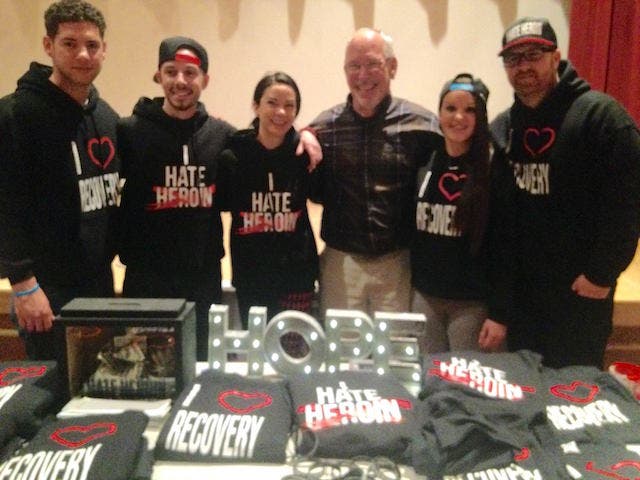
Maffetone and his Michael’s Hope team, including Trevor Murray and Jordan Stierle of Coram, Kristina Amato of Commack, Samantha Paulus of Port Jefferson, and Matt Liquori of Riverhead attended Wednesday’s event; they also recently hosted the first-ever Narcan training session to a crowd, with more than 100 in attendance in Mattituck.
Maffetone began by reading aloud the definition of ”hope,” and said it was a feeling or expectation and a desire for something to happen.
Michael’s Hope stands not only for hope, but for ”heroin, opiate prevention and education,” he said.
Heroin addiction, he said, “has no bias.”
The mission of Michael’s Hope, Maffetone said, is to shatter the sterotypes. “We feel strongly about putting a damper on the stigma of addiction,” he said.
Describing his brother, Maffetone said Michael and grew up with a good family, went on vacations. “We didn’t have everything handed to us but we had a good life,” he said.
Michael, he added, was an ROTC member and a “loving kid” who never even drank or smoked pot. A work-related injury led to a prescription for pain medication, which led him “down the road to institution, incarceration and ultimately, death.”
But, Maffetone added, his team reminds him every day that there is absolutely hope. Three of his Michael’s Hope team members are in long term recovery. Holding up one of the T-shirts the group sells to fundraise, Maffetone read the inscription on the back: “The ugliest disease hides in the most beautiful people.”
And, he said, “This is not just a family disease. It’s a community disease.”
Members of Michael’s Hope shared their stories.
Kristina said that her story was a bit different; she broke her clavicle at 10 and was on 42 types of medication for 10 years. Doctors told her she’d never be able to live without pain medication.
“I told them I’d do it on my own. I found an alternative, spiritual lifestyle.”
Her goal, Kristina said, is to educate young kids and encourage them to never “stop believing in hope.”
Samantha said she prefers to say she’s in long-term recovery, rather than an addict, largely due to the bias and perception that the word “addict” conjures up.
She was 15 when she first picked up a drink, Samantha said; she graduated from Suffolk County Community College and was known for never trying pills. “I would never do them. I didn’t want to be that person,” she said.
It was after two abusive relationships that things changed; she’d started doing drugs with the second person and after they broke up, couldn’t stop. ”I didn’t know what to do,” she said.
Shame, she said, made it hard to ask for help; she said she’d always suffered from insecurities. “I wanted everyone to like me and I didn’t understnad when people didn’t. Drinking made me comfortable in my own skin.”
She added that she was always prone to excess, dancing for seven days a week and eight hours on Saturday. The same thing happened when she got hooked on heroin.
At her first meeting, she cried, feeling the genuine love from strangers.
Now, she shares her message with high school students. Personally, having grown up with the DARE program and the message that drugs can kill, when she tried them for the first time and didn’t die, Samantha said, “I thought my entire life was a lie.”
Now, she wants kids to know if they have a problem, there is help — and hope.
“People do come back from this. I’m all about hope.”
Jordan, sober since 2009, described waking up in the parking lot of the Smith Haven Mall after overdosing on heroin. His first thoughts, he said, were of the video games he’d stolen and hidden, thinking he’d have to sell them to get money for more drugs.
“I was that kid that you did not want your son or daughter to hang out with. I was that bad. I got kicked out of every school, every rehab, every shelter.”
He was crippled by anxiety and depression, Jordan said. “I used those as a crutch not to work or be productive.”
Once he quit playing hockey, his dreams of a career with the Rangers as a goalie died, and so did his dreams. “I never felt loved because I did not love myself.”
But he found recovery, and a new life. On his birthday, reading the cards, he said, “I can’t believe I made it to 30. didn’t think I’d make it to 21. Now I want to live forever.”
Trevor said he grew up in Manorville with a great family and a full life.
He described meeting a girl he cared about and being too scared to speak to her until he’d had a drink and smoked pot. “Then I came back and said to myself, ’She should come to me.’”
Rather than face his fears and insecurities, Trevor relied on drugs for that false sense of bravado from the age of 15 to 23. “I started putting Band Aids on broken legs day after day until I was stuck.”
Finally, he got sober at 23, and now, wants to reach out to teens on an emotional level, letting them know that their feelings are normal.
Maffetone said the mission is to speak at schools, despite the view of some who put up barriers and refuse to see the problem festering in their communities. “They’re afraid their property values will drop. I don’t care about property values. I care about our kids.”
Next up, Maffetone has planned a free Narcan training in Greenport at the Old Schoolhouse on Front Street on March 31 from 5:30 p.m. to 7:30 p.m.
The first session was packed, he said, “Don’t tell me this community doesn’t think we have an issue,” he said.
Most recently, two treatment centers, Serenity Treatment and Brazos Recovery, have offered Michael’s Hope two scholarships that will allow four people to each for a free 90-day program; the scholarships are worth $180,000. “That’s hope,” he said.
It takes a community
Pastor Tom said local churches and synagogues will begin offering vouchers for rides to rehabs, and scholarships. “As a community, we can do a lot,” he said. “We can become a very empowering group.”
Southold Town Supervisor Scott Russell attended the event and pledged the town’s support in the battle.
He said he believes a lack of information and a sense of denial exists in the community. “A lot of people look at this disease and think it’s something that can happen to someone else. I wish this room was loaded with parents.”
Many parents, he added, don’t think their kids can become addicts because they’re playing lacrosse or are engaged in other activities. “That’s a delusion. We need to foster understanding. This isn’t a crime, it’s a disease.”
Also, he said, prevention efforts need to extend beyond one DARE program. “When you’re trying to teach kids math, you stay with it. You don’t just teach it for six months. You need a persistent and consistent message.”
The community, Russell said, needs to pool its resources, with a “commitment from the town” to help.
He said a new part-time youth director will shift the focus of that position to become more involved with the issue of substance abuse among teens in Southold.
“This is a community-wide problem and we need community-wide solutions,” Russell said.
Get more local news delivered straight to your inbox. Sign up for free Patch newsletters and alerts.