Politics & Government
Shinnecock Residents Vow to Continue Fight to Use Coopers Beach, Town, County Beaches, Kick Off Petition
Residents are outraged that they are being charged a fee for land they say is part of their heritage.


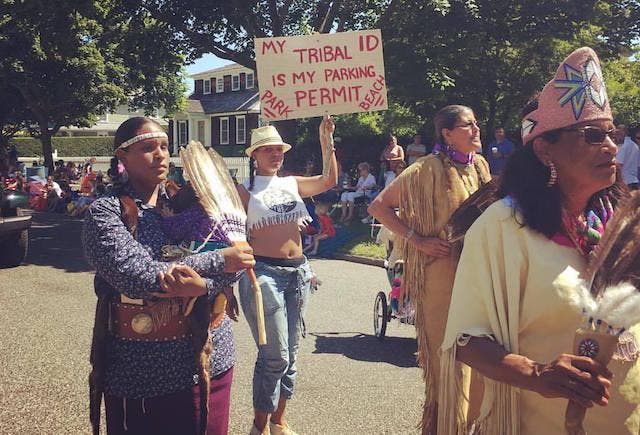
SOUTHAMPTON, NY - The fight escalates as members of the Shinnecock Indian Nation vow to continue their mission to shine light on the fact that they are being charged the same fee as non-residents to park at Coopers Beach.
And now, they plan to take that battle one step further, to encompass town and county beaches.
Residents of Southampton Village are able to park at Coopers Beach for free, but non-residents must pay $40 per day or $225 for the season, for parking and admission.
Find out what's happening in Southamptonfor free with the latest updates from Patch.
And that's something that Shinnecock Indian Nation members take issue with.
Former Tribal Chief Lance Gumbs said the beach was given to the village by the Shinnecock Indian Nation.
"Now you're telling us we can't go?" he asked. "That beach is part of our history."
Find out what's happening in Southamptonfor free with the latest updates from Patch.
Dyáni Brown, a member of the Shinnecock Indian Nation, agreed. "It's outrageous. For one thing, they're trying to charge us to access" the beach, she said.
She added that the are "equally upset" with the fact that they are charged at town and county beaches. "But they don't cost as much. And I got a ticket at the village first, which is why we're starting in the village. Trust, though — we're coming for for the town and county next. If I can walk into any federal park in the United States, show my Tribal ID and not be expected to pay a single red cent, then what makes any of these municipalities think they are above federal law."
Also, Brown said, Southampton Village has the closest strip of ocean to the Shinnecock reservation and hold ceremonial importance.
To that end, she's created a Facebook page, "Shinnecock's Plight for Village Ocean Access," which chronicles the history of the issue and states, "We welcomed them to our shores, now we are unwelcome at our own."
In addition, Brown has launched a petition, "People to Uphold Shinnecock's Right to Access Coastal Waters"; so far, 672 have signed the petition, with 328 more needed.
"Shinnecock, People of the Stony Shore, have every right to free and reasonable access to the coastal waters within their aboriginal territory, today known as the Village and Town of Southampton, and a Shinnecock citizen’s Federal Tribal Identification Card serves as adequate proof of this right," she wrote on the petition's page. "Your solidarity on this matter tells Southampton village and town officials that inventing policies that economically and culturally disenfranchise minority populations is unacceptable."
The Shinnecocks, she said, never relinquished the rights to use oceans and beaches, yet the village is charging those who live on the Reservation a fee. "They're impeding the way we practice our culture," she said.
The Shinnecock and other tribes still use the waters to keep tradition alive, Brown said. For example, on Sunday, on Rhode Island, paddlers from the Coastal Algonquin indigenous communities will participate in the 2016 Paddle to Nisqually Tribal Canoe Journey.
"Our coastal tribes utilize the waterways as ancient highways for thousands of years. As the original population of the American Northeastern region, we have faced European assimilation. Traditional culture is difficult to practice," a GoFundMe page for that event states. "Unity of the Indigenous groups and communities continues to strengthen through cultural customs being encouraged and expected."
Much of the the Shinnecock Nation's rich heritage begins with its history through the waterways, Brown said.
Similar paddle ceremonies are held by tribes throughout the year to honor ancestors.
"That's one of the reasons why I paddle," said Brown's cousin Chenae Bullock. "Presence on the water is a powerful thing. However, if the government is forcing us to pay to be in the water, we cannot be who we are as coastal people. Laws against our way of living has not only aided in the genocide of who we are but are continually oppressing us today."
Brown added that there are treaties that outline the terms of the land transfer regarding Coopers Beach. "We still have the right to fish there, to practice our religion, to access the beach," she said.
Even when a deer is caught, she said, the English traditionally were able to keep the body while members of the Shinnecock Indian Nation kept the skin.
"There's a historical acknowledgement of that sharing," she said.
It's not only Coopers Beach that the village has begun to "monetize", Brown said, but also, inlets and other areas, where permits are now required where they hadn't been before.
Brown added that the many members of the Shinnecock Indian Nation who took part in the recent July 4 parade in Southampton Village, including firemen and EMTs, are proof that they are very much woven into the fabric of the Southampton Village community.
"But they say we are outsiders, because of a border that they put us behind, to put us on the Reservation," Brown said, adding that children from the Reservation attend school in Southampton and contribute to the school budget. "But at the same time you're not going to welcome them to the beach that their ancestors welcomed you to," she said.
Brown added that village residents are afforded the right to access the beach for free because they pay taxes.
"We don't pay taxes because you have the land, you took all of that," she said. "Our compensation for staying behind that border is that we don't have to pay land tax."
Southampton Village Mayor Mark Epley addressed the issue: "As I told representatives of the Shinnecock Nation, Coopers Beach costs money to operate. We maintain the beach, pay lifeguards, beach attendants, remove trash, maintain a parking lot, etc. This all costs a lot of money and people who utilize Coopers Beach should help cover the cost. Why are they not upset about any of the town beaches or the county parks?"
Gumbs responded this week via social media: "What Mayor Mark Epley fails to realize is the true cost of what we lost. All the beach fees they charge for the next 400 years won't make up for that! 1640 to 2016, let's add up the rent for our stolen lands including the eight square miles that encompass Southampton Village — that we let you use — plus modern day interest, and then we can deduct the beach fees from that."
He echoed Brown's vow to look at town and county beaches, as well, as well as federal laws that pertain the Shinnecock Nation's use of them.
"We are the people of the shore," he said.
Get more local news delivered straight to your inbox. Sign up for free Patch newsletters and alerts.