Community Corner
Show Fights Racism With Comedy, Dialogue In Southampton Thursday
Read about last "United We Laugh" audience's riveting truths about being black, Native American, gay, Latino. Don't miss tonight's show.


SOUTHAMPTON, NY — The headlines come rapid fire, spewing escalating reports of hate: tightened security at Syracuse University after a spate of bias and racial bigotry incidents. An explosive Newsday report about the racial divide on Long Island long reflected in the housing and real estate market. An alleged incident where two high school students allegedly peed on a middle school student while using racial slurs against her and three other girls.
And that's just within the past few weeks.
A wave of hatred and intolerance has been intensifying across the United States in past years and months, at times erupting into deadly violence, and the public is left grappling with finding a way to stem the tide.
Find out what's happening in Southamptonfor free with the latest updates from Patch.
That's where one man, a comedian well-known for his work on "The Dr. Oz Show," has stepped in to create change with a show that audiences have embraced.
Comedian Richie Byrne believes that in a world ripped apart by racism and hate crimes, the only way to bridge the gap is by bringing people together through humor and sharing honest and meaningful conversation about what can be done to work together toward solutions —and hope.
Find out what's happening in Southamptonfor free with the latest updates from Patch.
But that's not easy when comedians today are vilified for cracking a joke, often losing gigs if their humor is perceived as politically incorrect. It's Byrne's belief, though, that the only way people can come together is by recognizing diversity and celebrating that in the end, we are more alike than different.
His new comedy show, "United We Laugh," has been touring the East End in recent months, and the dialogue sparked has been life-changing, according to audience members who open up honestly to share their most painful truths with an eye toward stamping out racism and intolerance forever.
Created by Byrne, hosted by Southampton Village, the Southampton Anti-Bias Task Force, and the Southampton Cultural Center and moderated by Southampton ABTF chair James "Dr. Love" Banks, the next "United We Laugh" event unfolds on Thursday, Nov. 21 at the Southampton Cultural Center, located at 25 Pond Lane in Southampton. Doors open at 6 p.m.; the show begins at 7 p.m. Tickets for the show cost $20; $10 for students under 21. Tickets are available at the door or online here.
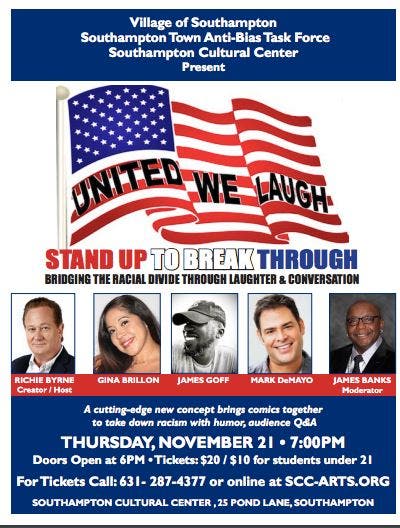
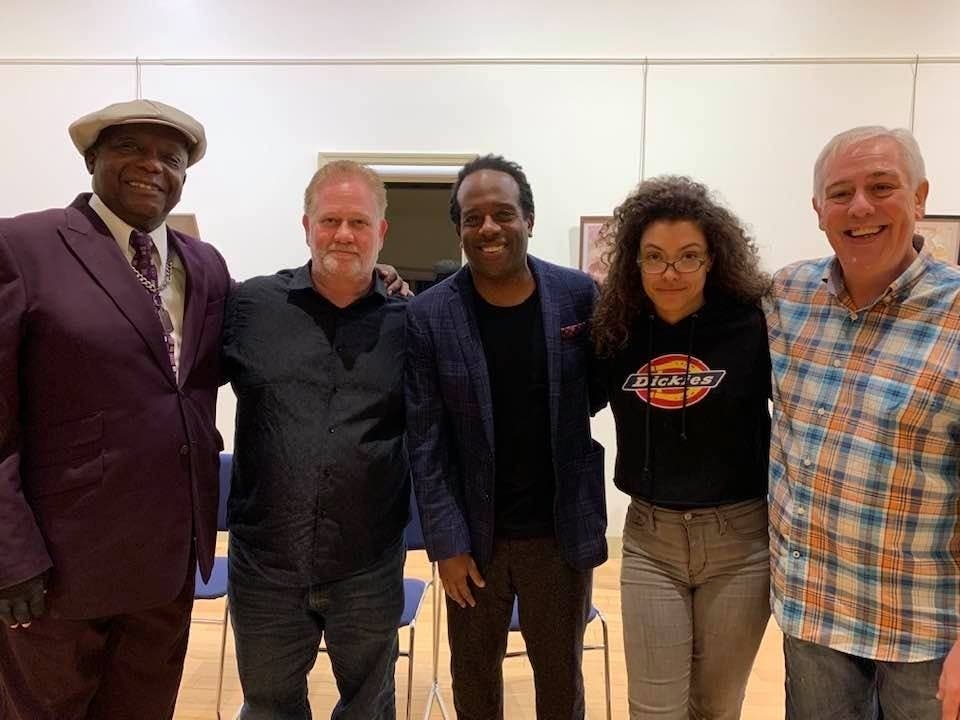
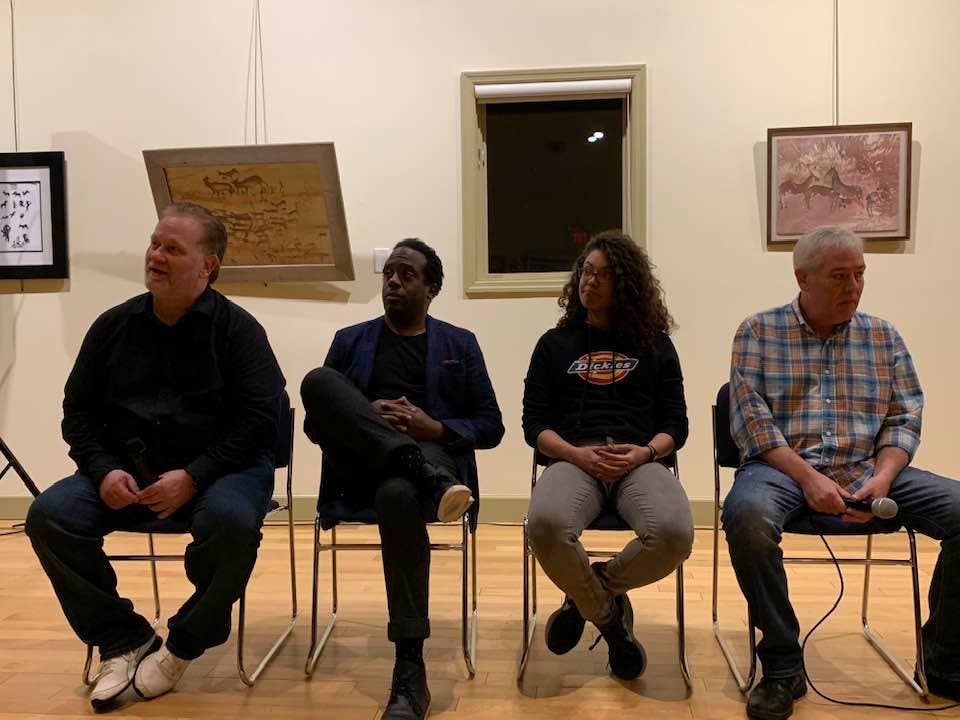
The show features an A-list lineup including creator and host Byrne, Gina Brillon, James Goff, Mark DeMayo and moderator Banks.
At the last "United We Laugh" event, the ever-revolving roster of comics included Vic Henley, Melissa Diaz, and Wali Collins.
The audience at that show delved deep and shared their heartfelt emotions about the hatred that divides.
"White people, because they have not experienced the things people of color have experienced, are not going to acknowledge the hardships, pain, and trauma people of other races have gone through," one woman said. "If people from those races expressed those traumas, many would say, 'It was so long ago.' 'It wasn't that bad.' 'Why should we talk about this?'"
Why, indeed.
Talking, and real community dialogue, Byrne believes, is the only way to create real change.
One woman, who attended "United We Laugh" shows in both Hampton Bays and Bridgehampton, said there is rampant racism in the Hamptons, with at least one Klu Klux Klan member distributing literature in Hampton Bays. "It breaks my heart to see it still alive," she said.
Henley, who grew up in the Deep South, recalls coming home from elementary school and seeing paid political announcements by "old racist guys, saying horrible things. I'm trying to watch Bugs Bunny."
Those childhood experiences leave an impact, Banks said. In his work with college students, he discusses post-traumatic slave syndrome, "which is the handing down of some of those discriminating attitudes, or the reaction to them. And it keeps them alive."
Throughout history, he said, one of the ways racism was passed on "was through jokes."
"But it's also the best way to take the edge off of these subjects," Byrne maintained.
"Absolutely," Banks agreed. "Because in this program, you aren't putting people down. You are actually asking people to open up and talk about it. The great thing about comedy is that it loosens people up so they can talk about these issues."
One man said he had no idea how racist Long Island was. "Levittown didn't allow blacks. Long Island's DNA is racism against African Americans — and I don't know why people don't talk about it. There's a fear of change, of losing power," he added.
Minerva Perez, executive director of Organizacion Latino-Americana of Eastern Long Island, grew up in a mixed Miami community. "I'm hispanic but when I came to Long Island, I became Latino. I couldn't understand what was happening here, with the sentiments around the immigrant community, the Latino community — because no one seems to be an immigrant around here anymore, just Latinos."
That backlash, she said, is damaging to children. "Working in the schools, you see self-hate. These kids hate themselves, hate their language." Anti-immigrant sentiments are seen among young kids, she said. Schools, she suggested, should commit to bringing similar comedy programs in, to tackle hatred with humor.
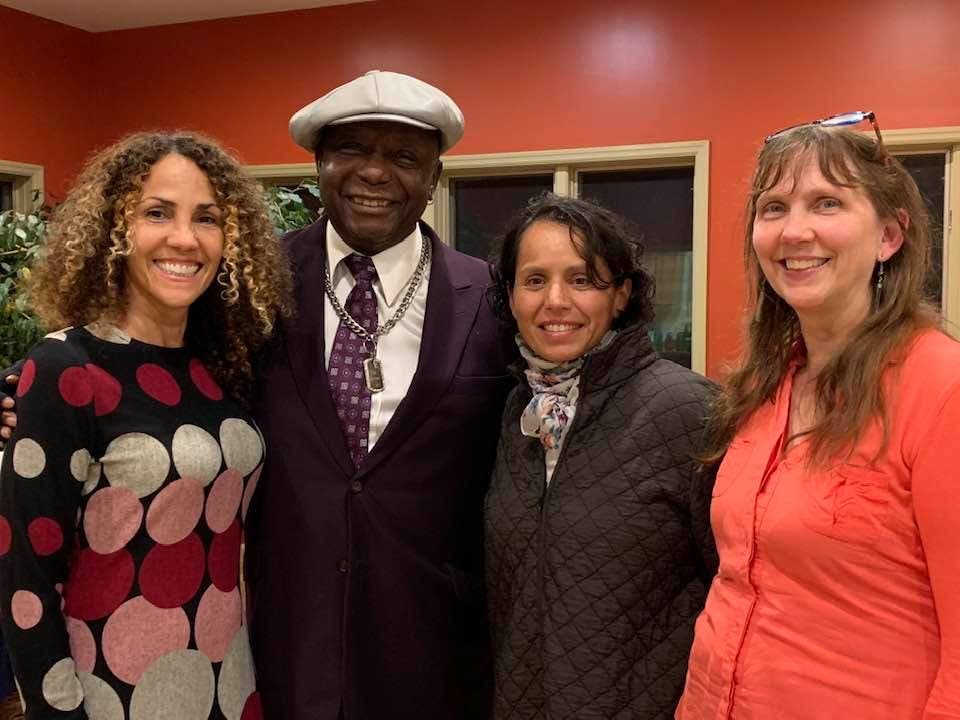
"We have videos of children, just 4 or 5, who dislike people of color — and some are people of color," Banks said. "They don't like themselves, at their age."
Sandra Dunn asked where comedians draw the line. "How do you decide where that line is?"
"There's no line," Henley said. "It's either funny or it's not. The line is when no one laughs."
And indeed, all the "United We Laugh" shows have drawn diverse crowds together in laughter. One woman left saying her cheeks hurt from laughing so hard. In that humor, honest dialogue followed.
One man said it's easy to be bold when everyone in the room shares your beliefs — Byrne agreed and said the whole mission of "United We Laugh" is to bring all voices together to listen and communicate in a safe space.
"I am gay," one man said. "I know what it's like to be discriminated against. I came to this country in 1960. I couldn't even come of the closet. I met my lover one year after I'd been here. Unfortunately, he died 12 years ago at which point we had been together 47 years," he said. "When we first moved out here to Southampton, we were very very picked upon by the children. They would come and throw rocks through out windows, write 'queer' on the side of the house. I know what it's like to be discriminated against too. I know hatred."
Collins said he respected the man's plight. "As a gay man I know you are having a struggle; however, being a black man does not equate to being a gay man. You can walk into this room and you have to say that you're gay, I walk into this room and everyone knows I'm black, just because I walked into the room."
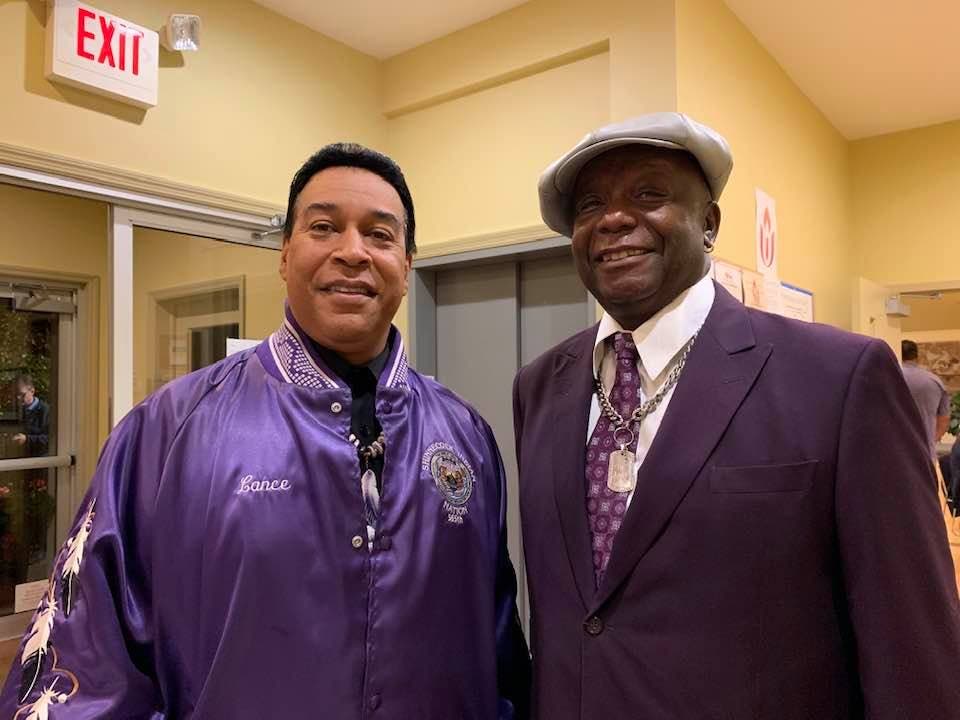
Lance Gumbs, vice chairman of the Shinnecock Indian Nation, spoke about institutional racism he and members of his tribe have experienced. Public perception often depicts Indians as similar to an Indian many have seen in a commercial, "with a tear on his face. That was the type of stereotype, there's a certain look — you have to have hair in a long braid," he said.
Growing up in Southampton, Gumbs said: "I got kicked out of school because three white boys on the football team wanted to cut off my hair one day. My father made sure we all knew karate so those boys went to the hospital. The one that got kicked out of high school was me because I was 'violent.' They tried to cut off my hair with a weapon in their hands, but I got kicked out of school. These are the kind s of things we have to live with in our community."
The erection of a large electronic sign on Sunrise Highway has sparked a sea of controversy and hateful comments, Gumbs said; the "appalling" vitriol has been poisonous to children on the reservation, he said.
"We tend to be this forgotten people," he said. "The reality is, I can trace our history here back to 1640 and the first written word in this community."
Another heated issue faced by Native Americans, he said, is the NFL's Washington Redskins' name and mascot. "The Washington Redskins have no idea what that word means to us," Gumbs said. "Everyone thinks it's a joke. In the 1700s there were posters that read, '50 shillings for the red skin of an Indian man,' '25 shillings for the red skin of an Indian woman.' '15 shillings for the skin of an Indian child.' For us, that word is extremely sensitive. How would they feel if we had the Kansas City kikes? Or the San Francisco chinks? Or the Atlanta niggers? We are not mascots. We are the forgotten people."
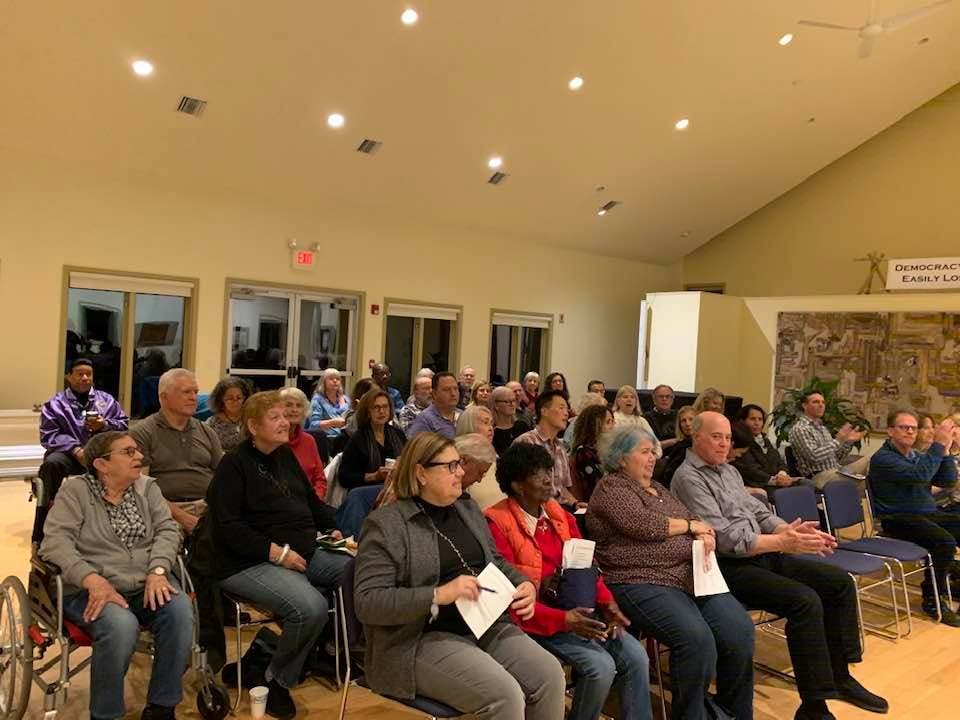
Others spoke about the unique challenges of being a white parent raising a black child and the questions that experience evoked.
It's that healthy dialogue, infused with humor, that stands as a testament to the healing power of laughter, Byrne said.
Sonia Spar, chair of the Southold Anti-Bias Task Force, applauded the show's message and said it is needed in today's divided world.
In a nation fiercely divided, with headlines about heated cases sparking racial tensions and hate crimes an escalating concern, the hilarious show was designed to help heal the angry chasm through hope and lead through laughter.
Conceived by Byrne, a comedian who wows with his warm-up on "The Dr. Oz Show", sold-out shows nationwide, and TV and film appearances, the show focuses on giving audiences the chance to share their unique perspectives — to listen and discuss explosive issues in a safe, non-confrontational space, where laughter has eased tensions.
"A major part of this dilemma is our inability to see the alternate perspective. We need to hear another's point of view in a way that's more relatable and less volatile," Byrne said. "The only way to accomplish this, one that's been overlooked, is through humor. Off-the-cuff honesty in humor has been compromised by a spike in sensitivity on all sides to the fear of offending. Humor is the most important tool in American society, and yet, the one component that seems to be lacking when it comes to race relations."
Plans for "United We Laugh" include a multi-cultural tour, a podcast, Facebook Live program and television show designed to heal through hope and lead through laughter.
"America has become too rigid, too serious," Byrne said. "This attitude has made our country dangerous. We need to open up and explore our feelings. Comedy is a unique way to do this. 'United We Laugh' seeks to offer understanding and insight into another person's racial point of view. By shifting the focus toward 'funny' these issues may not seem as dangerously divisive."
The kick-off "United We Laugh" show, held at the Hellenic Snack Bar & Restaurant in East Marion recently, followed by another thought-provoking and insightful event at the Hampton Bays Senior Center in September and the Unitarian Universalist Congregation of the South Fork in October, were successes, drawing an engaged crowd who spoke for more than an hour both times on critical issues.
"This is tremendous," said Lucius Banks, of the Long Island Chapter of the NAACP, after the Hampton Bays show.
"It's so needed," said another woman who shared her experiences at the event. During the show, not only the comedians and moderator Banks but also the audience opened up about how their lives had been touched and in some cases, deeply torn, by the racial divide.
"It's pretty obvious that people want to talk about this, want to open up," Byrne said. "And, there has been a level of civility that was important and needed as we move forward."
Byrne's premise has long been that in an atmosphere of friendship, it's always easier to discuss issues including racism without rancor, due to the level of trust and respect. That environment is one he hopes to foster in the "United We Laugh" shows, where the mood is reminiscent of a group of friends sharing conversation over dinner. "When you go to a party, you sit, you laugh, and you debate — and that's what happens at these shows," Byrne said.
The show, he added, is important now more than ever. "Comedy can help defuse the anger and leave it at the door — making the show a safe place to discuss the issues. At this juncture in society, this show is necessary," he said. "The goal is to make people laugh and discuss bias without boundaries."
Get more local news delivered straight to your inbox. Sign up for free Patch newsletters and alerts.