Politics & Government
County Exec, Candidate Seek EPA Help With Toxic Algae In Putnam
HABs threaten drinking water and recreational use of the lakes in Putnam County and across New York. See tips for the public.


PUTNAM COUNTY, NY — County Executive MaryEllen Odell and Chele Farley, who is running for Congress in the 18th district, are demanding the federal Environmental Protection Agency act to help clean up and prevent harmful algae blooms in bodies of water around the Hudson Valley. Putnam County lakes have been specially hard-hit in recent years.
The increasing frequency and duration of HABs threaten drinking water quality and the recreational use of the lakes in Putnam and elsewhere.
Toxic bacteria, naturally present in low numbers in lakes and streams, grow quickly in warm, shallow, undisturbed surface water that gets a lot of sunlight. When this happens, floating scums on the water surface may appear, along with discolored water covering all or portions of a lake.
Find out what's happening in Southeast-Brewsterfor free with the latest updates from Patch.
At high levels, ingestion of that bacteria may cause nausea, diarrhea and vomiting, along with irritation of the skin, eyes, nose, throat, and respiratory tract.
Prevention efforts focus on ways to control the level of nutrients the algae receive. These include promoting efficient septic systems operations, reducing plant fertilizer use, and managing storm water.
Find out what's happening in Southeast-Brewsterfor free with the latest updates from Patch.
Odell and Farley will meet with local residents and elected officials at Lake Casse in Mahopac on Wednesday and hold a press conference.
Farley, a Republican who is challenging Rep. Sean Patrick Maloney in the 2020 election, told Patch that she supports the work of the EPA to protect the environment and preserve natural resources.
"That is why it is critical for them to step up and help cure our lakes of toxic algal blooms. Beyond that, Congress needs to execute its oversight authority to make sure that the EPA doesn't use its regulatory authority to legislate actions and outcomes that should be left to our elected representatives," she said.
She acknowledged the GOP administration's initiative to cut funding for the EPA by 30 percent.
"When I get to Congress, my focus will be to work through the budget process to make sure that the core functions of agencies are appropriately funded, while looking for ways to reign in federal spending and reduce the deficit," she said. "However, my top priority must and will be to fight for the needs of the people of the Hudson Valley, including tackling critical environmental issues."
The increasing number of harmful algal blooms (HABs) around New York State has plagued local and state officials. Click to use the state's interactive map of 2019 HAB outbreaks (shown in screenshot below).
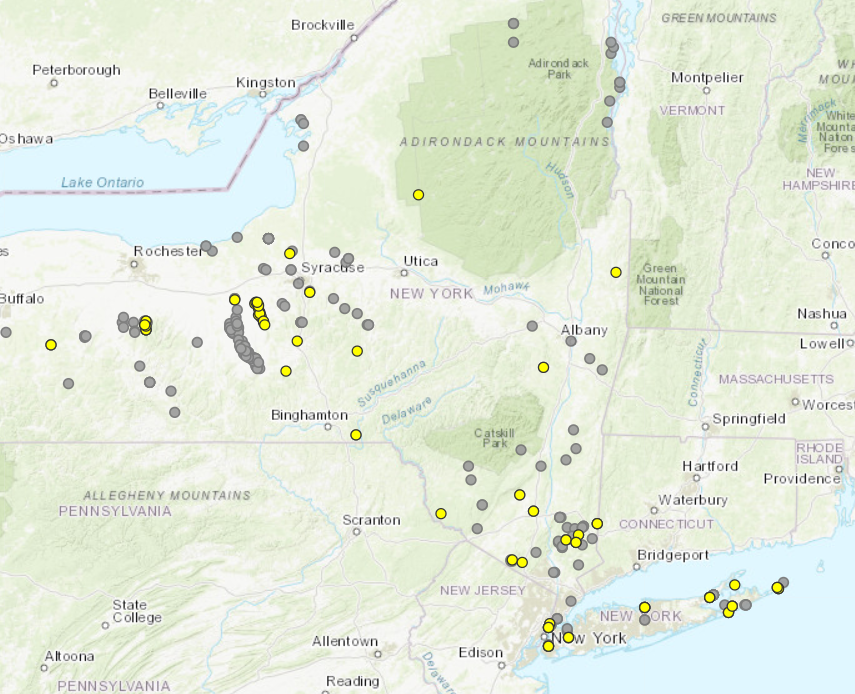
New York State level action plans to reduce harmful algal blooms in Lake Carmel and Palmer and Putnam lakes in Putnam County were initiated in 2018.
Putnam Lake is a 226-acre lake in the town of Patterson, Putnam County. Putnam Lake has shown elevated nutrient levels typical of other New York lakes that exhibit frequent HABs. The lake has suffered more than 30 weeks of documented HAB outbreaks since 2012. It is part of the New York City watershed.
Lake Carmel, a 187-acre lake located in the town of Kent, Putnam County, has shown elevated algal levels, typical of other lakes in the Lower Hudson with high phosphorus and nitrogen levels. Lake Carmel suffered 18 weeks of HAB outbreaks, resulting in more than 30 days of beach closures in 2017. It is part of the New York City watershed.
Palmer Lake is a 14-acre lake in the towns of Kent and Carmel, Putnam County. Palmer Lake has shown elevated nutrient and algae levels, although most of these blooms are not comprised of cyanobacteria, but instead are filamentous algae blooms. Palmer Lake suffered its first HAB outbreak in 2017, despite high nutrient and algae levels. It is also part of the New York City watershed.
New York environmental officials offer these recommendations for the public:
- People, pets and livestock should avoid contact with any floating mats, scums, or discolored water. Colors can include shades of green, blue-green, yellow, brown or red.
- Never drink, prepare food, cook, or make ice with untreated surface water, whether or not algae blooms are present. In addition to toxins, untreated surface water may contain bacteria, parasites, or viruses that could cause illness if consumed.
- People not on public water supplies should not drink surface water during an algal bloom, even if it is treated, because in-home treatments such as boiling, disinfecting water with chlorine or ultraviolet (UV), and water filtration units do not protect people from HABs toxins.
- If contact occurs, rinse thoroughly with clean water to remove algae.
- Stop using water and seek medical attention immediately if symptoms such as vomiting, nausea, diarrhea, skin, eye or throat irritation, allergic reactions, or breathing difficulties occur after drinking or having contact with blooms or untreated surface water.
- If you suspect that you have seen a HAB, report the HAB to DEC. Fill out and submit a Suspicious Algal Bloom Report Form. If possible, attach digital photos (close-up and landscape to show extent and location) of the suspected HAB in the web form. Email HABsInfo@dec.ny.gov if you are not able to complete the form.
- Report any health symptoms to NYS Health Department at harmfulalgae@health.ny.gov and your local health department.
SEE ALSO:
Get more local news delivered straight to your inbox. Sign up for free Patch newsletters and alerts.