Community Corner
The State of Hudson Harbor, Part 2
A two-part series on the state of the Hudson Harbor development, and all the strings attached.


Note: This is the second part in a two-part series. You can view the first part here. We were unable to get the latest design plans from the developer. The village could not provide renderings because they have not been fully approved.
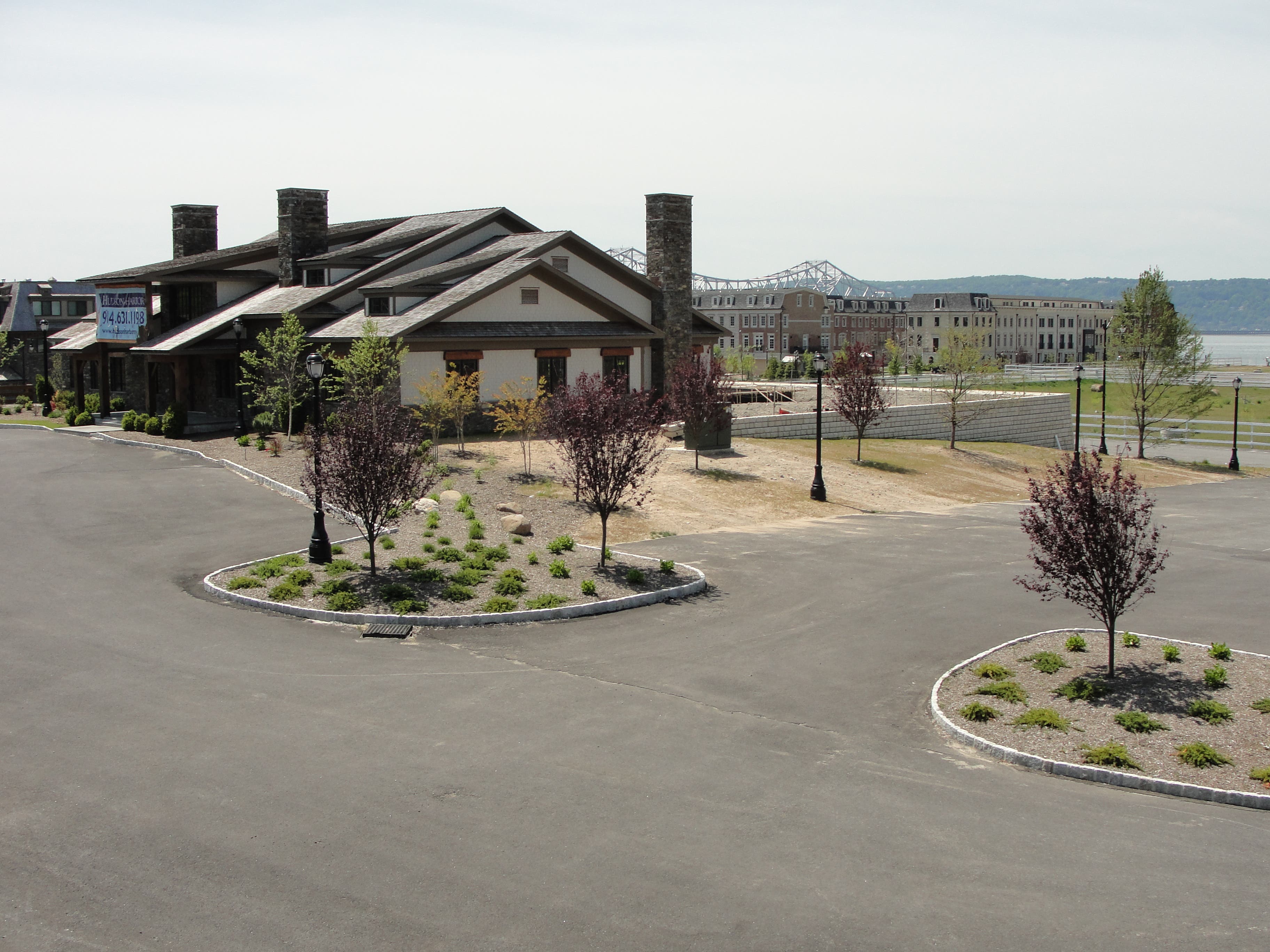
Hudson Harbor, the sweeping waterfront redevelopment that will also net the village a new aquatics center, is moving ahead with a few design changes, town officials said.
Late last month the town planning board gave their preliminary approval for Tarrytown Waterfront, LLC, the developer, to begin building two, twin 52-foot tall residential buildings along the water, documents show. Some members of the planning board are still concerned about the overall energy impact of the buildings, which uses a large amount of glass. The village's Architectural Review Board also gave approval for the two buildings, but asked that some of their concerns, mainly the wooden roof trim on the end of each building, be addressed before the project moves forward.
Find out what's happening in Tarrytown-Sleepy Hollowfor free with the latest updates from Patch.
The buildings, which will house as many as 52 condominiums each, will be four stories above their parking garages, a story more than the original plan agreed upon between the developer and the city in February 2006. The pool facility structure has remained unchanged.
Construction is likely to start within the next two months on phase two, town officials said.
Find out what's happening in Tarrytown-Sleepy Hollowfor free with the latest updates from Patch.
The planning board also gave the partial-green light for the developer to build 28, two-story townhouses in back of the waterfront towers. The townhouses will be separated by an acre-wide, round courtyard, which will be landscaped with native plants. The village's Architectural Review Board has not given final approval to the design plans for the condominium units.
"It opens the view corridors, so it's a nicer plan," said Kathy D'Eufemia, assistant to the village administrator.
She said changes to this portion of the project, known as Phase II, reflects the fact that thus far the condominium apartments have sold faster than the townhouses.
"The condos seem to be selling, that's why the board gave them permission to do more on the waterfront," D'Eufemia said. "We heard that they had some difficulty marketing the large townhouses, which is why in the second phase they are making smaller townhouses."
D'Eufemia said that each of the development's phases would bear some reflection of the economy, such as the recent decision to build more condominiums and smaller townhouses. The new plans also allow for the developer to combine units in the waterfront towers to market larger condominium units.
"In any of these projects marketing becomes an issue in terms of what you do for the next phase," she said.
She said she does not know when Phase III will begin. According to the Hudson Harbor website the project is moving along at, "a steady, measured pace."
According to the Tarrytown Building Department, Hudson Harbor currently has 31 certificates of occupancy. This is a noteworthy number because according to the agreement between the town and the developer, Ferry Landings LLC (owned by Natural RE/sources the same parent company as Tarrytown Waterfront LLC) Hudson Harbor is now 16 certificates of occupancy shy of activating an important deadline.
Within two years of the date that Hudson Harbor completes its 48th unit and receives its 47th certificate of occupancy, the developer must build the village a 22,500 square foot aquatics center, or it must give the village $5 million to build its own aquatics center.
Another part of the agreement, that the developer build an extension to the Senior Center, was finished two years ago, village officials said.
Joe Arduino said that since the addition was built, membership in the senior center has increased by about 100 to 350. He said the new space has helped accommodate the center's growth.
"It's been great," he said. "It's helped out overall with everything we've done."
D'Eufemia said demolition is set to begin next month on the former Tarrytown village hall site on Wildey Street where the developer agreed to build 12 units of moderate-income housing.
According to the 2006 agreement, the developer would build the moderate-income housing at the former village hall site in exchange for not making those units part of Hudson Harbor. Should the village hall site be too small for the moderate-income housing, the village will work with the developer to find plots of village-owned land..
Village officials say they do not know when construction will begin on the moderate-income units.
The developer will also pay the village $1 million toward its $10 million new village hall, which opened two years ago, officials said, and $750,000 for the purchase of the affordable housing land.
Once the affordable housing property is conveyed to the owners of the Hudson Harbor project, the developer will have to pay $1.25 million and an additional $250,000 per year, for two years to cover the cost owed to the village.
"They owe us $750,000 for purchase of the land," Village Administrator Michael Blau said. "But that might not happen for another two years."
Natural RE/sources negotiated with Tarrytown for more than a decade before reaching agreement on Hudson Harbor.
According to a Draft Environmental Impact Statement from 2004, Hudson Harbor would bring around 287 new residents to Tarrytown, a 2.2 percent increase in the village's population. They are expected to contribute taxes in the amount of $481,897 to Westchester County, $26,902 to the Town of Greenburgh, around $1.1 million to the Village
of Tarrytown and nearly $2.7 million to the school district.
The document notes that, "This 821 percent increase in taxes will produce tax revenues greater than the municipal and school districts costs incurred due to extra demand for their services."