Neighbor News
Four Yorktown High School Seniors Named Regeneron Scholars
Diagnosing eye diseases. Treating stroke. Fighting cancer. Helping the visually impaired. Yorktown HS seniors tackled all of these topics.
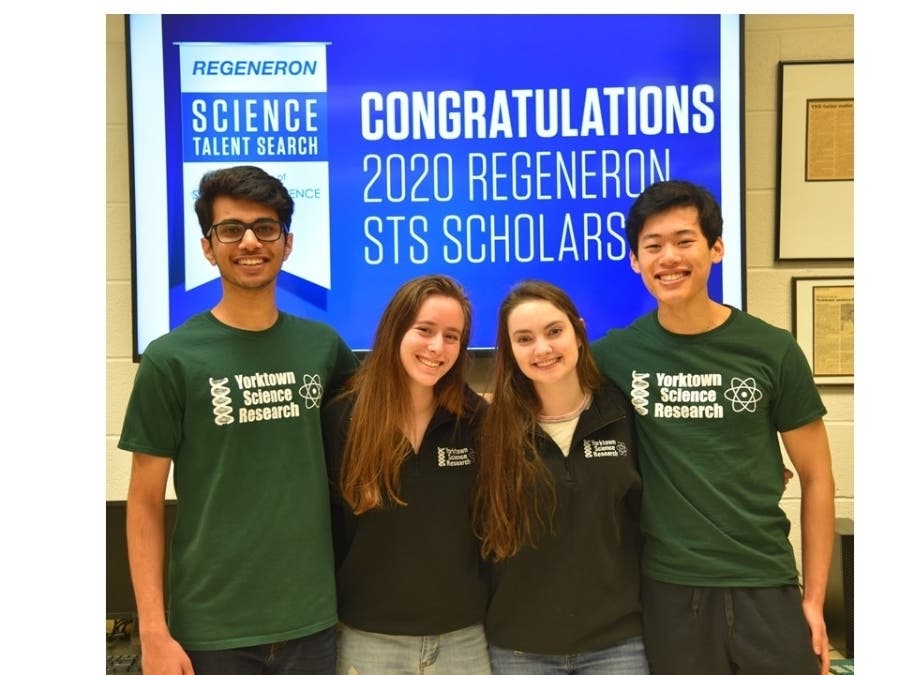
Diagnosing eye diseases. Treating stroke patients. Fighting cancer. Helping the visually impaired.
Those were the ambitious goals that propelled four Yorktown High School seniors to be named Scholars in the Regeneron Science Talent Search, the nation’s oldest and most prestigious science and math competition. Three hundred scholars were selected from 1,993 applicants from 659 high schools in 49 states, two U.S. territories.
Seniors Snehal Dubey, Sophie Vernik, Alanna Moskowitz and Andrew Lu, all members of Yorktown High School’s longstanding science research program, were recognized for their exceptional research skills, commitment to academics, innovative thinking and promise as scientists.
Find out what's happening in Yorktown-Somersfor free with the latest updates from Patch.
Snehal’s project, “The Application of Computer Algorithms for the Diagnosis of Eye Diseases Using Fundus Images,” used algorithms and artificial intelligence to analyze eye scans to detect diseases like glaucoma and diabetic retinopathy.
Snehal said he was inspired to study eye diseases by his experience going to an eye clinic in India, where his family lived for three years. “We spent two or three hours waiting for an exam and the place was packed, which made me realize how common eye diseases are,” he said.
Find out what's happening in Yorktown-Somersfor free with the latest updates from Patch.
Alanna’s project, “The Role of Secondary IDH2 Mutations in Drug Resistance and Cancer Development,” looked at drugs that can inhibit a gene mutation that causes cancer. Although researchers have identified a drug to inhibit the mutation, they have found that the body develops resistance to the drug through the development of a secondary mutation. Alanna looked at why that was happening and whether a second drug could prevent the subsequent mutation.
Sophie’s project, “Spreading Depolarizations as Preconditioning to Post-Stroke Neuronal Death,”
examined the effects of a history of migraines on stroke survivors. Although it is counterintuitive, Sophie said, patients with a history of migraines appear to suffer less brain cell death after stroke than those who did not have migraines.
Andrew’s project, “Mobile RGBD-based Situational Awareness Aid for the Blind and Visually Impaired,” sought to alleviate some of the challenges of the blind and visually impaired by using an app that can detect obstacles up to 12 feet away, and can aid in reading signs with text. Unlike a cane, which can only detect obstacles on the ground, the app can detect obstacles that are raised off the ground. In testing, the app had 85.5% accuracy in detecting obstacles and 80% accuracy in reading signage.
All of the winners praised the district’s science research program, which is run by Michael Blueglass and Rachel McNelis, and the overall support provided by the school administration and faculty.
“I think science research might be the most important part of my high school career,” said Sophie. “It taught me discipline and how to explain and present my findings, skills that I will use for college and the rest of my life.”
“We’re very lucky and blessed to have so much support for this program from the parents, our fellow teachers, community members and administration,” said McNelis.
Blueglass said, “The skills and knowledge that they have learned throughout the entire process will last them a lifetime. We know that they will continue to make a difference in college and beyond.”