Community Corner
Law and Order in Newtown
The Newtown Heritage Walk recognizes Newtown's role as county seat from 1725 until 1812.
While Newtown preceded Doylestown as the county seat from 1725 until 1812, the seat’s location and subsequent move followed William Penn’s vision for the commonwealth.
After Penn was granted the charter for Pennsylvania, he drew up a set of laws for government and a preliminary constitution he called, The Frame of Government of the Province of Pennsylvania in America, according to opening notes in The Records of the Courts of Quarter Sessions and Common Pleas of Bucks County, Pennsylvania 1684-1700.
The Frame “authorized standing Courts in such places and numbers as they should judge convenient for the good government of the Province,” it quoted.
Find out what's happening in Newtownfor free with the latest updates from Patch.
It’s not surprising that in 1684 the first Court House should be located in Falls Township near the Delaware River and below Morrisville –- not far from Penn’s estate, Pennsbury. The location was called Crewecorne and was also referred to as Crookhorne.
Until 1752, the Bucks County border extended all the way to the New York colony line.
Find out what's happening in Newtownfor free with the latest updates from Patch.
Therefore, prior to the designation of the Bucks County seat in Falls Township, Upland Court in New York had jurisdiction over Bucks County to the Falls and the Manhattan Court had jurisdiction over the probate of wills, according to the Pennsylvania Magazine of History and Biography, Volume 26.
As the population of the colony expanded, the move of the County Seat to Bristol in 1705, 10 miles north to Newtown in 1725, and to Doylestown in 1812 followed Penn’s call for convenience. In fact, when a petition was presented before the assembly to move the seat to Newtown, it was considered at the time to be about the center of the county.
An Act of Assembly of 1723 made Newtown the seat and appointed William Biles, Joseph Kirkbride, Thomas Watson, M.D. and Abraham Chapman as commissioners. They were tasked with purchasing property on which to build a court house and prison, according to W. W. Davis’ History of Bucks County.
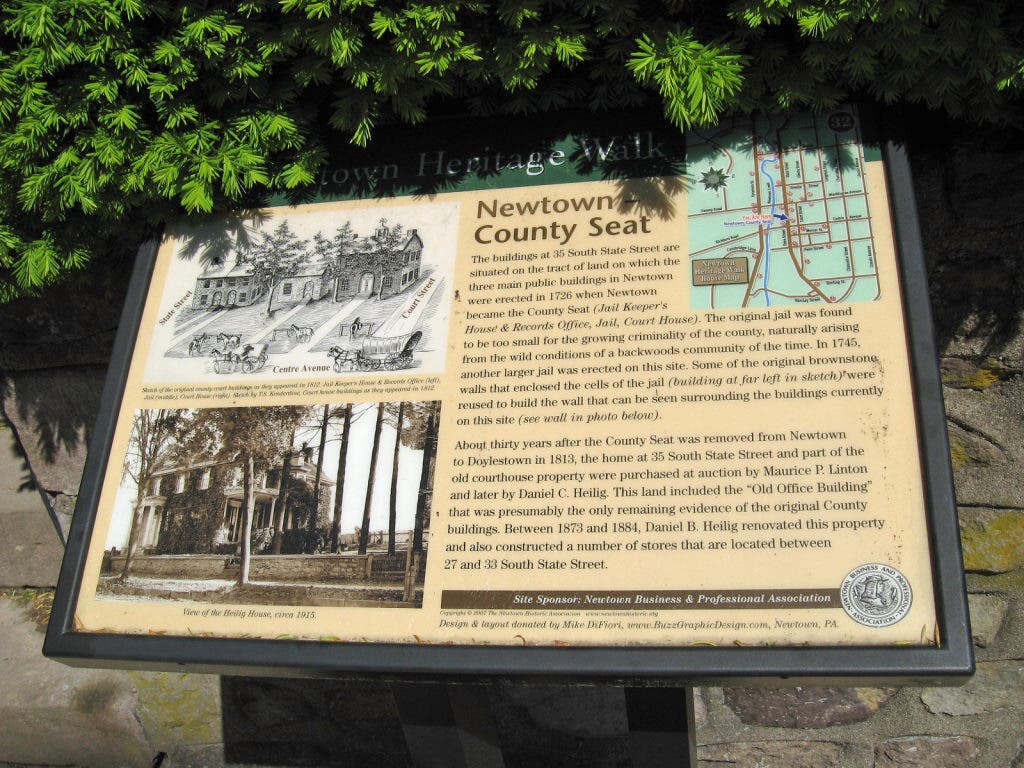
On July 17, 1725, they purchased five acres on the east side of State street, (now in the heart of the borough) for that purpose from John Walley, son of Newtown’s original settler Shadrack Walley. The purchase price was twelve pounds, five shillings. Extending from Washington Avenue down to Penn street, Court Street divided the acreage, which was laid out in six squares, according to Davis, with the courthouse and prison built on the first square.
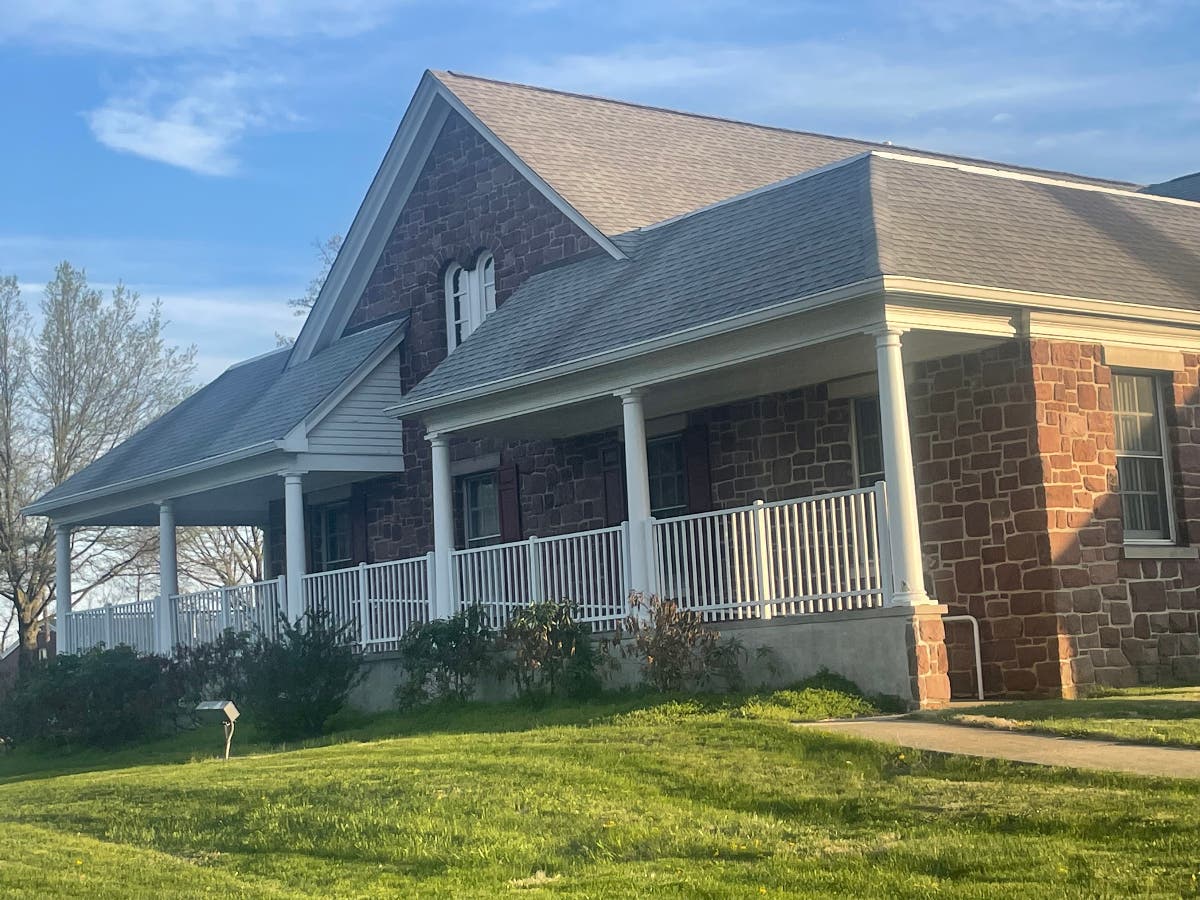
The buildings at 35 South State Street are built on that particular tract of land and a Newtown Heritage Walk marker is placed at the site.
A circa 1930 account written by Mary T. Hillborn on the topic of the court for discussion at a New Century Club meeting was reprinted in a July 23, 1970 issue of the Delaware Valley Advance.
Hillborn described the courthouse as “a two-story stone building – double doors in front-fire-place in each end of the building, stone chimneys, old-fashioned hip roof, and a square box on top in which hung the bell.”
“The high ground on which the court buildings were erected gave them a very inspiring appearance from King Street, now Centre Avenue,” Hillborn wrote.
The commissioners were authorized to sell land not needed for the court house and other public buildings, which they did. The fifth square was sold off to Joseph Thornton, who built the Court Inn, now home to the Newtown Historic Association. It was one of several inns and public houses that catered to the court’s booming clientele.
Indeed, those looking for a wee drop – including prisoners – didn’t need to go far. One of the jailers, Paddy Hunter, sold rum in the prison office, according to Davis’ history.
During its tenure, members of the Society of Friends such as Joseph Smith of Buckingham were jailed for their stances on the Revolution. Another prisoner was Elizabeth Thomas who plead not guilty to murder. She was convicted of manslaughter and branded with a hot iron on her hand, according to Hillborn.
Prison overcrowding was a problem even in Colonial times. In fact, a new jail had to be built in Newtown as early as 1745. The old jail then served as a workhouse for the prisoners.
When discussion of building another new jail came up in 1800, county residents, who had a few years earlier begun petitioning for the county seat to move farther up-county, pressed the issue, according to Davis. A bill was subsequently signed by the governor on Feb. 28, 1810 to move the seat and appoint three non-biased persons to make suggestions. Doylestown was chosen.
There was much public dissent, however, after the move. So much so that several petitions as late as 1855 were presented to the assembly to divide the county and restore Newtown as the county seat.
Interestingly enough, for those who might remember an effort by a Northeast Philadelphia politician in the 1980s to secede from Philadelphia, the early townships that make up that section of the city (and incorporated into it in 1854) were part of the 1855 plan to expand the lower boundaries of a separated Bucks County.
“The bill passed the house but the senate committee reported against it, and it was not brought up again,” Davis wrote.
For more information, click here.