Crime & Safety
Cause Of Fatal Philadelphia Amtrak Derailment Revealed By NTSB
The National Transportation Safety Board revealed the cause of last year's fatal derailment during a meeting Tuesday.


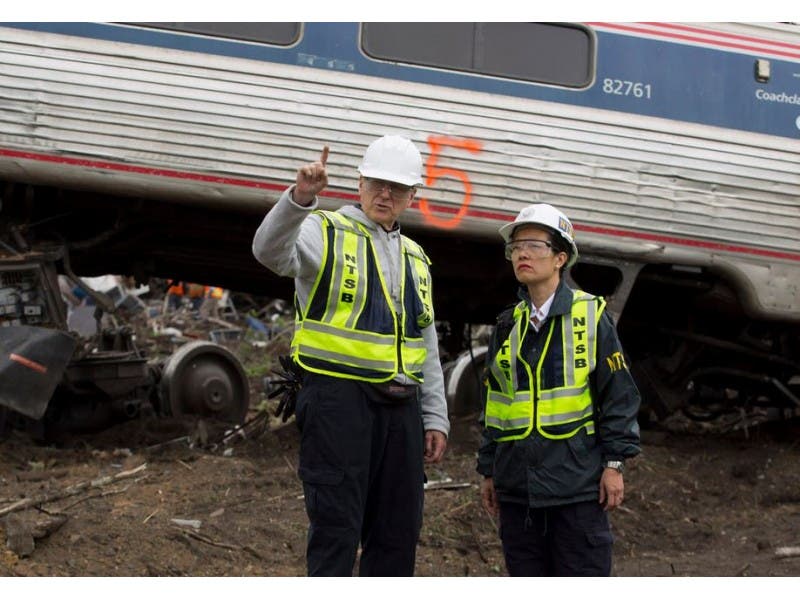
The engineer of Amtrak Train 188 was distracted by radio communication just before the train derailed in Philadelphia last May, killing eight people, investigators with the National Transportation Safety Board said Tuesday.
Investigators believe Brandon Bostian was distracted by reports that a nearby SEPTA train had been struck by debris. Bostian was concerned there were SEPTA workers on the track near the disabled train and worried for the safety of the SEPTA train and its passengers, the NTSB said during a meeting just days after the one-year anniversary of the May 12 crash.
Investigators say Bostian, who was highly regarded by his coworkers and had no past blemishes on his safety record, lost "situational awareness," causing him to believe he was at a different curve in the track.
Find out what's happening in Newtownfor free with the latest updates from Patch.
Shortly after passing the disabled SEPTA train that had reported the debris and traveling around a curve, the Amtrak train was going 65 miles per hour, the NTSB reported. Bostian then applied full throttle and held it at its high position for about 40 seconds, increasing the train's speed to 106 miles per hour, investigators found.
"Given that the maximum authorized speed was 80 miles per hour, this maneuver was not an appropriate action at this location. However, this maneuver would have been appropriate after the curve just past the derailment site," the NTSB said during the presentation.
Find out what's happening in Newtownfor free with the latest updates from Patch.
The darkness likely contributed to Bostian's confusion about where he was. Investigators say Bostian had no medical issues that caused a lapse in consciousness. Extensive toxicology testing also came up negative.
Bostian was not using his cell phone in the moments leading up to the derailment, the NTSB has said. Officials there have analyzed his cell phone calls, texts and data usage from tower records and information from the train’s WiFi system.
Authorities believe the crash would have been prevented by Positive Train Control technology, which is now in place along the Northeast Corridor. Positive Train Control controls train speed via GPS, wireless radio and other technology.
The NTSB says if Positive Train Control was in place on the night of the crash, it would have stopped the train altogether if the engineer had not responded to its commands to reduce the train's speed.
The Crash and Investigation
The derailment happened shortly before 9:30 p.m. in the Frankford Junction section of the city. In addition to the eight deaths, 200 people were injured when the train sped off the tracks and crashed on its side.
Investigators from the NTSB say the train headed from Washington, D.C. to New York was traveling 106 mph when it went into the Port Richmond turn, which has a 50 mph speed limit.
In February, the NTSB released more than 2,000 pages of information related to the crash investigation.
Included in that release were more than 75 pages of interview transcripts with the conductor, who during the first interview with investigators recalled very little about the moments leading up to the crash.
Bostian has said in interviews with investigators that he doesn’t remember the immediate moments leading up to the crash. However, in an interview six months later, Bostian recalled additional “dream-like” details of the crash but could not positively say if his recollections were in fact accurate.
“There’s several gaps in my memory as I approached the accident curve. And I couldn’t say with certainty that my memory is accurate,” Bostian told investigators on Nov. 10.
Other people who were interviewed during the investigation report that Bostian radioed to report the train was being targeted by what he believed was rocks or gunfire. The train derailed moments after that radio communication.
The crash caused more than $9 million in damage, officials estimate.
PHOTO: NTSB
Get more local news delivered straight to your inbox. Sign up for free Patch newsletters and alerts.