Community Corner
The Fascinating History of Fort Ninigret, Part 3: From Indigenous Fort to Historic Landmark
What happened to Fort Ninigret after the early days of European contact?


In Part 1 of this series, I looked at one of Charlestown's most interesting historical questions: Who actually built Fort Ninigret?
In Part 2, I examined the evidence and the competing theories surrounding the site. While the Dutch clearly had an important trading connection to Fort Ninigret, the historical and archaeological evidence points toward an Indigenous fortified site associated with the Niantic and Narragansett people.
But that leaves another question.
Find out what's happening in Charlestownfor free with the latest updates from Patch.
What happened to the fort after those early years?
The answer takes us well beyond the 1600s and into the history of the Narragansett people, the changing landscape of Charlestown and eventually Rhode Island's early historic preservation movement.
Find out what's happening in Charlestownfor free with the latest updates from Patch.
A fort that outlasted its original purpose
Fort Ninigret was not a European-style stone fortress. Its defenses consisted primarily of earthen embankments, ditches and wooden palisades.
That helps explain why so little of the original structure remains above ground today.
The fort appears to have been used during a period when Indigenous communities were dealing with increasing competition, warfare and European trade throughout southern New England. Archaeological investigations later found evidence of both Indigenous occupation and European trade, including iron tools, glass beads, brass materials, buttons and other objects.
The site was therefore more than simply a defensive position.
It was part of a much larger network of people, trade and political relationships developing along the southern New England coast.
By 1637, Fort Ninigret was already an established landmark. During the Pequot War, Connecticut forces led by Captain John Mason passed through the area on their way toward the Pequot stronghold at Mystic.
The fort had already become part of the written historical record.
The land around the fort changes
As English settlement expanded throughout Rhode Island, the land surrounding Fort Ninigret changed dramatically.
The Narragansett and Niantic people faced increasing pressure from colonial expansion and competing claims to their traditional lands.
The history of Charlestown during the 17th and 18th centuries cannot really be separated from that larger story.
The land was changing hands. Communities were changing. European settlement was expanding.
Yet the fort itself remained.
The earthworks that had once served a practical purpose gradually became an archaeological and historical reminder of an earlier Charlestown.
By the 1800s, the fort was becoming something different
By the 19th century, Fort Ninigret was no longer functioning as the kind of fortified settlement it had been centuries earlier.
Instead, the remaining earthworks had become a physical reminder of the Indigenous history of the area.
And that eventually attracted the attention of historians and preservationists.
The Rhode Island Historical Preservation and Heritage Commission notes that interest from the Rhode Island Historical Society and local historians helped lead to the state's preservation of Fort Ninigret in 1883, at a pivotal moment in the history of the Narragansett community.
That year is particularly important.
1883: Fort Ninigret becomes a memorial
On August 30, 1883, the site was formally memorialized.
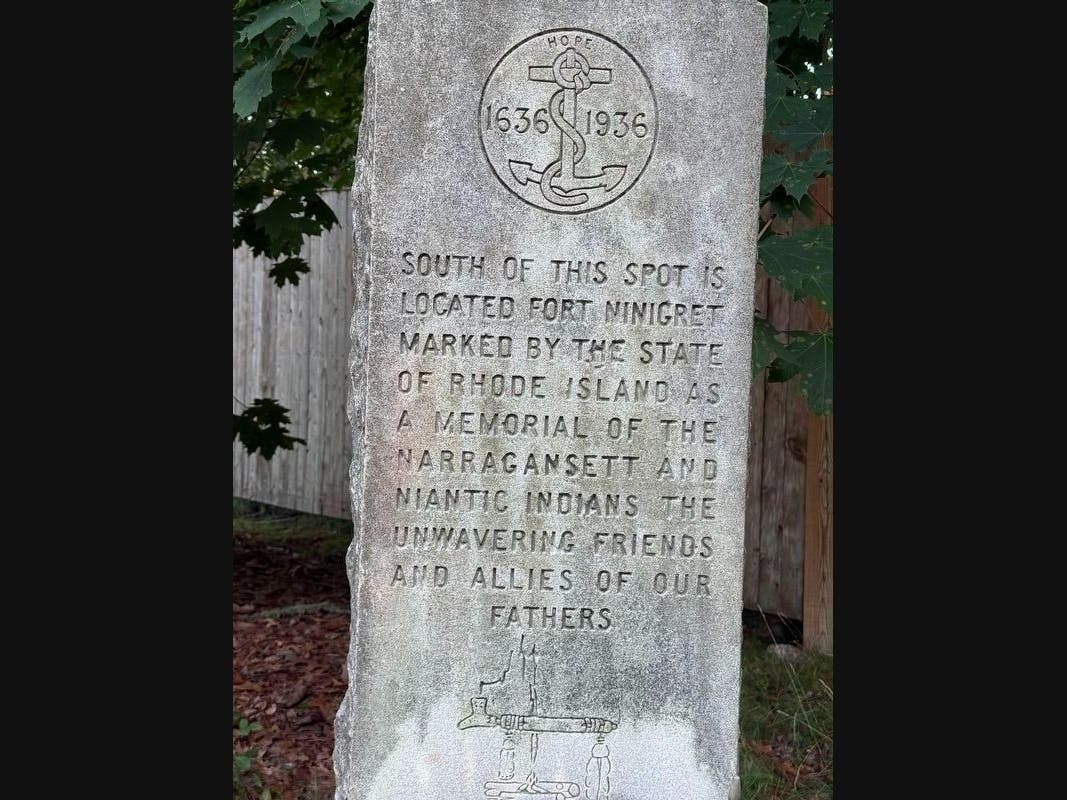
The state placed a memorial at the fort honoring the Narragansett and Niantic Indians.
The inscription described them as:
“Unwavering friends and allies of our fathers”
The state also reshaped portions of the earthworks and marked the outline of the historic fort.
In other words, the site was no longer simply an old fortification sitting on the landscape.
It was being intentionally preserved as a historic monument.
But there is an important distinction here.
The way Fort Ninigret was commemorated in 1883 reflects the attitudes and language of the late 19th century. The history of the site itself reaches much further back, to a time when Indigenous people were building communities, protecting themselves and participating in regional trade long before modern Charlestown existed.
That is an important part of understanding the site today.
Archaeology begins to tell more of the story
For generations, much of what people knew about Fort Ninigret came from historical accounts and the visible earthworks.
Archaeology began filling in some of the gaps.
Investigations conducted in the 1970s uncovered artifacts that provided additional evidence about the people who occupied the site and their interactions with Europeans.
The discoveries included Indigenous pottery as well as European trade materials such as iron tools, glass beads, brass fragments, nails, buttons and pieces of clay smoking pipes.
The artifacts helped reinforce something that historians had increasingly recognized:
Fort Ninigret was part of a complicated world.
It was Indigenous.
It was connected to European trade.
And it existed during a period when those two worlds were increasingly coming into contact with one another.
1970: Fort Ninigret enters the National Register
Another major milestone came in 1970, when Fort Ninigret was added to the National Register of Historic Places.
The National Register identifies the site as significant for Native American history, commerce and military history, with its period of significance extending into the 17th and early 18th centuries.
That designation helped ensure that Fort Ninigret would be recognized not simply as an old piece of land in Charlestown, but as a nationally significant historic site.
Today, the Rhode Island Historical Preservation and Heritage Commission continues to list Fort Ninigret, also known as the Niantic Fort, among Charlestown's National Register properties.
What we see today
If you visit Fort Ninigret today, you may not immediately understand just how much history is beneath your feet.
There is no towering stone fortress.
There are no wooden walls surviving from the 1600s.
Instead, you see the landscape.
The earthworks.
The shape of the old enclosure.
The memorial.
And beyond it, the waters that helped make this location so important in the first place.
That quiet landscape can make it easy to overlook what happened here.
But the absence of a large surviving structure is part of the story.
Fort Ninigret is an archaeological site.
Its history is preserved in the land itself and in the artifacts and historical records that have survived.
A story that is still being understood
Perhaps the most fascinating thing about Fort Ninigret is that the story did not end when the fort stopped being used.
It continued through the changing fortunes of the Narragansett and Niantic people.
It continued through 19th-century preservation efforts.
It continued through archaeological investigations.
And it continues today every time historians, archaeologists and visitors ask questions about what happened here.
The fort that once represented protection and community eventually became a place of remembrance.
And that brings us to the final chapter.
In Part 4, I'll take a closer look at Fort Ninigret today, what remains at the site and why this small piece of Charlestown's landscape represents a much bigger story about Indigenous history, European contact and the preservation of Rhode Island's past.